
Certifying a Whole Production Floor: How Team & Corporate IPC Training Actually Works
Jul 05, 2026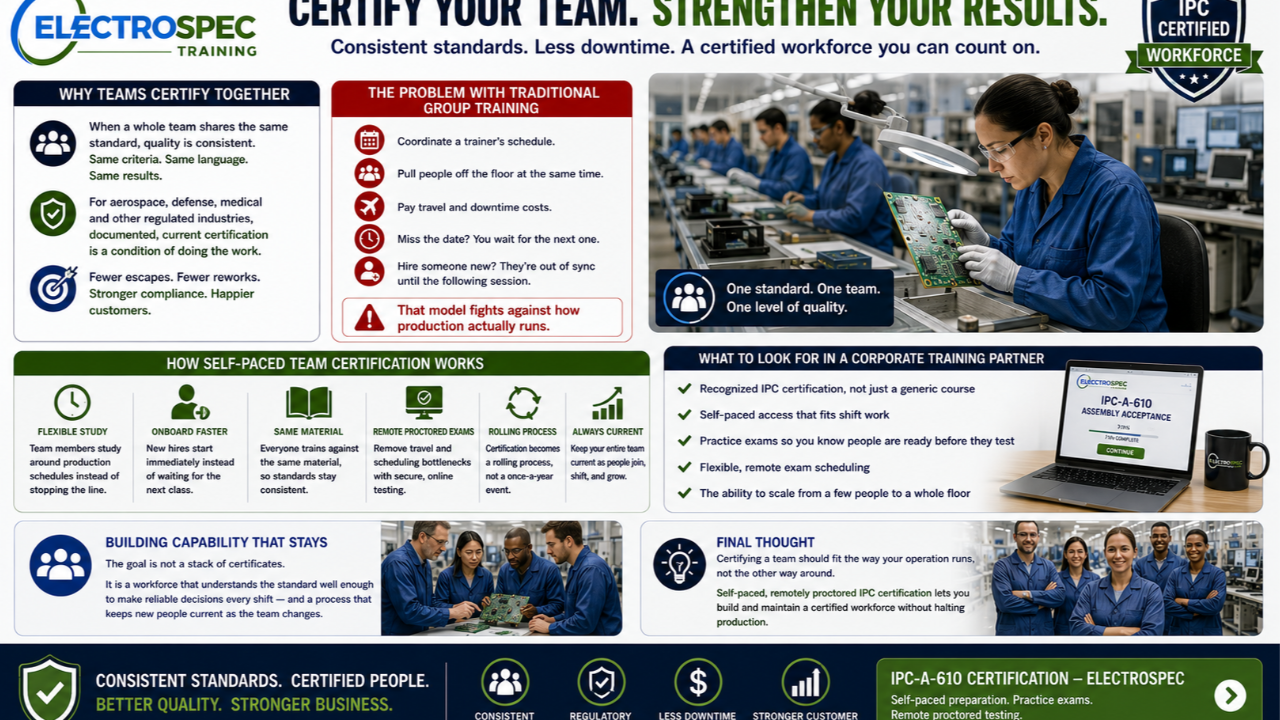
Certifying one inspector is straightforward. Certifying an entire production floor — consistently, on schedule, without shutting down the line — is a different problem.
Here is how team and corporate IPC training actually works, and what to look for.
Why Teams Certify Together
When a whole team shares the same standard, quality stops being a matter of individual interpretation. Operators, inspectors, and engineers apply the same acceptance criteria, speak the same language, and make consistent calls.
For contracts that require it — aerospace, defense, medical — documented, current certification across the team is not a nice-to-have. It is a condition of doing the work.
The Problem With Traditional Group Training
Classic on-site classes mean coordinating a trainer’s schedule, pulling people off the floor in a block, and paying travel and downtime costs. Miss the date and you wait for the next one. Hire someone new and they are out of sync until the following session.
That model fights against how production actually runs.
How Self-Paced Team Certification Works
On-demand certification preparation changes the logistics:
- Team members study around production schedules instead of stopping the line
- New hires start immediately instead of waiting for the next class
- Everyone trains against the same material, so standards stay consistent
- Remote proctored exams remove travel and scheduling bottlenecks
- Certification becomes a rolling process, not a once-a-year event
What to Look For in a Corporate Training Partner
- Recognized certification, not just a generic course
- Self-paced access that fits shift work
- Practice exams so you know people are ready before they test
- Flexible, remote exam scheduling
- The ability to scale from a few people to a whole floor
Building Capability That Stays
The goal is not a stack of certificates. It is a workforce that understands the standard well enough to make reliable decisions every shift — and a process that keeps new people current as the team changes.
Choosing the Right Certification Level for Each Role
Not everyone on the floor needs the same certification. A practical corporate plan matches certification level to responsibility:
- Certified IPC Specialist (CIS) — operators, inspectors, and technicians who apply the acceptance criteria every day.
- Certified IPC Trainer (CIT) — qualified people who will train and certify CIS personnel inside the company.
- Certified Standards Expert (CSE) — engineers and quality leaders who serve as the in-house authority on the standard.
This structure keeps costs aligned with need and gives the organization a clear path to maintain certification internally over time.
Selecting the Right Standard
The standard depends on what the team builds and inspects. Assembly lines usually need IPC-A-610. Cable and harness operations need IPC/WHMA-A-620. Incoming inspection and supplier quality teams benefit from IPC-A-600. Many facilities need a mix.
Planning a Team Rollout
- Identify roles and requirements. List who needs certification and at what level, based on contracts and internal procedures.
- Set a realistic timeline. Stagger enrollment so production coverage is never at risk.
- Track progress. Monitor practice exam readiness so people test when they are prepared.
- Plan for renewal. Build recertification dates into your training matrix from the beginning.
Keeping Records Audit-Ready
Customers and auditors expect to see current certifications for the people doing the work. A good program keeps certificate copies, expiration dates, and role assignments in one training record, so there are no surprises when an auditor asks who inspected a lot.
Private and Custom Programs
Some companies prefer a dedicated program for their team. ElectroSpec offers private team programs that can be delivered live online or on-site, with the official IPC exam and a free retake for every participant, practice questions, and a single invoice for purchasing and reimbursement. Self-paced enrollment remains available for individuals and small groups who need to start immediately.
Final Thought
Certifying a team should fit the way your operation runs, not the other way around. Self-paced, remotely proctored IPC certification lets you build and maintain a certified workforce without halting production.
If you are looking to certify a group, ElectroSpec can help you structure it.
IPC-A-610 Certification — ElectroSpec