
How ElectroSpec Developed CID & CID+ Training: Why Our Standards-Based Approach Matters
Jul 11, 2026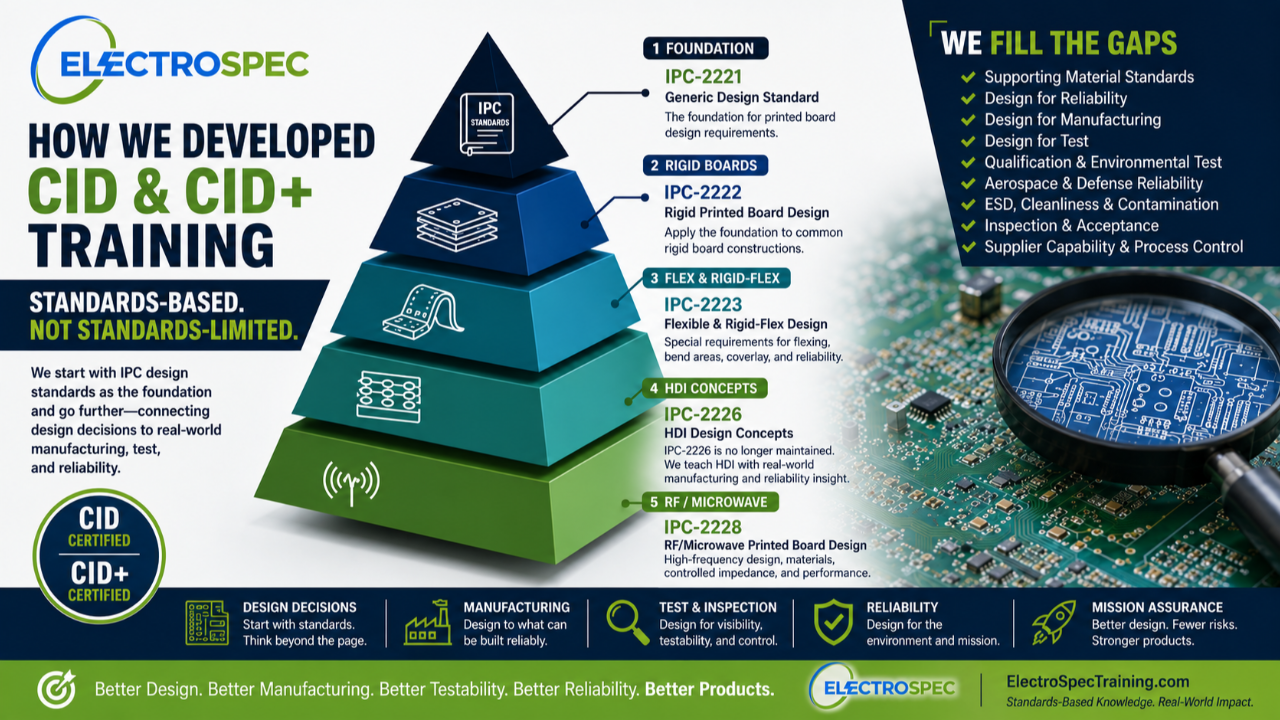
Core Position
ElectroSpec’s CID and CID+ training starts with the IPC design standard family, but it does not stop there.
IPC standards provide the foundation for printed board design, but advanced design judgment requires more than reading one standard or following a checklist.
That is especially true for aerospace, defense, medical, RF, high-reliability, and mission-critical electronics.
1. Start With IPC-2221: Generic Design Foundation
IPC-2221 provides the generic design requirements for printed boards.
This is the foundation layer. It gives designers the baseline framework for:
- Design documentation
- Electrical spacing
- Conductor sizing
- Material considerations
- Thermal concerns
- Mechanical constraints
- Fabrication assumptions
- Reliability considerations
This is where the designer learns the basic language of printed board design requirements.
2. Build Into IPC-2222: Rigid Printed Board Design
After IPC-2221, ElectroSpec moves into IPC-2222 for rigid printed board design.
This is where students connect generic requirements to actual rigid board construction, including:
- Stackup
- Layers
- Plated through holes
- Annular ring
- Conductor routing
- Manufacturing capability
- Assembly impact
- Inspection and reliability concerns
3. Expand Into IPC-2223: Flexible and Rigid-Flex Design
IPC-2223 adds the flex and rigid-flex design layer.
This is critical because flex and rigid-flex designs cannot be treated like rigid boards with bendable material.
Students need to understand:
- Bend areas
- Dynamic vs. static flexing
- Coverlay
- Adhesives
- Stiffeners
- Conductor routing through bend regions
- Strain relief
- Mechanical stress
- Long-term movement and fatigue risk
4. Treat IPC-2226 Carefully Because It Is No Longer Maintained
IPC-2226 historically supported HDI design guidance, but IPC is no longer maintaining it.
That matters.
ElectroSpec should not build the course as if IPC-2226 is the current active backbone for HDI design.
Instead, HDI concepts should be taught carefully, using 2226 where historically useful, while also explaining practical manufacturing realities, supplier capability, microvia reliability concerns, stackup risk, testing limitations, and current industry lessons learned.
This is a good place to show why ElectroSpec’s approach matters.
The course does not blindly follow outdated or unsupported material. It teaches designers how to use standards intelligently while understanding where additional engineering judgment is required.
5. Use IPC-2228 for RF, Microwave, and High-Frequency Design
IPC-2228 belongs in the advanced design discussion because it addresses RF, microwave, and high-frequency printed board design.
This is where students need to understand that high-frequency design is not just routing traces.
It involves:
- Laminate selection
- Dielectric properties
- Loss tangent
- Controlled impedance
- Stackup discipline
- Transmission line behavior
- Copper roughness
- Signal performance
- Manufacturing tolerance
- Fabrication process impact on electrical behavior
This is especially important for aerospace, defense, communication, radar, RF, microwave, and advanced electronic systems.
6. Fill the Gaps With Supporting Material Standards
IPC design standards do not fully teach material behavior.
ElectroSpec’s approach goes deeper into supporting material standards because material selection directly affects reliability.
Students need to understand how materials influence:
- Thermal performance
- Coefficient of thermal expansion
- Glass transition temperature
- Decomposition temperature
- Moisture absorption
- CAF risk
- Delamination
- Laminate reliability
- Flexibility
- High-frequency electrical performance
- Long-term environmental durability
This is where design becomes more than layout. It becomes product reliability engineering.
7. Bring in Aerospace, Defense, Reliability, Test, and Manufacturing Knowledge
This is the major differentiator.
IPC design standards are important, but they do not fully cover everything needed for high-reliability aerospace and defense products.
ElectroSpec fills that gap by bringing in lessons from:
- Design for reliability
- Design for manufacturing
- Design for test
- Qualification testing
- Thermal cycling
- Vibration
- Mechanical shock
- Humidity exposure
- Cleanliness and contamination control
- ESD control
- Materials and process control
- Supplier capability
- Inspection and acceptance requirements
- Mission assurance expectations
This matters because a PCB can be designed to an IPC standard and still fail if it is not designed for the actual environment, manufacturing process, test strategy, and mission profile.
8. Why ElectroSpec’s Approach Matters
Many design courses teach isolated topics.
ElectroSpec teaches how design requirements connect to real product outcomes.
The goal is not just to help students pass CID or CID+.
The goal is to help students understand how design decisions affect:
- Fabrication
- Assembly
- Soldering
- Inspection
- Rework
- Testing
- Reliability
- Supplier communication
- Customer acceptance
- Field performance
This is why the course starts with IPC-2221, builds into the sectional design standards, treats unsupported or legacy standards carefully, and fills the missing pieces with material science, manufacturing reality, aerospace reliability, and test knowledge.
Key Takeaway
ElectroSpec’s CID and CID+ training is standards-based, but not standards-limited.
We start with IPC-2221 as the foundation.
We build into IPC-2222 for rigid boards, IPC-2223 for flex and rigid-flex designs, and IPC-2228 for RF, microwave, and high-frequency applications.
We treat IPC-2226 carefully because it is no longer maintained, while still addressing HDI concepts through practical manufacturing and reliability understanding.
Then we go beyond IPC design standards by adding supporting material standards, aerospace and defense reliability lessons, design for test, design for manufacturing, and high-reliability product considerations.
That approach matters because designers do not just create PCB artwork.
They create the foundation for manufacturable, inspectable, testable, and reliable electronic products.