
CID vs Design Courses: Why Certification, Standards Alignment, and Updated Training Matter
Jun 19, 2026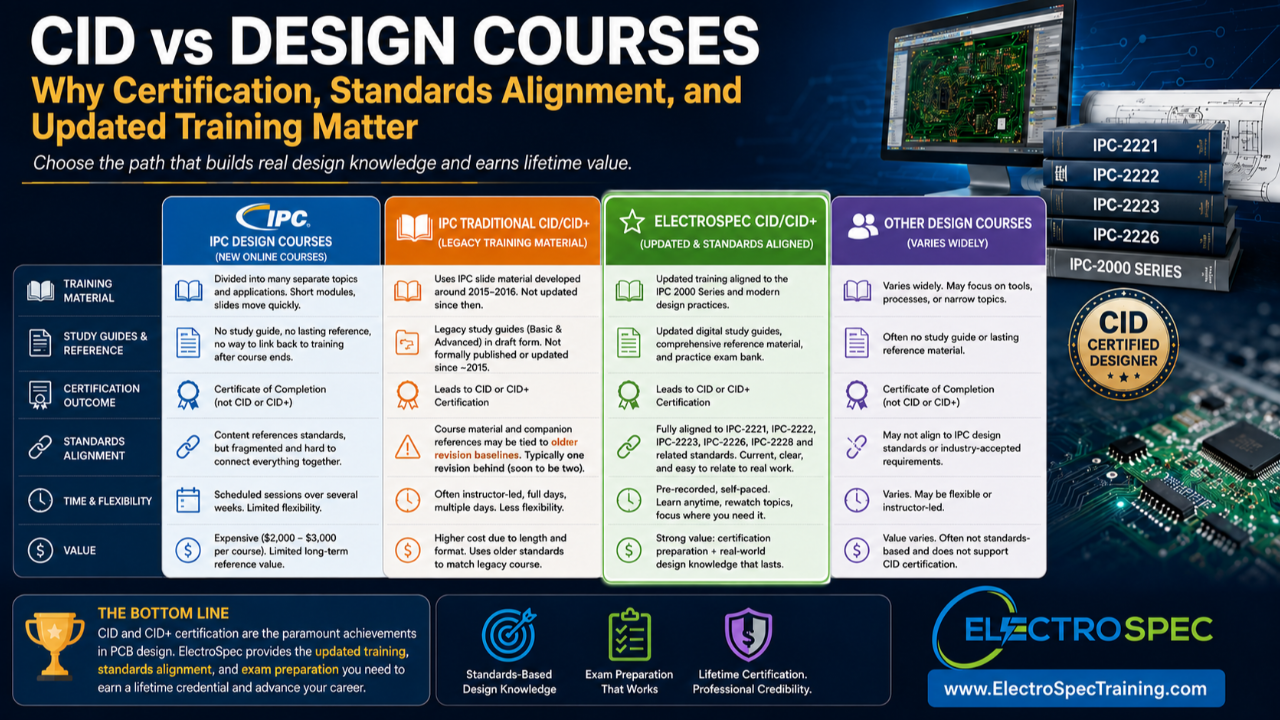
PCB design training is changing quickly.
There are more online design courses available than ever before. Some focus on layout software. Some focus on individual IPC standards. Some focus on manufacturability, HDI, flex, rigid-flex, or documentation. Some provide useful technical exposure.
But there is an important difference between taking a design course and earning CID or CID+ certification.
A course completion certificate says a student attended training or completed a lesson.
CID and CID+ certification show something stronger.
They show that a designer completed a recognized certification path and passed a certification exam tied to a broader printed board design body of knowledge.
That matters because PCB design is not just about knowing tips, tools, or isolated best practices. It is about communicating requirements through standards, drawings, documentation, fabrication notes, stackups, materials, tolerances, and design decisions that affect real product performance.
For designers, engineers, fabricators, assemblers, suppliers, and customers, common design language is essential.
That is why ElectroSpec built a different approach.
Our CID and CID+ training is designed to prepare students for certification while also strengthening practical knowledge of IPC design standards.
CID and CID+ Are the Recognized Design Certification Path
CID and CID+ are valuable because they provide a common achievement across the PCB design community.
A designer who earns CID or CID+ has done more than watch a course. They have completed a recognized design certification path and passed an exam demonstrating broad printed board design knowledge.
CID provides the foundation.
CID+ builds toward advanced design understanding.
Together, they create a progression from basic printed board design knowledge into more advanced topics involving documentation, manufacturability, materials, fabrication, assembly, reliability, and complex design requirements.
Just as important, CID and CID+ are long-term credentials. They help demonstrate professional commitment and design knowledge to colleagues, employers, customers, and suppliers.
That makes CID and CID+ different from ordinary course completion certificates.
A completion certificate may show participation.
CID and CID+ show certification achievement.
The Problem with Scattered Online Design Courses
Many online design courses divide topics into separate short courses or individual applications.
One course may cover a specific IPC standard.
Another may cover flex.
Another may cover HDI.
Another may cover documentation, fabrication, or manufacturability.
That type of training can be helpful, but it can also feel scattered.
Students may see a slide briefly, move to another slide, take a quiz, and then lose access to the material. There may be no detailed study guide, no lasting reference material, no practice exam bank, no clear connection back to current standards, and no path to CID or CID+ certification.
That creates a practical problem.
A student may complete the course, but may not know how to apply the information later to design reviews, fabrication questions, customer requirements, drawings, procurement notes, or manufacturing issues.
A design course should not disappear when it ends.
Good design training should leave the student with standards alignment, reference material, practice, and a clear path toward certification.
Without that, a course may produce a certificate of completion, but not lasting design capability or recognized certification.
A Completion Certificate Is Not the Same as CID Certification
This distinction is important.
Any training center or online learning platform can issue a certificate of completion. That certificate may confirm that a student watched videos, attended sessions, or completed a course.
But it does not carry the same meaning as CID or CID+ certification.
CID certification shows that the student completed a recognized certification path and passed the CID exam.
CID+ certification shows progression into advanced design knowledge and more complex design expectations.
For employers, customers, suppliers, and colleagues, that matters because certification creates a common reference point.
The question is not simply:
“Did you take a course?”
The better question is:
“Did the course prepare you for recognized design certification and help you understand the standards behind the requirements?”
That is where many design courses fall short.
The Legacy CID Training Challenge
Traditional CID and CID+ training has one major advantage: it leads to recognized certification.
That is valuable.
However, much of the legacy CID and CID+ training material used in traditional programs has not kept pace with current design standards, technology, and industry expectations.
Many traditional programs still rely on older slide material and legacy study guide content. Traditional CID/CID+ training still provides value because it leads to certification, but students should understand that some legacy course materials and companion references may be tied to older revision baselines.
For working designers, that creates a practical need for updated study material that helps bridge certification preparation to current IPC-2220 series design standards and today’s fabrication, assembly, and reliability expectations.
This is not about pointing fingers.
It is about recognizing a real training gap.
A certification program must prepare students for the exam, but it should also prepare them for current design work.
A student should not have to choose between certification preparation and modern design standards awareness.
They need both.
Standards Should Be the Backbone of Design Training
PCB design training should be backed by standards.
Otherwise, design guidance can become opinion, habit, preference, or isolated “best practice” without clear source authority.
That becomes a communication problem.
When a designer speaks with a fabricator, assembler, customer, quality engineer, or supplier, requirements need to come from somewhere.
Is the requirement from an IPC standard?
Is it from a customer specification?
Is it a fabrication capability limitation?
Is it a proven design practice?
Is it a company preference?
Is it only an instructor opinion?
Standards alignment helps answer those questions.
It gives designers a stronger technical foundation and a common language with the rest of the manufacturing chain.
ElectroSpec’s approach is built around the IPC design standards family and related design guidance, including:
- IPC-2221
- IPC-2222
- IPC-2223
- IPC-2226
- IPC-2228
- Legacy design guidance where still useful
- Companion standards and related requirements
- Lessons learned from aerospace, defense, medical, and high-reliability electronics
The goal is not to memorize rule numbers.
The goal is to understand how design standards work together and how to apply them to real products.
ElectroSpec’s Updated CID and CID+ Training Approach
ElectroSpec developed an updated CID and CID+ training approach to close the gap between legacy CID training, scattered online design courses, and real standards-based design knowledge.
Our programs are built around updated training material, pre-recorded instruction, digital study guides, practice exam support, and alignment to IPC design standards.
The training has two major purposes.
First, prepare students for CID and CID+ certification exams.
Second, strengthen the student’s ability to understand and use design standards in real engineering and manufacturing environments.
Those two goals work together.
A student should not only be ready to pass the exam.
A student should also be more comfortable opening a design standard, understanding the requirement, connecting it back to training, and applying it to a design decision.
That is real value.
Pre-Recorded Training Helps Students Learn Better
CID and CID+ cover a large amount of material.
A fast classroom format can be difficult because students may hear a concept once, move to the next topic, and never have time to fully absorb the relationship between standards, design decisions, manufacturability, assembly, reliability, and testing.
Pre-recorded training solves that problem.
Students can pause.
Rewatch.
Review difficult topics.
Move faster through familiar material.
Spend more time where they need help.
This matters because design training is not just procedural.
It is conceptual.
Students need time to understand cause and effect.
A designer must understand how one decision affects fabrication, assembly, inspection, testing, reliability, cost, and field performance.
That takes more than a quick slide review.
It takes structured learning and reference material.
Updated Digital Study Guides Create Lasting Value
A major weakness in many online courses is that the training disappears.
Students watch content, complete a quiz, receive a completion certificate, and then have little to reference later.
ElectroSpec’s updated digital study guides are designed to give students something more useful.
A strong study guide should help connect:
- Training topics
- Exam preparation
- Design standards
- Design terminology
- Documentation requirements
- Fabrication and assembly concerns
- Class 1, 2, and 3 expectations
- Reliability and manufacturability considerations
This is important because designers need reference material after the course.
A designer may not remember every slide, but they should understand how to return to the guide, connect concepts to standards, and continue learning.
Training should not vanish when the course ends.
It should become a professional reference.
Why Standards Alignment Matters to Designers, Fabricators, and Customers
PCB design is communication.
The designer communicates intent through layout, drawings, notes, stackups, material requirements, tolerances, fabrication requirements, and assembly requirements.
Fabricators need to understand what must be built.
Assemblers need to understand how the design supports assembly.
Inspectors and quality teams need to understand what criteria applies.
Customers need to understand whether requirements were properly flowed down.
When training is not aligned to standards, communication breaks down.
Where did the requirement come from?
Is it a proven best practice?
Is it an IPC requirement?
Is it a customer requirement?
Is it a fabrication capability issue?
Is it only the preference of one instructor or one company?
Standards alignment helps answer those questions.
It gives designers a stronger technical foundation and a common language with the rest of the manufacturing chain.
Why Other Design Courses May Fall Short
Other design courses can be helpful, but many do not lead to CID or CID+ certification.
Some focus on software.
Some focus on one narrow topic.
Some teach company-specific preferences.
Some may contain good design advice but do not connect that advice clearly to standards.
Some issue completion certificates without preparing students for a recognized design certification exam.
That does not make them worthless.
But it does limit what they prove.
If a course does not align to design standards and does not lead to CID or CID+ certification, it may be difficult for the student to communicate the value of that training to employers, customers, fabricators, or colleagues.
The risk is design training becomes fragmented.
ElectroSpec is working to solve that problem by connecting updated training, digital study guides, standards alignment, and CID/CID+ certification preparation into one practical path.
CID and CID+ Should Build More Than Exam Readiness
Passing the exam matters.
But the best training should do more than prepare students to pass.
It should help students think like designers.
That means understanding:
- Why requirements exist
- How design classes affect expectations
- How fabrication capability affects design choices
- How assembly processes affect layout decisions
- How materials affect reliability
- How documentation controls product intent
- How testing and qualification affect design margin
- How aerospace, defense, medical, and Class 3 work require more conservative design thinking
CID and CID+ training should help students connect standards to real product performance.
That is the difference between memorizing content and building design judgment.
The ElectroSpec Difference
ElectroSpec’s CID and CID+ training is built for designers, engineers, manufacturing professionals, quality personnel, supplier managers, and technical leaders who want more than a completion certificate.
Our approach focuses on:
- CID and CID+ certification preparation
- Updated pre-recorded training
- Updated digital study guides
- Standards-based design knowledge
- Alignment to IPC design standards
- Practice exam preparation
- Real-world aerospace, defense, medical, and high-reliability lessons learned
- Practical understanding of design requirements, fabrication, assembly, inspection, and reliability
The purpose is simple.
Help students earn certification and become stronger design professionals.
Bottom Line
There is a major difference between taking a design course and earning CID or CID+ certification.
Online design courses may provide useful information, but many are scattered, temporary, difficult to reference later, and do not lead to recognized design certification.
Traditional CID training leads to certification, but much of the legacy material has not kept pace with current standards, modern design practices, and updated design expectations.
Other design courses may provide training, but often do not align clearly to standards or lead to a recognized CID credential.
ElectroSpec fills the gap.
Our CID and CID+ training is built around updated material, pre-recorded instruction, digital study guides, standards alignment, practice exam preparation, and a clear path to CID certification.
CID and CID+ remain the paramount design certification achievements because they show that a designer completed the recognized path and passed the certification exam.
ElectroSpec helps students get there with updated training that connects certification preparation to real design standards and real design decisions.
If you want design training that does not disappear after the course, training that helps you understand the standards, and training that prepares you for CID or CID+ certification, ElectroSpec is ready to help.
Enroll today at ElectroSpecTraining.com and build design knowledge that supports certification, communication, manufacturability, reliability, and product success.