
How Design, Soldering, Inspection & ESD Work Together to Build Reliable Electronic Assemblies
Jun 20, 2026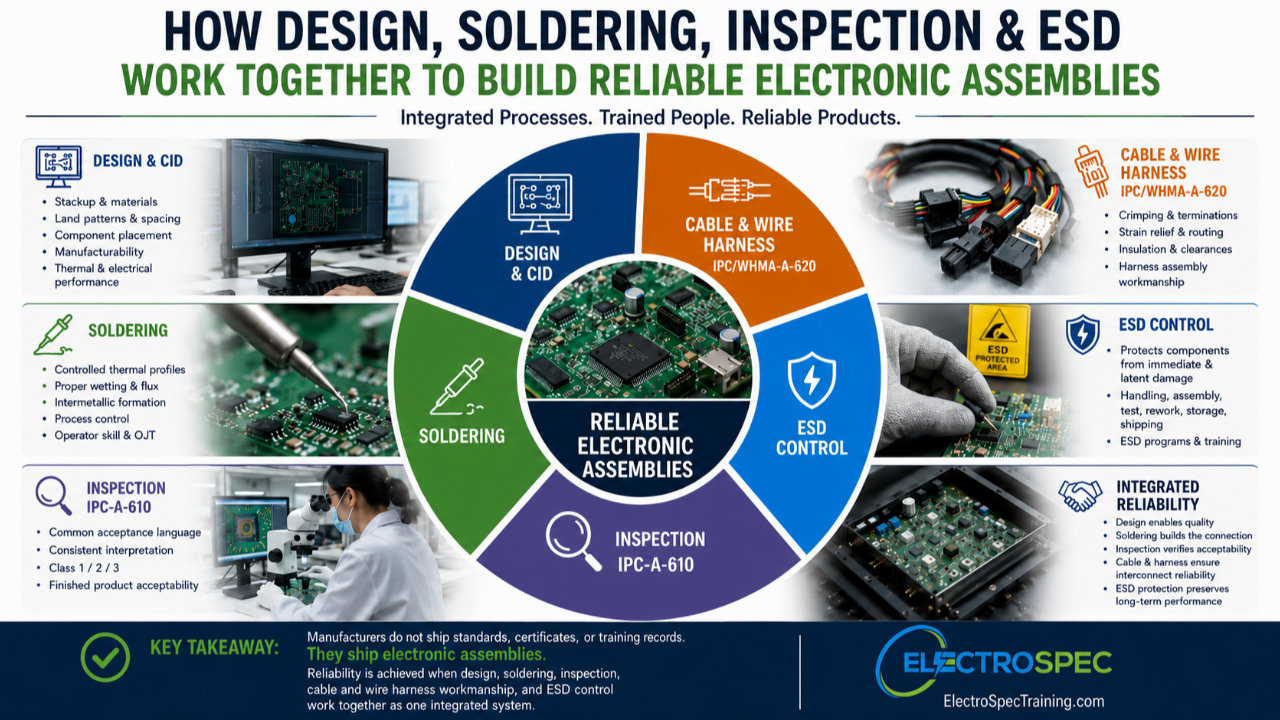
Reliable electronic assemblies are not created by one standard, one certification, or one inspection step.
They are built through an integrated manufacturing system where design decisions, materials, process control, workmanship standards, inspection, and electrostatic discharge protection all work together.
Manufacturers do not ship standards, certificates, or training records.
They ship electronic assemblies.
That is why reliability depends on more than checking a box. It depends on aligning design, soldering, inspection, cable and wire harness workmanship, and ESD control into one practical manufacturing system.
Design Sets the Foundation for Reliability
Design decisions establish the starting point for everything that follows.
Printed board stackups, land patterns, component spacing, conductor width, clearance, creepage, material selection, and component placement all influence how well a product can be manufactured, inspected, tested, repaired, and used in the field.
A design can make manufacturing easier, more consistent, and more reliable.
A poor design can create soldering problems, inspection limitations, thermal stress, assembly defects, field failures, and unnecessary rework.
That is why CID and CID+ training are so valuable. Design certification helps engineers and designers understand not only what a design rule says, but why that rule matters.
Good PCB design supports:
- Proper solder joint geometry
- Inspection access
- Thermal performance
- Electrical performance
- Manufacturability
- Assembly consistency
- Long-term reliability
Design choices set the upper limit on manufacturing quality. A production team cannot inspect or solder its way out of every design weakness.
Soldering Turns Design Intent Into Physical Reality
Once the design is released, soldering processes convert design intent into a real electronic assembly.
This is where material behavior, process control, operator skill, equipment capability, and workmanship come together.
Controlled thermal profiles, proper wetting, flux chemistry, cleanliness, solder volume, and intermetallic formation all determine whether solder joints will survive mechanical stress, vibration, thermal cycling, handling, and field use.
A solder joint is not just a visual feature.
It is a mechanical, electrical, and metallurgical connection.
That connection must be formed correctly and controlled consistently. Good soldering depends on approved materials, controlled processes, trained personnel, and work instructions that reflect the actual product being built.
This is where J-STD-001, process engineering, and company-specific OJT become important. Requirements must be translated into real production controls, not left for operators to interpret on their own.
IPC-A-610 Defines Finished Assembly Acceptability
IPC-A-610 provides the common acceptance language for printed circuit board assemblies.
It helps inspectors, operators, engineers, suppliers, and customers determine whether a completed electronic assembly meets acceptability requirements.
This matters because manufacturing teams need one consistent way to evaluate finished product quality.
IPC-A-610 supports consistent interpretation of:
- Solder joint acceptability
- Component mounting
- Lead and termination conditions
- Cleanliness and residues
- Coating and marking conditions
- Hardware and mechanical assembly features
- Class 1, Class 2, and Class 3 workmanship expectations
IPC-A-610 is especially important because it focuses on the finished product.
The process may be controlled by engineering, work instructions, and manufacturing procedures, but the final assembly still must meet product acceptance requirements before it is released.
IPC/WHMA-A-620 Extends Acceptance to Cable and Wire Harness Assemblies
Electronic product reliability does not stop at the printed circuit board.
Cable and wire harness assemblies are often just as critical as the PCB assembly itself.
A perfectly acceptable circuit board can still fail if the cable assembly has poor crimping, inadequate strain relief, damaged insulation, poor routing, weak soldered terminations, or uncontrolled workmanship.
IPC/WHMA-A-620 provides the acceptance framework for cable and wire harness assemblies.
It supports consistent evaluation of:
- Crimped terminations
- Soldered wire terminations
- Insulation clearance
- Connector assembly
- Splices
- Harness routing
- Strain relief
- Lacing, tying, and securing
- Cable and wire damage
A cable or harness failure can compromise an otherwise compliant electronic assembly. That is why IPC/WHMA-A-620 belongs in the same reliability conversation as IPC-A-610.
ESD Control Protects the Product You Cannot Fully Inspect
Electrostatic discharge is different from many workmanship issues because damage may not be visible.
An assembly can look acceptable, pass inspection, and even pass initial testing, while still containing latent ESD damage that reduces long-term reliability.
ESD control protects sensitive components during:
- Receiving
- Handling
- Assembly
- Inspection
- Test
- Rework
- Storage
- Packaging
- Shipping
Latent ESD damage is especially dangerous because it may escape normal inspection and test, only to appear later as premature field failure.
This is why ESD training and ESD control programs are essential for high-reliability electronics manufacturing.
ESD protection is not just an operator awareness topic. Strong ESD programs require coordinators, managers, engineers, quality personnel, test personnel, and failure analysis teams who understand cause and effect across the full production environment.
Reliability Requires Integration
Design, soldering, inspection, cable and wire harness workmanship, and ESD control are often taught as separate topics.
In real manufacturing, they are connected.
Design affects soldering.
Soldering affects inspection results.
Inspection verifies product acceptability.
Cable and wire harness workmanship affects system-level reliability.
ESD control protects sensitive components throughout the entire process.
When these areas are treated as disconnected training events, companies may miss the larger reliability picture.
When they are aligned, the organization builds a stronger manufacturing system.
The Real Goal Is Reliable Product
The goal is not simply to collect certifications.
The goal is to build electronic assemblies that meet requirements, survive their intended environment, and perform reliably in the field.
That requires the right training for the right role.
Designers need to understand design standards, materials, spacing, stackups, manufacturability, and reliability.
Operators need practical OJT, work instructions, and workmanship awareness tied to the products they build.
Inspectors need strong acceptance criteria knowledge through IPC-A-610 and IPC/WHMA-A-620.
Process engineers need to translate standards into controlled manufacturing processes.
ESD coordinators and quality personnel need enough technical depth to prevent immediate and latent damage.
Each role supports the same outcome: reliable electronic assemblies.
Key Takeaway
Manufacturers do not ship standards, certificates, or training records.
They ship electronic assemblies.
Reliability is achieved when design, soldering, inspection, cable and wire harness workmanship, and ESD control work together as one integrated system.
That is the foundation of high-reliability electronics manufacturing.
ElectroSpec Training helps electronics manufacturers align IPC-A-610, IPC/WHMA-A-620, CID/CID+, soldering and rework training, and iNARTE ESD certification into practical training paths that support real manufacturing reliability.