
EMC vs. EMI: What's the Difference, and Why It Matters in Electronics
Jun 30, 2026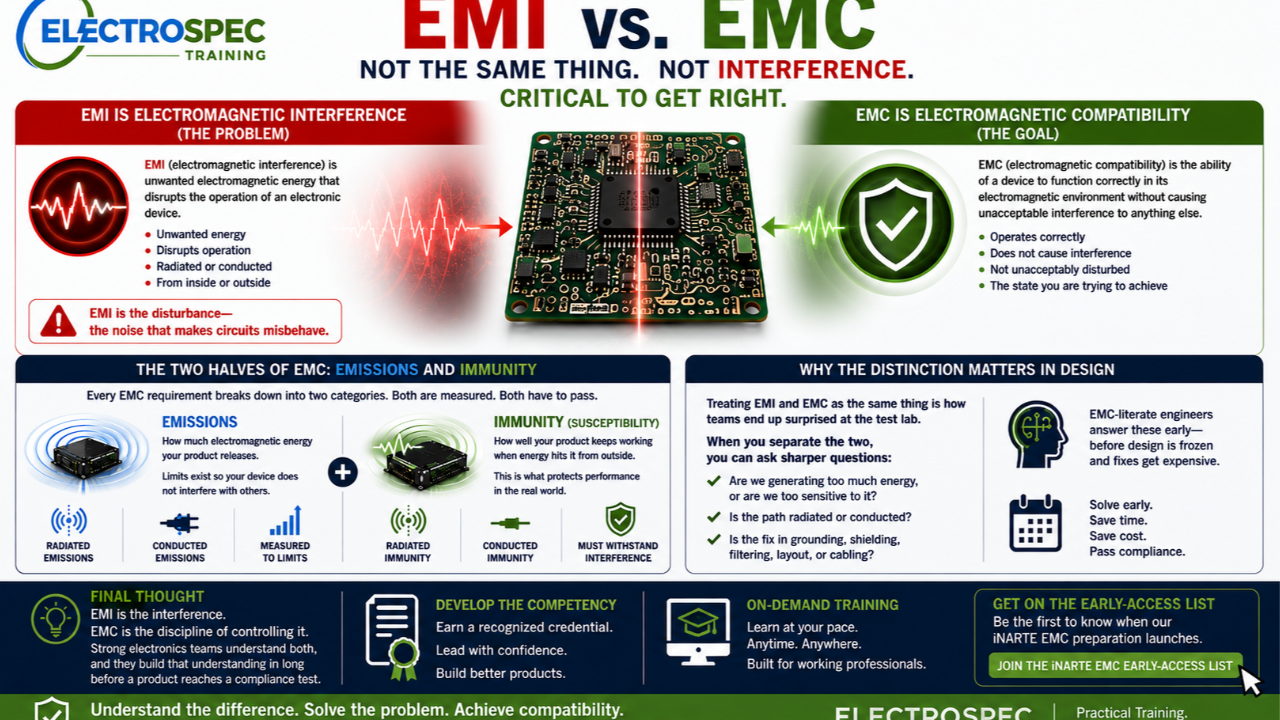
People use EMC and EMI as if they mean the same thing. They do not.
Understanding the difference is the first step toward designing electronics that pass compliance testing instead of failing it.
EMI Is the Problem
Electromagnetic interference (EMI) is unwanted electromagnetic energy that disrupts the operation of an electronic device.
It can be radiated through the air or conducted along cables and power lines. It can come from inside the product or from the environment around it. Either way, EMI is the disturbance — the noise that makes circuits misbehave.
EMC Is the Goal
Electromagnetic compatibility (EMC) is the ability of a device to function correctly in its electromagnetic environment without causing unacceptable interference to anything else.
In other words, EMC is the state you are trying to achieve. EMI is the thing standing in your way.
A product is electromagnetically compatible when it does two things at once: it does not emit excessive interference, and it is not unacceptably disturbed by interference from elsewhere.
The Two Halves of EMC: Emissions and Immunity
Every EMC requirement breaks down into two categories.
- Emissions — how much electromagnetic energy your product releases. Limits exist so your device does not interfere with others.
- Immunity (susceptibility) — how well your product keeps working when energy hits it from outside. This is what protects performance in the real world.
Both are measured. Both have to pass. A product can be quiet and still fail immunity, or robust and still fail emissions.
Why the Distinction Matters in Design
Treating EMI and EMC as one fuzzy concept is how teams end up surprised at the test lab.
When you separate the two, you can ask sharper questions: Are we generating too much energy, or are we too sensitive to it? Is the path radiated or conducted? Is the fix in grounding, shielding, filtering, layout, or cabling?
Those are the questions EMC-literate engineers answer early — before design is frozen and fixes get expensive.
Common Sources of EMI
Interference usually comes from ordinary features of an electronic design rather than exotic failures:
- Fast switching edges — digital clocks and switching power supplies generate harmonics far above their fundamental frequency.
- Large current loops — poorly planned return paths turn traces and cables into efficient antennas.
- Cables — often the longest conductors in a system and a major path for both radiated and conducted energy.
- Ground discontinuities — split planes, slots, and poor bonding that force return currents to take unintended paths.
- External sources — radio transmitters, motors, lightning, and electrostatic discharge that the product must tolerate.
Radiated Versus Conducted
EMC testing separates interference by how it travels. Radiated emissions and immunity involve energy moving through the air as electromagnetic fields. Conducted emissions and immunity involve energy traveling along power lines, signal cables, and other connections.
The distinction matters because the fixes are different. Radiated problems often point toward layout, shielding, and cable design. Conducted problems often point toward filtering, grounding, and power-supply design.
EMC Starts at the Circuit Board
Most EMC outcomes are decided long before a product reaches the test chamber. Stack-up choices, ground plane continuity, component placement, decoupling, trace routing, and connector placement all shape how a board emits and how it responds to external energy.
Fixing EMC late — with ferrites, shielding cans, or cable changes after a failed test — is possible, but it is almost always more expensive and slower than designing it in from the start.
Why Compliance Testing Matters
Many markets require products to meet EMC regulations before they can be sold. Aerospace, defense, automotive, and medical programs add their own EMC requirements on top of commercial rules. A failed test can delay a launch, trigger redesign, and damage customer confidence.
Teams that understand EMC can predict problems, run meaningful pre-compliance checks, and walk into formal testing with confidence instead of hope.
Where iNARTE EMC Certification Fits
iNARTE EMC certification recognizes engineers and technicians who understand electromagnetic compatibility principles, measurement, and compliance. For employers, it provides independent validation that the people designing and testing products have the knowledge to get EMC right.
Final Thought
EMI is the interference. EMC is the discipline of controlling it. Strong electronics teams understand both, and they build that understanding in long before a product reaches a compliance test.
If you want to develop that competency and earn a recognized credential for it, get on the early-access list for our iNARTE EMC preparation.
Join the iNARTE EMC Early-Access List — ElectroSpec