
ESD Control Program Basics: Building Toward ANSI/ESD S20.20 Compliance
Jul 06, 2026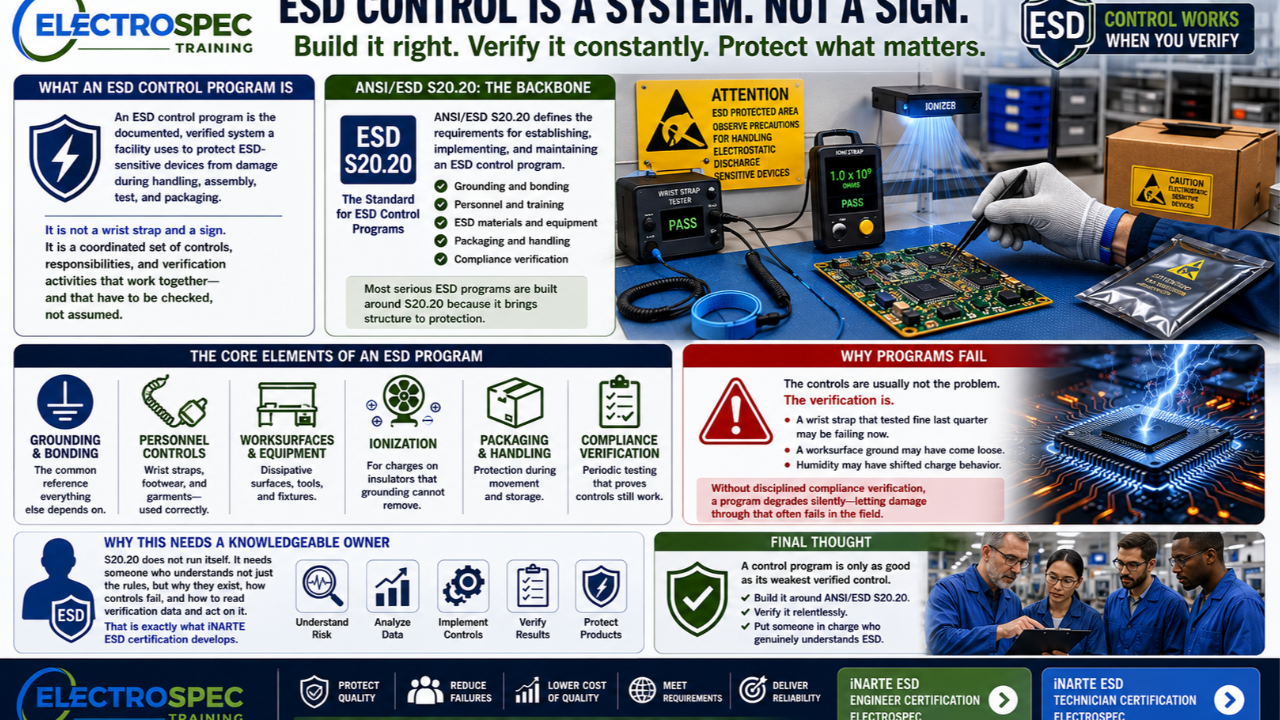
Most ESD failures do not come from one dramatic zap. They come from a control program that looked fine on paper and quietly stopped working.
Here are the fundamentals of an ESD control program and the standard that holds it together.
What an ESD Control Program Is
An ESD control program is the documented, verified system a facility uses to protect electrostatic-discharge-sensitive devices from damage during handling, assembly, test, and packaging.
It is not a wrist strap and a sign on the wall. It is a coordinated set of controls, responsibilities, and verification activities that work together — and that have to be checked, not assumed.
ANSI/ESD S20.20: The Backbone
ANSI/ESD S20.20 is the widely adopted standard for ESD control programs. It defines the requirements for establishing, implementing, and maintaining a program — covering grounding, personnel and equipment controls, packaging, and the compliance verification that proves the program is working.
Most serious ESD programs are built around S20.20 because it gives structure to something that otherwise drifts into guesswork.
The Core Elements
- Grounding and bonding — the common reference everything else depends on
- Personnel controls — wrist straps, footwear, and garments, used correctly
- Worksurfaces and equipment — dissipative surfaces, tools, and fixtures
- Ionization — for charges on insulators that grounding cannot remove
- Packaging and handling — protection during movement and storage
- Compliance verification — periodic testing that proves controls still work
Why Programs Fail
The controls are usually not the problem. The verification is. A wrist strap that tested fine last quarter may be failing now. A worksurface ground may have come loose. Humidity may have shifted charge behavior.
Without disciplined compliance verification, a program degrades silently — and the damage it lets through is often latent, passing inspection and test only to fail in the field months later.
Why This Needs a Knowledgeable Owner
S20.20 does not run itself. It needs someone who understands not just the rules but why they exist, how controls fail, and how to read verification data and act on it. That is exactly the competency iNARTE ESD certification develops.
Defining ESD Protected Areas
An effective program begins by defining where ESD-sensitive items are handled unprotected. These ESD Protected Areas (EPAs) must be clearly identified, and everyone entering them must follow the required controls. An EPA may be a single workstation, a production line, or an entire building, depending on the operation.
Know How Sensitive Your Parts Are
Different devices tolerate different levels of electrostatic discharge. Device sensitivity is characterized using models such as the Human Body Model (HBM) and Charged Device Model (CDM). Knowing the sensitivity of the parts you handle helps determine how strict your controls need to be and whether your program provides adequate protection.
The ESD Control Plan
A written ESD control plan documents the program: its scope, the controls used, the technical requirements for each, training requirements, packaging and marking practices, and how compliance is verified. The plan is what turns good intentions into a consistent, auditable system.
Training Is a Control
People are both the most common source of static charge and the most important part of the solution. Everyone who handles ESD-sensitive items or works in an EPA needs initial and recurrent training so they understand how damage happens and how to use the controls correctly. Records of that training are part of demonstrating compliance.
Compliance Verification in Practice
- Checking personnel grounding such as wrist straps and footwear, often at every entry or shift
- Periodic measurement of worksurfaces, flooring, seating, and equipment grounding
- Verifying ionizers are balanced and neutralizing charge within required times
- Auditing packaging and handling practices on the production floor
- Recording results and acting quickly on failures
Building Toward Compliance Step by Step
Few facilities build a complete program in one step. A practical path is to establish grounding and EPAs first, add personnel and worksurface controls, write the control plan, train everyone, and then begin a verification schedule that proves the controls work. Gaps found during verification become the roadmap for continuous improvement.
Final Thought
A control program is only as good as its weakest verified control. Build it around ANSI/ESD S20.20, verify it relentlessly, and put someone in charge who genuinely understands ESD.
ElectroSpec’s iNARTE ESD certification preparation builds that exact capability.
iNARTE ESD Engineer Certification — ElectroSpec
iNARTE ESD Technician Certification — ElectroSpec