
How to Become iNARTE ESD Certified: Requirements, Process, and What the Certification Actually Gets You
Jun 28, 2026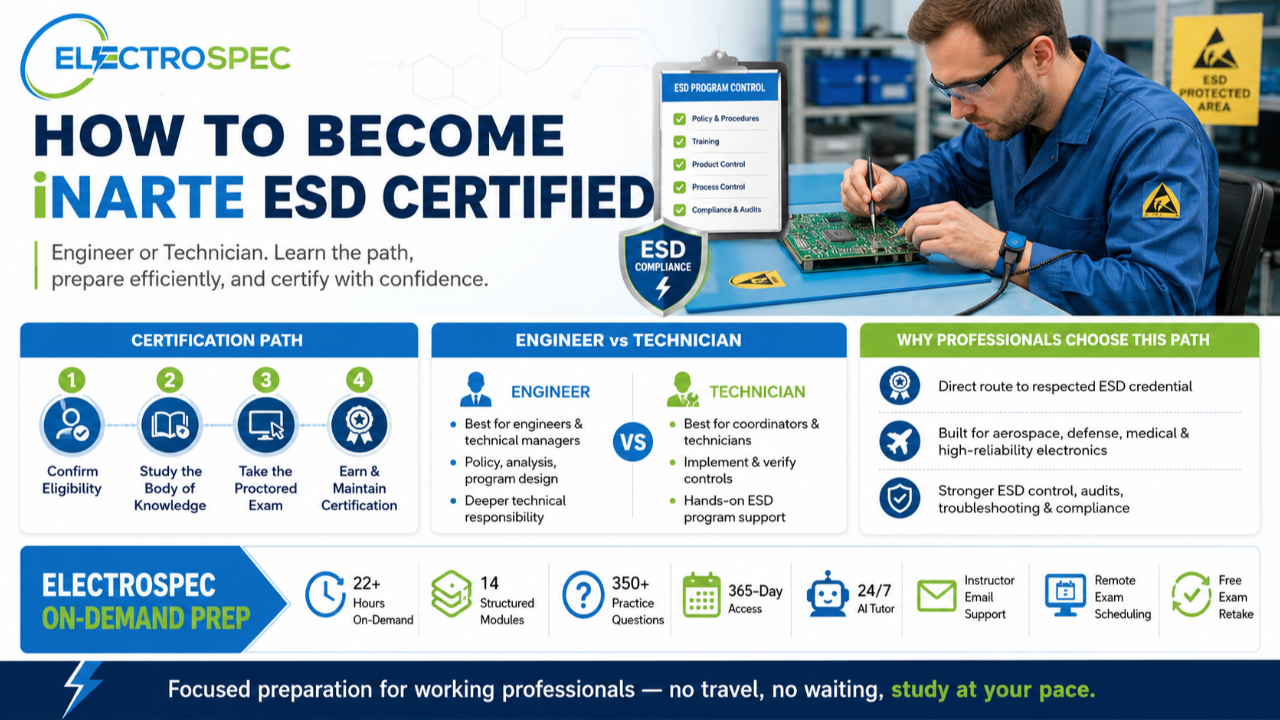
Search “how to become iNARTE ESD certified” and you mostly get vague answers, scattered course pages, and very little that explains the actual path.
This is the straight version.
If you are responsible for ESD control — or you want to be — here is what the certification is, who it is for, what you need, how the exam works, how long it takes, and how to prepare without stepping away from your job.
What iNARTE ESD Certification Actually Is
iNARTE ESD certification is a recognized professional credential for people who understand and manage electrostatic discharge control at a technical level.
It is not operator awareness training. It is not a wrist-strap class. It is a credential that signals you can build, evaluate, troubleshoot, and defend an ESD control program — the kind of capability auditors, customers, and high-reliability programs actually look for.
It comes in two levels, ESD Engineer and ESD Technician. Both prove real ESD competency. The right one depends on your role and background, and we break that down below.
Who Should Get Certified
iNARTE ESD certification is built for the people a company relies on to keep sensitive product safe:
- ESD coordinators and ESD program managers
- Quality, process, manufacturing, and reliability engineers
- Test technicians and quality technicians
- Failure analysis and compliance verification personnel
- Anyone in aerospace, defense, medical, or high-reliability electronics responsible for ESD risk
If you are ever asked why a process is safe, why a control failed, or what needs to change to reduce ESD risk, this certification is for you. Operators need ESD awareness, but the person who owns the program needs something deeper.
Engineer vs. Technician: Which Path Is Yours
The Engineer level fits professionals with an engineering background or responsibility for deeper technical analysis — process, quality, manufacturing, and reliability engineers, and technical managers who need to understand ESD physics, cause and effect, system-level controls, and program design.
The Technician level fits hands-on personnel — ESD coordinators, test and quality technicians, lead technicians, and manufacturing support staff who need strong applied knowledge without full engineering credentials.
Both strengthen your company’s ESD protection. Pick based on your role, your background, and the kind of decisions you are expected to make. If you are unsure, the responsibilities you hold day to day are the best guide — people who set policy and analyze failures lean Engineer; people who execute and verify controls lean Technician.
iNARTE vs. ESDA: Why Many Professionals Choose the Direct Path
ESDA offers excellent ESD education, and for organizations building deep internal expertise across many people, its academy is valuable.
But the ESDA program-manager path is a larger, multi-course commitment that can require significant time, coordination, and cost before you reach certification readiness. iNARTE ESD certification is a more direct route. Instead of spreading ESD knowledge across many separate courses, it condenses the key control concepts into one focused, certification-driven path.
For a working professional who needs serious ESD knowledge but cannot disappear from production or quality responsibilities for weeks, that focus is the whole point.
What You Actually Need
Two things determine whether you earn the credential: meeting iNARTE’s eligibility criteria, and passing the certification exam.
Eligibility is based on a combination of education and relevant work experience, verified through iNARTE. For most working professionals in electronics, quality, or manufacturing, the real gate is not eligibility — it is exam readiness. ESD is technical, layered, and easy to underestimate: charge generation, material behavior, grounding, fields and shielding, ionization, packaging, compliance verification, and device sensitivity all build on each other. Miss the foundation and the later topics never quite click.
If you want the exact eligibility breakdown for your situation, iNARTE confirms it directly, and we are glad to help you figure out where you stand before you commit.
The Process, Step by Step
- Learn the body of knowledge. Work through ESD fundamentals up to program-level control in a structured way, not piecemeal.
- Practice under exam conditions. Use practice questions to find weak spots and build recall, not just recognition.
- Schedule your proctored exam. Choose a time that works for you rather than waiting on a classroom date.
- Pass and certify. Earn the iNARTE ESD Engineer or Technician credential.
- Maintain it. Keep the credential current the way you would any professional certification.
How to Prepare Without Leaving Work
This is where most people get stuck. Traditional ESD program training can mean travel, fixed classroom dates, and a multi-course commitment before you are even ready to test.
ElectroSpec built a more direct path. As an iNARTE-recognized training provider, our iNARTE ESD Engineer & Technician preparation is condensed, concise, and built for working professionals. Students get:
- 22+ hours of on-demand instruction
- 14 structured modules
- 350+ practice questions
- 365-day course access
- 24/7 AI tutor support
- Instructor email support
- Official iNARTE exam coordination
- Flexible remote exam scheduling
- A free exam retake if needed
No travel. No waiting for a cohort. Study, review the hard parts until they make sense, and schedule your exam when you are ready.
What the Certification Actually Gets You
For you, it is proof of real ESD competency — a credential that carries weight in quality, engineering, and high-reliability manufacturing roles.
For your company, it is internal capability. A certified person can support operators, review compliance verification data, evaluate workstations and materials, identify weak controls, and make better decisions before failures become customer problems.
That is the difference between being compliant and being safe. ESD damage is often invisible until it becomes expensive — latent failures pass inspection and test, then surface in the field months later. Certified expertise is how you catch it early.
Frequently Asked Questions
How long does it take to become iNARTE ESD certified?
It depends on your starting knowledge and study pace. Because the preparation is self-paced, a motivated professional working through the material consistently can be exam-ready in a matter of weeks rather than months, then schedule the proctored exam soon after.
Do I need an engineering degree?
Not necessarily. The Engineer level suits those with an engineering background or analytical responsibility, while the Technician level is designed for skilled hands-on personnel without full engineering credentials. iNARTE verifies eligibility based on a mix of education and experience.
Engineer or Technician — which should I take?
Match it to your role. If you set ESD policy, design controls, or analyze failures, the Engineer level fits. If you implement and verify controls on the floor or in the lab, the Technician level fits.
Is iNARTE ESD certification recognized?
Yes. iNARTE is a long-established certification body, and the ESD credential is respected across aerospace, defense, medical, and high-reliability electronics.
What happens if I do not pass?
ElectroSpec includes a free exam retake, so a single off day does not cost you the credential.
Final Thought
Becoming iNARTE ESD certified is not complicated once you can see the path: confirm eligibility, prepare seriously, pass the exam, and put that knowledge to work.
The hard part has always been finding focused, practical preparation that respects your time. That is exactly what ElectroSpec’s on-demand program is built to be.
iNARTE ESD Engineer Certification — ElectroSpec
iNARTE ESD Technician Certification — ElectroSpec