
iNARTE ESD Engineer vs. iNARTE ESD Technician: Which Certification Fits Your Role?
Jun 26, 2026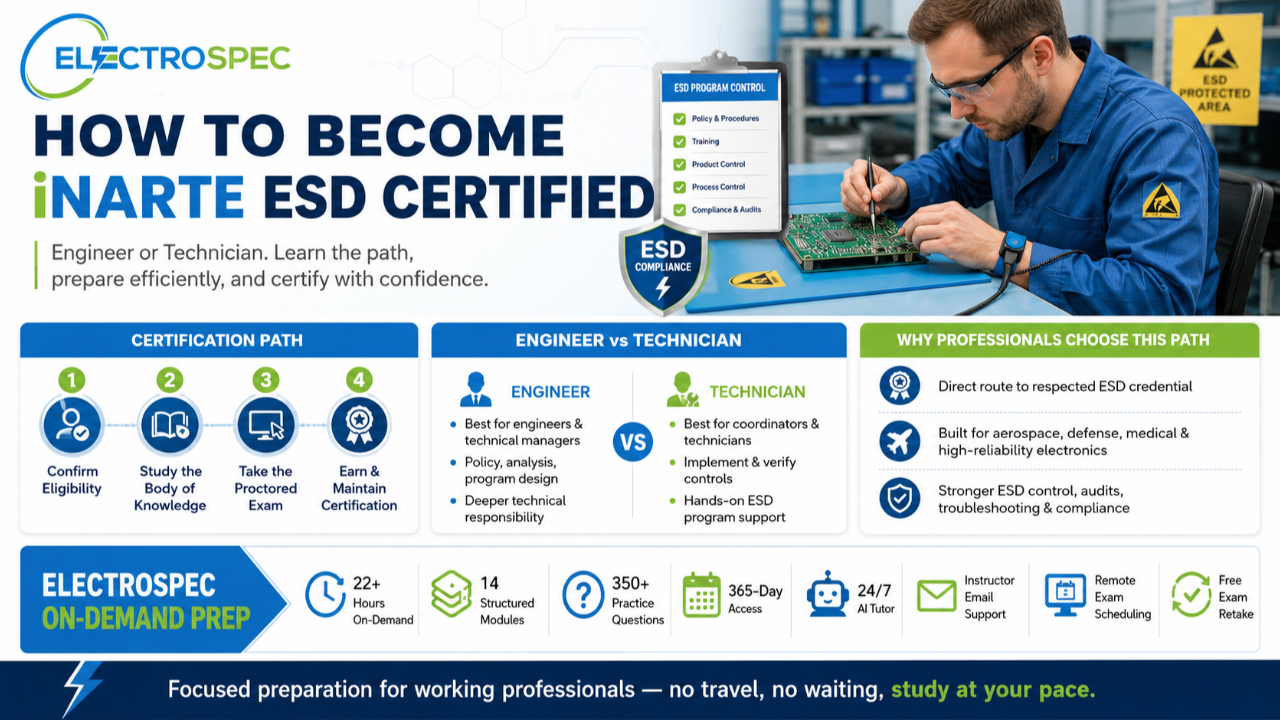
Electrostatic discharge control is more than wearing a wrist strap or placing a mat on a bench.
A strong ESD control program requires people who understand how static charge is generated, how sensitive devices can be damaged, how controls are verified, and how corrective actions are applied when a process is not working.
That is why iNARTE ESD certification can be valuable for electronics manufacturing, aerospace, defense, medical, test, quality, and failure analysis personnel.
Two common paths are:
iNARTE ESD Engineer
iNARTE ESD Technician
Both credentials support ESD control knowledge, but they are not the same. The right path depends on your education, experience, responsibilities, and role in the ESD control program.
What iNARTE ESD Certification Is Designed to Recognize
The iNARTE Electrostatic Discharge Control certification program is intended for technical personnel whose training and experience involve ESD control, engineering design, corrective measures, and minimizing or eliminating electrostatic discharge risk.
That makes it different from basic operator ESD awareness training.
Operator ESD training is usually designed to help personnel follow company procedures safely.
iNARTE ESD certification is deeper. It is intended for personnel who need to understand ESD principles, evaluate controls, support troubleshooting, and help improve or maintain the ESD control program.
iNARTE ESD Engineer
The iNARTE ESD Engineer path is generally the stronger fit for personnel who are responsible for engineering decisions, program development, technical analysis, corrective actions, or broader ESD control planning.
This path is typically suited for:
- ESD coordinators
- ESD program managers
- Process engineers
- Manufacturing engineers
- Quality engineers
- Test engineers
- Reliability engineers
- Failure analysis personnel
- Aerospace, defense, and medical electronics engineers
- Personnel responsible for ESD control plan development or technical ownership
The Engineer credential is more appropriate when the person is expected to understand cause and effect, evaluate program weaknesses, review technical requirements, support audits, and drive corrective action.
For many companies, this is the level needed for someone responsible for the ESD control program, not just working inside it.
iNARTE ESD Technician
The iNARTE ESD Technician path is generally the better fit for experienced technical personnel who support ESD controls, testing, verification, and daily implementation.
This path may fit:
- ESD technicians
- Manufacturing technicians
- Test technicians
- Quality technicians
- Lab technicians
- ESD auditors
- ESD monitors
- Production support personnel
- Personnel performing periodic checks or compliance verification
The Technician credential is useful when a person needs more than basic operator awareness, but may not be responsible for full engineering ownership of the ESD control program.
A technician may verify wrist straps, flooring, worksurfaces, ionizers, packaging, grounding, and process controls. They may support investigations, document results, and help identify when controls are not working as intended.
The Main Difference Is Responsibility
A simple way to separate the two is this:
The ESD Engineer is usually responsible for understanding, designing, improving, or technically managing the ESD control system.
The ESD Technician is usually responsible for supporting, verifying, testing, documenting, and helping maintain the ESD control system.
Both roles matter.
A strong ESD program needs engineers who can evaluate risk and define controls.
It also needs technicians who can verify that the controls are working every day.
Why This Matters in Real Manufacturing
Many companies treat ESD as a simple compliance requirement.
That is a mistake.
ESD damage can be immediate, but it can also be latent. A device may pass initial inspection and test, then fail later in the field because of damage that occurred during handling, assembly, test, rework, storage, or shipping.
That is why ESD control must be understood across the process.
An effective ESD control program requires knowledge of:
- Charge generation
- Device sensitivity
- Grounding and bonding
- Personnel grounding
- Worksurface control
- Ionization
- Packaging
- Handling
- Test and verification
- Auditing
- Corrective action
- Failure analysis
- Process discipline
The more responsibility a person has for the ESD control program, the more technical depth they need.
Which One Should You Choose?
Choose iNARTE ESD Engineer if you are responsible for program ownership, engineering judgment, corrective action, risk assessment, ESD control plan development, process engineering, quality engineering, test engineering, or failure analysis.
Choose iNARTE ESD Technician if you support the program through testing, verification, daily controls, audits, monitoring, documentation, production support, or lab support.
If your role is somewhere in the middle, look at your actual job responsibilities.
If you are expected to define or improve the ESD program, the Engineer path may be a better fit.
If you are expected to verify and support the ESD program, the Technician path may be the better fit.
ElectroSpec’s Training Approach
ElectroSpec’s iNARTE ESD training is designed to help students understand ESD control beyond basic awareness.
The goal is not to simply memorize terms for an exam.
The goal is to understand how ESD risk appears in real electronics manufacturing and how controls work together to protect sensitive devices.
Our training supports students by focusing on:
- ESD fundamentals
- ESD control program concepts
- Grounding and bonding
- Personnel grounding
- Workstations and worksurfaces
- Ionization
- Packaging and handling
- Test and verification
- Process controls
- Troubleshooting and corrective action
- Manufacturing and quality impacts
- Practice exam preparation
This makes the training useful for both Engineer and Technician candidates, depending on the student’s background and certification path.
Key Takeaway
iNARTE ESD Engineer and iNARTE ESD Technician certifications both support stronger ESD control knowledge, but they fit different responsibilities.
The Engineer path is best for personnel responsible for technical ownership, program decisions, engineering analysis, corrective action, and ESD control plan improvement.
The Technician path is best for personnel responsible for supporting, testing, verifying, documenting, and helping maintain ESD controls in production, lab, test, or quality environments.
Both roles help protect electronic products from immediate and latent ESD damage.
ElectroSpec Training helps students prepare for iNARTE ESD certification with practical, online training designed for real electronics manufacturing environments.