Stop Treating IPC-7711/7721 Like Acceptance Criteria
Jun 11, 2026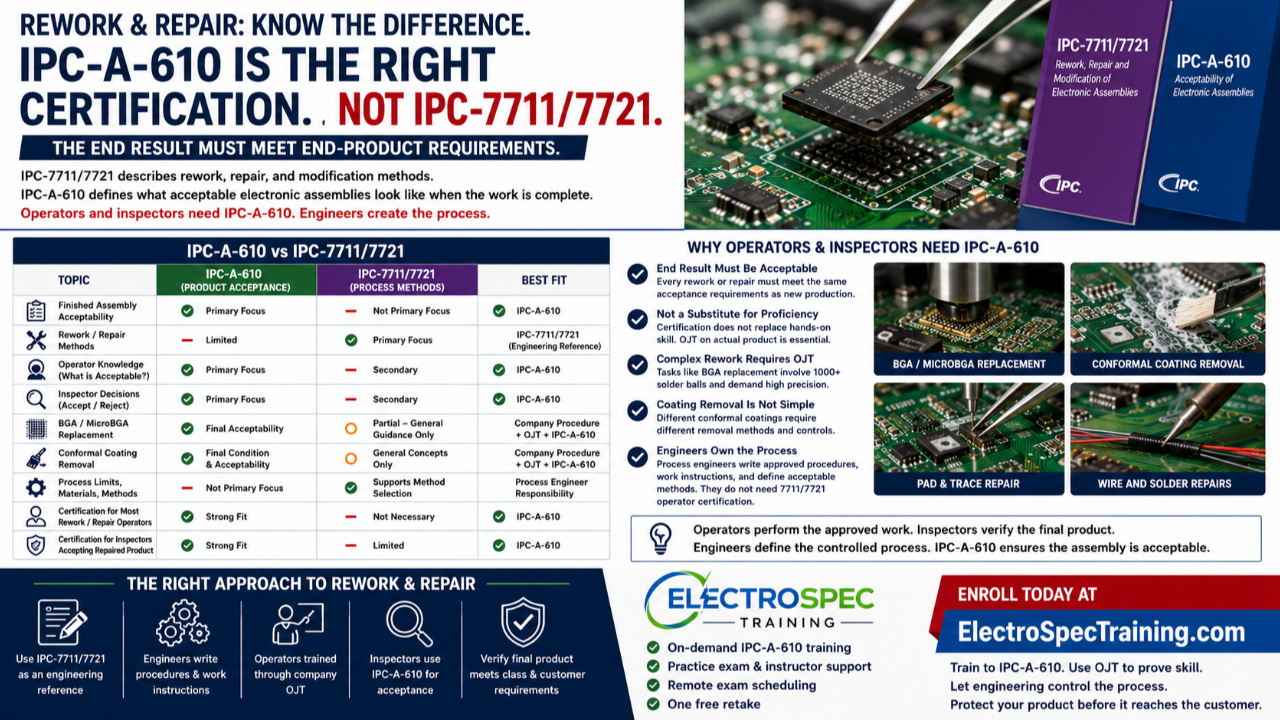
The Better Training Model for Electronics Rework & Repair
Rework and repair are some of the most misunderstood areas in electronics manufacturing training.
Many companies assume that sending operators to IPC-7711/7721 training automatically qualifies them to perform rework and repair on production assemblies. In some cases, they also treat IPC-7711/7721 as if it provides final acceptance criteria for completed electronic assemblies.
That is not the best way to look at it.
IPC-7711/7721 is a valuable technical guide. It provides recommended methods and process guidance for rework, repair, and modification of electronic assemblies and printed wiring boards. It is useful. It belongs in the hands of process engineers, product engineers, quality engineers, master technicians, and technical leaders.
But it should not be treated as a blanket authorization for operators to choose repairs, perform repairs, or determine final product acceptability.
For high-reliability Class 3 electronics, especially in aerospace, defense, automotive, and medical applications, that approach can create unnecessary risk.
Rework and Repair Are Not the Same Thing
One of the first problems is that rework and repair are often grouped together, even though they are not the same from a quality or customer approval standpoint.
Rework generally restores the product to the original drawing, specification, or workmanship requirement. For example, removing and replacing a component or correcting a solder joint may be considered rework when the product is returned to full compliance.
Repair is different. Repair often restores functionality or usability after damage or nonconformance, but it may not return the product to its original manufactured condition. Examples may include lifted pad repair, conductor repair, laminate repair, jumper wires, land replacement, or other corrective actions that alter or restore a damaged feature.
That distinction matters.
Standard rework is often controlled by the manufacturer’s approved procedures. Repair, especially on Class 3 hardware, may require Material Review Board review, engineering disposition, or customer approval.
In many high-reliability environments, repair should not be treated as a routine operator-level decision.
IPC-7711/7721 Is a Guide, Not Product Acceptance Criteria
IPC-7711/7721 helps answer an important question:
“How can this rework or repair operation be performed?”
But it does not fully answer:
“Is this product acceptable?”
And it does not automatically answer:
“Is this repair authorized by the customer, contract, drawing, engineering authority, or MRB?”
That is where many companies get into trouble.
If IPC-7711/7721 is handed to operators as the controlling authority, the company may unintentionally shift engineering responsibility onto the production floor. Operators are then expected to select the method, understand the design risk, interpret customer requirements, and determine acceptability.
That is not a strong control model for Class 3 products.
Rework and Repair Are Product-Specific
Rework and repair are not just manual skills. They are technical processes affected by product design, materials, thermal mass, component density, coating systems, cleanliness requirements, tooling, and customer restrictions.
A method that works on one assembly may not be acceptable on another.
Some of the biggest variables include:
- Board thickness and thermal mass
- Internal copper planes
- Component density
- Fine-pitch and area array devices
- Prior thermal exposure
- Heat-sensitive components
- Conformal coating type and thickness
- Cleaning access
- Flux entrapment risk
- Customer or contract restrictions
- Class 3 reliability expectations
This is why rework and repair procedures should be written and approved by the company’s technical authority, not selected informally by the operator from a guide.
Conformal Coating Makes Rework and Repair Even More Complicated
Conformal coating is one of the most challenging parts of rework and repair.
There are several common coating families, including acrylic, urethane, silicone, parylene, and other specialty coatings. Even within those families, coatings vary by formulation, thickness, cure condition, adhesion, age, and removal method.
Coating removal and replacement can affect:
- Solderability
- Cleanliness
- Adhesion
- Insulation resistance
- Component markings
- Adjacent coating integrity
- Visual acceptance
- Environmental protection
- Long-term reliability
A technician should not be expected to choose a coating removal and replacement method without an approved procedure. For Class 3 products, the risk is too high.
Cleanliness After Rework Is Hard to Verify
Cleanliness is another major issue.
After rework or repair, residues may be trapped under components, around coating edges, beneath low-standoff devices, or in areas that are difficult to inspect visually. If conformal coating is involved, cleanliness verification becomes even more difficult.
Visual inspection alone may not be enough.
Depending on the product and customer requirements, cleanliness control may require defined cleaning processes, inspection methods, ionic cleanliness considerations, SIR concerns, UV inspection, or additional verification.
That level of control is not created by simply sending an operator to IPC-7711/7721 training.
The Better Model: IPC-A-610 Certification + Engineering-Controlled OJT
For many manufacturers, the better training model is simple:
Use IPC-A-610 certification as the primary training and certification foundation for product acceptability.
Use IPC-7711/7721 as an engineering guide.
Then build internal OJT around company-approved procedures.
IPC-A-610 helps operators, inspectors, technicians, engineers, and quality personnel understand whether the completed electronic assembly conforms to the applicable acceptance requirements. That is the critical knowledge needed after rework or repair is performed.
IPC-7711/7721 remains valuable, but it should be used by engineering and technical leadership to develop internal procedures, not as a substitute for those procedures.
Recommended Training Structure
A strong rework and repair training program should include three pieces.
First, certify the right personnel to IPC-A-610. This gives operators, inspectors, quality personnel, and engineers a common understanding of final product acceptability.
Second, have process engineering and product engineering review IPC-7711/7721 and determine which methods are applicable to the company’s products, customers, materials, and risk profile.
Third, create an internal OJT program with defined qualification levels.
A practical OJT structure may include:
Beginner:
Performs low-risk rework under direct supervision. No independent repair decisions.
Intermediate:
Performs approved rework independently and selected repair tasks under procedure control.
Master:
Performs complex rework, supports repair development, trains others, and assists engineering with process validation.
Even at the master level, repair authorization should still follow company procedures, MRB requirements, engineering disposition, and customer approval where required.
Operators Should Know When to Stop
A good training program does not just teach people how to perform work. It teaches them when to stop.
Operators and technicians should escalate when they see:
- Lifted pads
- Damaged conductors
- Barrel damage
- Laminate damage
- Unknown coating type
- Coating removal damage
- Multiple rework attempts
- Cleanliness concerns
- Overheating evidence
- Customer-restricted repair conditions
- Any condition not clearly covered by an approved procedure
This protects the customer, the product, and the company.
When IPC-7711/7721 Training May Still Make Sense
This does not mean IPC-7711/7721 training has no value.
It can be useful for process engineers, master technicians, repair specialists, and companies that perform frequent board-level repair. It may also be appropriate when a customer contract specifically requires it.
The caution is this:
Do not use IPC-7711/7721 certification as a substitute for engineering-controlled procedures, customer approval, internal OJT, or final product acceptance training.
For many companies, the better first investment is IPC-A-610 certification supported by controlled internal OJT.
ElectroSpec Training Can Help
ElectroSpec Training provides flexible IPC-A-610 training and certification support for CIS, CIT, and CSE candidates through an on-demand learning model designed for modern manufacturing teams. Students receive 24/7 access to training, practice questions, instructor support, and remote exam scheduling, allowing operators, inspectors, engineers, and quality personnel to complete certification without disrupting production schedules.
For organizations developing rework and repair programs, ElectroSpec recommends IPC-A-610 as the core certification for product acceptability, supported by company-specific OJT, engineering-approved procedures, and controlled use of IPC-7711/7721 as a technical guide.
ElectroSpec also supports electronics manufacturing teams with IPC training, ESD program support, workmanship assessments, technical consulting, facility assessments, and process reviews.
Final Thought
Do not train operators to choose repairs from a guide.
Train them to recognize product acceptability, follow approved procedures, document the work, and escalate high-risk repair decisions to engineering.
For high-reliability electronics manufacturing, that is a much stronger model.
IPC-A-610 CIS Certification — ElectroSpec