
IPC-A-600 vs. IPC-A-610: Bare-Board Acceptance vs. Assembly Acceptance
Jul 01, 2026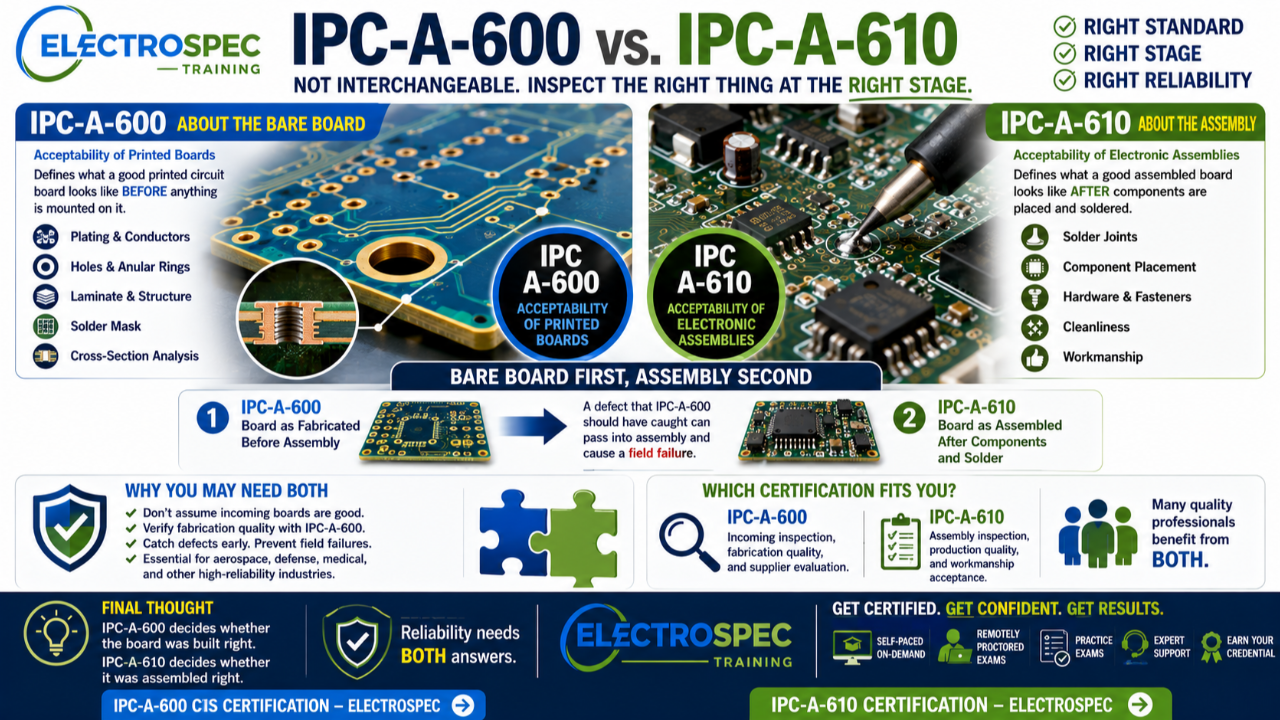
IPC-A-600 and IPC-A-610 sound almost identical. They are not interchangeable, and confusing them leads to inspecting the wrong thing at the wrong stage.
Here is the clean distinction.
IPC-A-600 Is About the Bare Board
IPC-A-600, Acceptability of Printed Boards, defines what a good printed circuit board looks like before anything is mounted on it.
It covers the fabricated board itself — plating, conductors, holes, laminate, solder mask, and internal structure visible in cross-section. It is the acceptance standard for what comes out of the fabrication shop.
IPC-A-610 Is About the Assembly
IPC-A-610, Acceptability of Electronic Assemblies, defines what a good assembled board looks like after components are placed and soldered.
It covers solder joints, component placement, hardware, cleanliness, and the workmanship of the populated assembly. It is the acceptance standard for what comes off the production line.
Bare Board First, Assembly Second
The two standards map to two stages of the same product.
- IPC-A-600 — the board as fabricated, before assembly
- IPC-A-610 — the board as assembled, after components and solder
A defect that IPC-A-600 should have caught — a plating void, a delamination, an out-of-spec annular ring — can pass straight into assembly and surface as a field failure no amount of IPC-A-610 inspection would have prevented.
Why You May Need Both
If your team only inspects assemblies, you are trusting that every bare board you receive was acceptable. IPC-A-600 knowledge lets you verify incoming boards instead of assuming they are good.
For high-reliability work — aerospace, defense, medical — understanding both standards closes the gap between “the assembly looks fine” and “the product is actually reliable.”
Which Certification Fits You
Incoming inspection, fabrication quality, and supplier evaluation point toward IPC-A-600. Assembly inspection, production quality, and workmanship acceptance point toward IPC-A-610. Many quality professionals benefit from both.
Different Inspection Tools and Methods
The two standards also call for different ways of looking at the product. IPC-A-610 inspection is largely visual, supported by magnification, and focused on what can be seen on the finished assembly: solder fillets, component orientation, damage, and cleanliness.
IPC-A-600 includes externally visible characteristics, but it also covers internal conditions that can only be evaluated through microsection analysis — plating thickness inside holes, layer registration, internal voids, and separations. That is why a complete bare-board evaluation often involves the fabricator's cross-section reports as well as incoming visual inspection.
Where the Standards Meet
Some conditions sit right at the boundary. A lifted pad, measling near a component, or a solder mask problem might be caused by the fabricator or by the assembly process. Knowing both standards helps teams determine where a problem started, which is essential for effective corrective action.
Without that knowledge, fabricators and assemblers can spend weeks pointing at each other while defective product keeps flowing.
Both Use Product Classes
IPC-A-600 and IPC-A-610 both use Class 1, Class 2, and Class 3 to scale acceptance criteria to the product's end use. The same physical condition can be acceptable for one class and a defect for another. The class required on the drawing or purchase order governs both the bare board and the assembly, and inspectors must apply the correct class at each stage.
A Practical Example
Consider a board with slightly thin copper plating in a few plated-through holes. At bare-board stage, IPC-A-600 criteria determine whether that plating is acceptable for the required class. If it is not caught, the board moves to assembly, where IPC-A-610 inspection may find perfect-looking solder joints on those same holes.
The assembly passes. Months later, thermal cycling cracks the thin barrel and the product fails intermittently. The defect was always a bare-board issue — it simply was never evaluated against the right standard.
Building a Complete Quality Picture
- Receiving and supplier quality — IPC-A-600 to verify boards before they enter production
- Production and final inspection — IPC-A-610 to verify the assembled product
- Quality engineering — both, to trace root causes across the fabrication and assembly boundary
Final Thought
IPC-A-600 decides whether the board was built right. IPC-A-610 decides whether it was assembled right. Reliability needs both answers.
ElectroSpec offers self-paced, remotely proctored certification preparation for each.
IPC-A-600 CIS Certification — ElectroSpec
IPC-A-610 Certification — ElectroSpec