
IPC-A-600: Why Bare-Board Acceptance Decides Quality Before Assembly Starts
Jul 02, 2026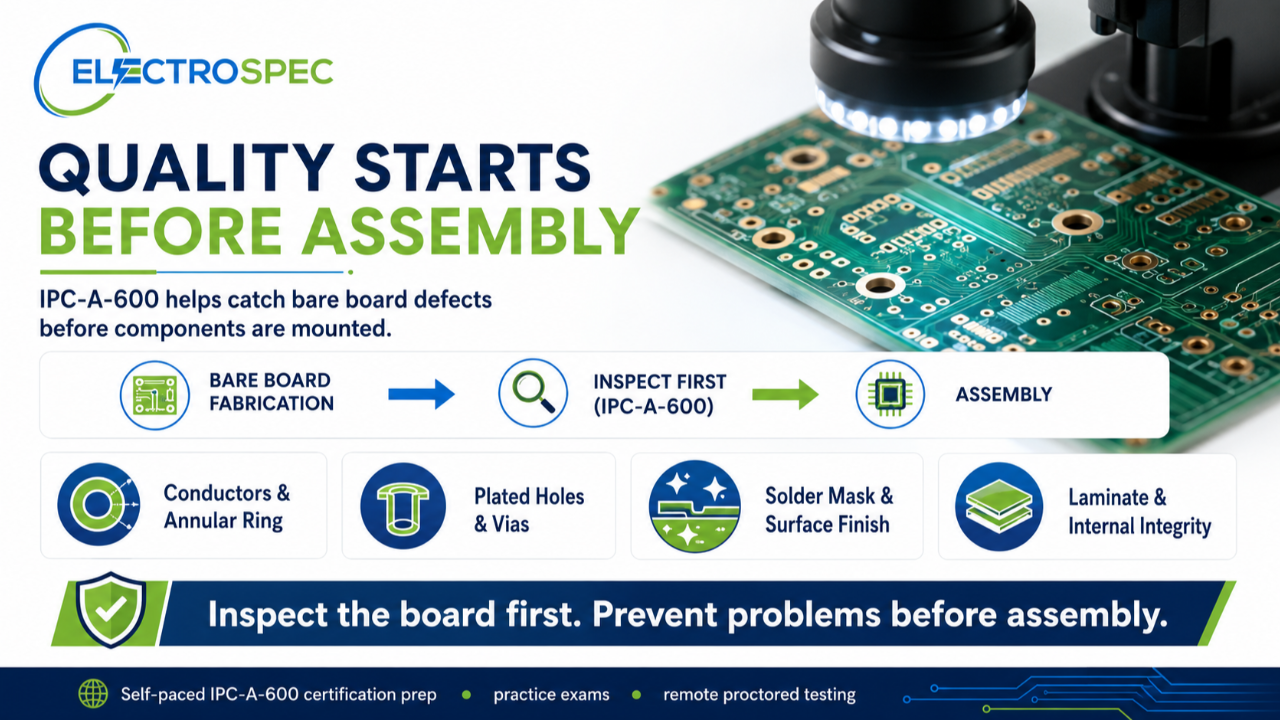
Most electronics quality programs start inspecting at assembly. By then, a bad bare board has already been populated, soldered, and paid for.
IPC-A-600 moves the first quality decision earlier — to the board itself.
The Board Is a Product Before It Is a Platform
It is easy to think of a printed board as a blank canvas that only matters once components are on it. In reality, the bare board is a finished, complex product with its own failure modes.
Plating thickness, hole quality, lamination, conductor spacing, solder mask registration, and internal layer integrity are all determined at fabrication — long before your team ever sees the assembly.
What IPC-A-600 Defines
IPC-A-600, Acceptability of Printed Boards, is the industry standard for what a good bare board looks like. It covers both external features you can see and internal features revealed in cross-section.
- Conductors, spacing, and annular ring
- Plated-through holes and vias
- Laminate quality and delamination
- Solder mask and surface finish
- Internal layer registration and integrity
Why It Matters Before Assembly Starts
A defective bare board does not announce itself. It gets assembled like any other, passes a visual check of the solder joints, and ships — then fails in the field when a marginal via or a plating void finally opens.
No amount of assembly inspection catches a defect that lives inside the board. IPC-A-600 is how you catch it at the door.
Who Should Understand IPC-A-600
- Incoming inspection and receiving quality personnel
- Supplier quality engineers evaluating fabricators
- Process and quality engineers in high-reliability electronics
- Anyone responsible for what arrives before assembly begins
Common Bare-Board Defects That Escape Into Assembly
Several board-level conditions are easy to miss if no one is looking for them specifically:
- Plating voids and thin plating in holes — can crack under thermal cycling and cause intermittent opens that are extremely hard to troubleshoot.
- Annular ring breakout — drill registration errors that leave too little copper around a hole, weakening the connection.
- Delamination and blistering — separation between layers, often made worse by the heat of reflow or wave soldering.
- Measling and crazing — internal laminate conditions that may or may not be acceptable depending on the product class.
- Solder mask misregistration — mask on pads or exposed copper where it should be covered, affecting solderability and bridging.
- Conductor width and spacing reductions — etching defects that reduce current capacity or electrical clearance.
External Versus Internal Inspection
IPC-A-600 covers two kinds of evaluation. Externally observable characteristics can be checked with visual inspection and magnification at receiving. Internally observable characteristics — plating thickness in holes, layer registration, internal separations — are evaluated through microsection (cross-section) analysis of coupons or sample boards.
Understanding both helps receiving inspectors know what they can verify at the dock and when to request microsection data from the fabricator.
Product Classes Change the Answer
As with IPC-A-610, IPC-A-600 criteria depend on the product class. A condition acceptable for a Class 1 or Class 2 board may be a defect for Class 3. Receiving inspection must know which class the purchase order and drawing require — otherwise good boards get rejected or, worse, marginal boards get accepted for high-reliability use.
Using IPC-A-600 in Supplier Management
IPC-A-600 knowledge is also a supplier-management tool. Quality engineers who can speak the fabricator's language can write clearer purchase requirements, review certificates of conformance and microsection reports with confidence, and have productive corrective-action conversations when problems appear.
The result is fewer disputes, faster resolution, and a supply base that understands exactly what acceptable means for your product.
How Certification Helps
IPC-A-600 Certified IPC Specialist (CIS) certification gives inspectors and engineers a structured understanding of the standard, its terminology, and how to apply the criteria by product class. For companies, it creates documented, consistent competency at the point where board quality is decided.
Final Thought
Quality is cheapest to enforce at the earliest possible stage. For electronics, that stage is the bare board — and IPC-A-600 is the standard that governs it.
ElectroSpec offers self-paced IPC-A-600 certification preparation with practice exams and remote proctored testing.
IPC-A-600 CIS Certification — ElectroSpec