
IPC-A-610 vs. IPC J-STD-001: Why A-610 Training Matters More for Operators & Inspectors
Jun 14, 2026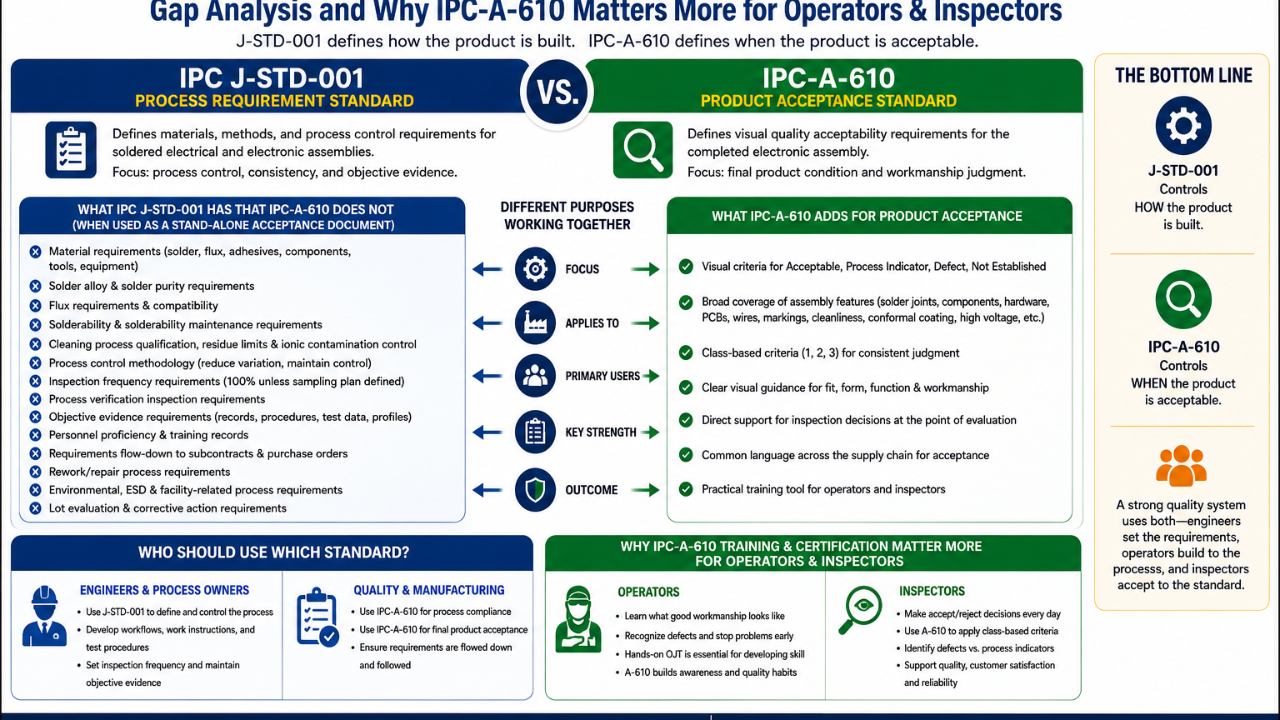
The real gap analysis between product acceptance and process control.
In electronics manufacturing, IPC-A-610 and IPC J-STD-001 are often discussed as if they compete with each other. They do not. They serve different purposes.
IPC J-STD-001 is a manufacturing and process requirement standard. It belongs in engineering documentation, procurement requirements, manufacturing planning, process setup, workflow development, and work instructions.
IPC-A-610 is the product acceptance standard. It belongs in the hands of operators, inspectors, quality technicians, production leads, and anyone making day-to-day workmanship decisions on completed electronic assemblies.
That distinction matters because operators and inspectors are not usually responsible for designing the soldering process, qualifying materials, defining cleaning limits, setting inspection frequency, or establishing process control plans. Those requirements should already be translated by product engineers, process engineers, manufacturing engineers, and quality engineers into the actual workflow, manufacturing procedures, test procedures, work instructions, and acceptance checkpoints used on the production floor.
For operators and inspectors, the more urgent question is not, “What does the process engineering standard require?” The practical question is, “Is this assembly acceptable, a process indicator, or a defect?”
That is why IPC-A-610 training and certification is often more valuable for operators and inspectors than IPC J-STD-001 certification.
J-STD-001 controls how the product is built
IPC J-STD-001 is extremely important. It defines many requirements that are critical to reliable soldered electronic assemblies. These include material controls, solder alloy requirements, flux requirements, solderability, solder purity maintenance, cleaning and residue controls, inspection frequency, process verification, personnel proficiency, flow-down requirements, and objective evidence.
Those are serious requirements, but they are not all operator-level decision points.
An operator on the production floor is usually not selecting the solder alloy. The operator is not defining the flux chemistry. The operator is not deciding the cleaning process validation method. The operator is not writing the process control plan. The operator is not setting ionic contamination test limits or determining whether a solder bath analysis interval is acceptable.
Those tasks belong to engineering, manufacturing, quality, and process ownership.
J-STD-001 should be invoked on drawings and procurement documents because it gives the engineering team the authority to define controlled manufacturing requirements. It helps ensure the product is built using qualified materials, documented procedures, controlled processes, verified inspections, and objective evidence.
But once those requirements are flowed into production, operators and inspectors need clear, usable criteria for the hardware in front of them.
That is where IPC-A-610 becomes the better training standard.
IPC-A-610 controls how the finished assembly is accepted
IPC-A-610 is built around product acceptability. It is visual, practical, class-based, and focused on the finished condition of the assembly.
That makes it especially powerful for operators and inspectors.
Operators need to know what good workmanship looks like. They need to recognize common defects before work moves downstream. They need to understand solder joint appearance, component damage, hardware installation, conductor spacing, cleanliness, board damage, wire conditions, and handling concerns.
Inspectors need even more. They must make consistent acceptance decisions. They must know the difference between acceptable, process indicator, and defect. They must apply product class correctly. They must avoid rejecting acceptable conditions based on personal preference. They must also know when a condition requires engineering review, MRB disposition, or process investigation.
IPC-A-610 gives them that language.
It helps answer:
- Is the solder joint acceptable?
- Is the condition only a process indicator?
- Is the condition a defect?
- Does product class change the answer?
- Is minimum electrical clearance violated?
- Is fit, form, or function affected?
- Is damage cosmetic or functional?
- Is this a workmanship issue, process trend, or rejection condition?
Those are the daily questions on the production floor.
The gap: what J-STD-001 has that A-610 does not
A strong quality system needs to understand the gap between the two documents.
J-STD-001 includes many requirements that IPC-A-610 does not fully provide as a stand-alone product acceptance document. These include:
- Material requirements
- Solder alloy requirements
- Flux requirements
- Solder paste requirements
- Pb-free process controls
- Solder purity maintenance
- Solder bath contamination limits
- Cleaning process qualification
- Residue testing and process monitoring
- Process control methodology
- Objective evidence requirements
- Process verification inspection
- Inspection frequency requirements
- Flow-down to subcontracts and purchase orders
- Rework and repair process controls
- Personnel proficiency records
These are important, but most of them should be converted into controlled production instructions before the operator or inspector ever touches the assembly.
In other words, the operator should not need to interpret J-STD-001 to decide which solder alloy is approved. The work instruction should already say that.
The inspector should not need to decide the ionic cleanliness test method. The manufacturing or quality procedure should already define it.
The production worker should not need to decide whether Pb-free and tin-lead processes are properly segregated. The process plan should already control it.
The operator should follow the approved process. The inspector should verify the completed product.
That is exactly why IPC-A-610 training is so useful.
Operators need A-610 awareness plus hands-on OJT
For operators, IPC-A-610 training provides the “what good looks like” foundation.
However, operators who perform hand soldering also need supervised on-the-job training. Hand soldering is a physical skill. It requires repetition, coaching, correction, practice boards, real hardware exposure, and demonstrated proficiency.
A classroom course can teach:
- What a good solder joint looks like
- What nonwetting looks like
- What a cold solder joint looks like
- What bridging looks like
- What excess solder looks like
- What insulation damage looks like
- What component damage looks like
- What conditions should be stopped and escalated
But classroom training alone does not make someone a skilled hand soldering operator.
For hand soldering, the best model is IPC-A-610 awareness and certification combined with job-specific OJT, workmanship coaching, and practical skills verification.
Operators need to know acceptance criteria, but they also need to build muscle memory.
Inspectors need A-610 even more
Inspectors are the strongest audience for IPC-A-610 certification because their job is product acceptance.
An inspector must make decisions that affect shipment, rework, scrap, MRB, customer acceptance, and process feedback. That requires more than knowing how soldering is performed. It requires knowing how to judge the completed assembly.
IPC-A-610 is designed for that decision.
It gives inspectors a common language for:
- Acceptable conditions
- Process indicators
- Defects
- Product classes
- Electrical clearance
- Fit, form, and function
- Hardware issues
- Component damage
- Printed board damage
- Cleanliness and FOD
- Solder joint criteria
- Wire and terminal conditions
- Jumper wires
- High-voltage visual concerns
This is why IPC-A-610 certification is one of the most practical certifications for inspection personnel. It directly supports the task inspectors perform every day.
Engineers need the standards differently
Product engineers and process engineers absolutely need to understand IPC requirements, but they do not always need the same certification path as operators and inspectors.
Engineers should know how to invoke J-STD-001 correctly on drawings, contracts, and procurement documents. They should understand how J-STD-001 affects material selection, process control, cleanliness, solderability, inspection planning, and objective evidence. They should also understand IPC-A-610 so they know how the final assembly will be judged.
But many engineers are not production soldering operators. A full J-STD-001 course with hands-on soldering may not be the best use of time for every engineer. Engineers often benefit more from a focused standards application course that explains how to flow requirements into drawings, work instructions, manufacturing procedures, inspection plans, and supplier requirements.
The operator needs execution skill.
The inspector needs acceptance judgment.
The engineer needs requirements flow-down and process control understanding.
Those are not the same training need.
The better training model
The strongest training model separates responsibilities clearly.
For product and process engineers:
Use J-STD-001 to define manufacturing and process requirements. Convert those requirements into drawings, work instructions, manufacturing procedures, test procedures, inspection plans, and supplier flow-down.
For operators:
Use IPC-A-610 to understand workmanship expectations and defect recognition. Add hands-on OJT for soldering skill, component handling, ESD control, job-specific workmanship, and process discipline.
For inspectors:
Use IPC-A-610 as the primary certification for product acceptance decisions. Inspectors need to apply class-based criteria consistently and know when conditions are acceptable, process indicators, or defects.
For quality engineers:
Use both standards. J-STD-001 supports process compliance and objective evidence. IPC-A-610 supports product acceptance, audit consistency, and defect disposition.
Recommended shop-floor message
J-STD-001 belongs in the engineering and manufacturing system.
IPC-A-610 belongs at the inspection bench.
J-STD-001 should drive the process plan.
IPC-A-610 should drive the acceptance decision.
J-STD-001 helps engineers define how to build the product.
IPC-A-610 helps operators and inspectors recognize whether the completed product is acceptable.
Conclusion
IPC J-STD-001 is essential for process control, material control, and engineering flow-down. It should be invoked on drawings and translated into controlled manufacturing documentation.
But for operators and inspectors, IPC-A-610 training and certification is often more important because it supports the real decisions they make every day.
Operators need to recognize good workmanship and know when to stop, fix, or escalate.
Inspectors need to determine whether the finished assembly is acceptable, a process indicator, or a defect.
Those are IPC-A-610 decisions.
The best electronics manufacturing systems do not force operators and inspectors to act like process engineers. They give engineers responsibility for process definition, then train operators and inspectors to execute and evaluate the work correctly.
That is the real gap analysis:
J-STD-001 defines the controlled process.
IPC-A-610 defines the accepted product.
For operators and inspectors, IPC-A-610 is the more practical, more direct, and more important certification.