
Flex and Rigid-Flex Training: Topic Course or Advanced Design Framework?
Aug 07, 2026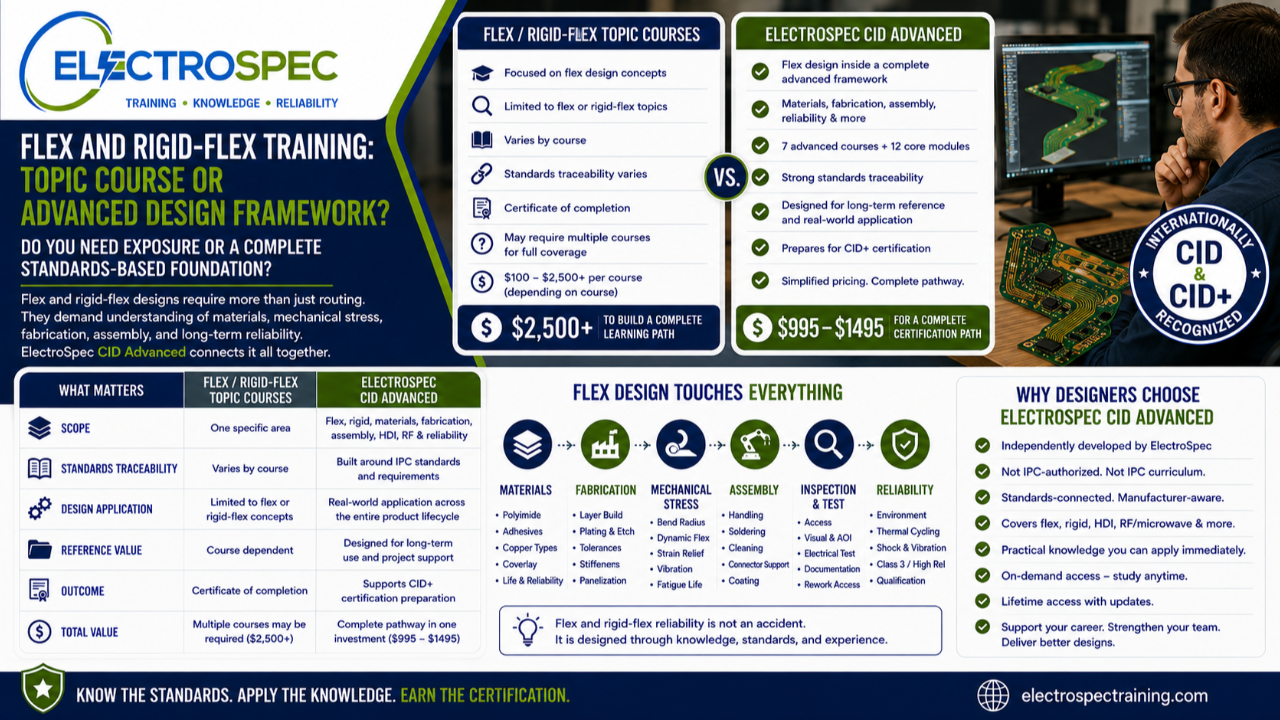
Flex and rigid-flex circuit design is not just another PCB layout topic.
It is a specialized design discipline that connects materials, mechanical motion, bend reliability, stackup design, fabrication capability, assembly process limits, inspection access, documentation, and long-term product reliability.
That is why flex and rigid-flex training matters.
But when comparing training options, designers and employers should ask an important question:
Is flex and rigid-flex being taught as a standalone topic, or is it part of a broader advanced design framework tied to standards, materials, fabrication, reliability, and certification preparation?
That distinction matters.
A topic course may introduce flex concepts.
A standards-based advanced design pathway helps the designer understand how flex and rigid-flex decisions affect the entire product lifecycle.
Flex Design Is Not Simply a Bendable PCB
A flexible circuit is not just a thin printed board that bends.
Flex and rigid-flex designs introduce design concerns that are different from traditional rigid board layouts.
Designers must consider:
- base material selection
- adhesive systems
- adhesiveless constructions
- copper type and thickness
- bend radius
- static versus dynamic flexing
- coverlay
- stiffeners
- strain relief
- transition areas
- via placement
- conductor routing through bend areas
- tear stops
- mechanical support
- connector interfaces
- fabrication tolerances
- assembly handling
- inspection access
- qualification environment
A rigid PCB may primarily be designed around electrical, mechanical, thermal, and manufacturability constraints.
A flex or rigid-flex design adds motion, bending, folding, vibration, strain, and mechanical life.
That changes the design problem.
The Topic Course Approach
Based on the catalog examples reviewed, flex and rigid-flex PCB training is often offered as an individual topic course.
That can be useful.
A designer may need a focused course to understand flex construction, bend areas, fabrication concerns, and common design mistakes.
A topic course may be a reasonable choice when someone needs narrow exposure to flex design.
But flex and rigid-flex design rarely exist in isolation.
A real flex product still depends on:
- material selection
- fabrication capability
- assembly process compatibility
- documentation quality
- inspection and test strategy
- solder joint reliability
- connector reliability
- environmental exposure
- Class 3 or high-reliability expectations
- customer requirements
- qualification requirements
A standalone course may teach flex as a topic.
But the designer still needs to know how flex fits into the broader design standards and manufacturing framework.
ElectroSpec CID Advanced Places Flex in the Larger Design System
ElectroSpec’s CID Advanced training includes a dedicated Flexible PCB Design Course as part of a broader advanced PCB design pathway.
The full CID Advanced track includes:
- PCB Fabrication & Assembly
- PCB Materials
- Rigid PCB Design
- Flexible PCB Design
- HDI PCB Design
- RF/Microwave PCB Design
- Environmental Stress Screening
This matters because flex design depends heavily on the other areas.
A designer cannot make good flex decisions without understanding materials.
A designer cannot make good rigid-flex decisions without understanding fabrication and assembly.
A designer cannot design for harsh environments without understanding environmental stress, mechanical fatigue, and qualification risk.
A designer cannot make reliable advanced product decisions by studying flex in isolation.
Flex belongs inside the full advanced design framework.
Standards Traceability Matters in Flex Design
Flex and rigid-flex designs need traceability back to standards and requirements.
A designer should be able to ask:
- Is this design concern tied to a flex design standard?
- Is this a material requirement?
- Is this a fabrication capability issue?
- Is this a bend reliability concern?
- Is this a documentation requirement?
- Is this an assembly or soldering concern?
- Is this an inspection or test limitation?
- Is this a Class 3 or high-reliability concern?
- Is this tied to customer flow-downs?
- Is this tied to qualification testing?
- Is this an engineering judgment based on use environment?
This is where standards traceability becomes critical.
Without traceability, flex design training can become a list of tips.
With traceability, the designer learns how to connect design choices back to requirements, standards, materials, fabrication limits, and reliability expectations.
That is the difference between learning about flex and designing flex responsibly.
Flex Design Is a Materials Problem
Materials are central to flex and rigid-flex reliability.
Material choices affect bending performance, fatigue life, dimensional stability, thermal behavior, soldering compatibility, and environmental resistance.
Designers must think carefully about:
- polyimide materials
- copper type
- copper thickness
- adhesive systems
- coverlay
- stiffeners
- bonding materials
- plating
- surface finish
- thermal expansion
- moisture exposure
- compatibility with assembly and coating processes
A designer who treats flex like a thin rigid board may create reliability problems.
A designer who understands materials can make better decisions about bend areas, conductor routing, reinforcement, stackup, and product life.
That is why ElectroSpec’s CID Advanced approach includes both flexible PCB design and PCB materials.
Flex Design Is a Fabrication Problem
Flex and rigid-flex designs are highly dependent on fabrication capability.
A design may look acceptable in CAD but still create fabrication risk.
Important fabrication concerns include:
- layer registration
- etching tolerances
- plating reliability
- hole formation
- rigid-to-flex transitions
- coverlay openings
- adhesive squeeze-out
- stiffener placement
- panelization
- dimensional stability
- controlled impedance where applicable
- supplier capability
- documentation clarity
Designers must understand what the fabricator can build consistently.
A flex topic course may introduce some of these issues.
ElectroSpec CID Advanced connects fabrication and flex design together as part of the broader advanced pathway.
Flex Design Is a Mechanical Reliability Problem
Flex and rigid-flex designs often fail because mechanical reality was not fully considered.
The electrical design may work.
The initial build may pass test.
But the product may still fail in use if the flex area experiences repeated bending, vibration, unsupported movement, connector strain, or concentrated stress.
Designers should consider:
- bend radius
- bend location
- dynamic flex cycles
- conductor orientation through bend regions
- stiffener placement
- transition reinforcement
- connector support
- strain relief
- cable routing
- installation stress
- service handling
- vibration
- shock
- thermal cycling
This is especially important for aerospace, defense, medical, industrial, automotive, and harsh-environment applications.
Flex reliability is not accidental.
It must be designed.
Flex Design Is an Assembly and Inspection Problem
Flex and rigid-flex products can also create assembly and inspection challenges.
Designers must consider:
- how the product will be handled during assembly
- whether the flex area needs support during processing
- how components will be soldered
- whether the assembly can be cleaned
- whether the product can be coated
- whether solder joints can be inspected
- whether test points are accessible
- whether connectors are supported
- whether rework is possible or allowed
- whether documentation clearly defines the requirements
If these issues are not considered early, the product may become difficult to build and verify.
That is why flex design should be connected to fabrication, assembly, inspection, and quality.
Courses Come and Go, But Flex Requirements Remain
Training catalogs change.
Course names change.
Offerings are added, removed, renamed, or repackaged.
That is normal.
But flex and rigid-flex design requirements remain important because the product still has to work in the real world.
A designer needs a durable reference framework.
They need to understand not only what a course said, but where the requirement belongs.
They need to know how to return to standards, drawings, supplier capabilities, material specifications, customer flow-downs, and qualification plans.
ElectroSpec’s CID Advanced training is designed to give students a broader framework they can reference beyond a single course.
Certificate of Completion vs. CID+ Preparation
A flex topic course may provide a certificate of completion.
That can show that the student completed the course.
But a certificate of completion is not the same as a training pathway built to support a recognized PCB design certification.
ElectroSpec CID Advanced is designed to support preparation for CID+ certification.
That changes the purpose of the training.
The goal is not only to introduce flex and rigid-flex design.
The goal is to help advanced designers connect flex design to materials, fabrication, assembly, reliability, standards traceability, and professional certification preparation.
Price and Value
Price should be compared to scope and outcome.
A single flex or rigid-flex topic course may be useful for narrow exposure.
But if the designer also needs materials, fabrication, rigid design, HDI, RF, environmental reliability, assembly considerations, and certification preparation, then multiple topic courses may be needed.
That can become expensive quickly.
ElectroSpec’s simplified comparison is different.
ElectroSpec CID Advanced is commonly positioned in the $995 to $1,495 range, depending on the offering.
A broader pathway built from multiple individual topic courses can reach $2,500+ when a student needs complete coverage across advanced design areas.
The better question is:
Is the student buying one flex topic, or building an advanced standards-based pathway toward CID+ certification?
Comparison Summary
| Question | Flex or Rigid-Flex Topic Course | ElectroSpec CID Advanced |
|---|---|---|
| Main purpose | Teach selected flex design concepts | Place flex inside a broader advanced design framework |
| Scope | Course dependent | Flex, rigid, materials, fabrication, assembly, HDI, RF, ESS, reliability |
| Standards traceability | Varies by course | Built around standards and requirements |
| Reference value | May be limited to one topic | Designed for long-term reference and application |
| Reliability focus | Course dependent | Connects flex design to mechanical stress, environment, and qualification |
| Outcome | Often certificate of completion | Supports CID+ certification preparation |
| Best fit | Narrow flex exposure | Designers seeking advanced standards-based certification preparation |
A Flex Designer Needs More Than Flex Rules
A strong flex designer needs to understand more than bend radius.
They need to understand the complete design environment.
They should ask:
- What materials are appropriate?
- What is the bend condition?
- Is the flex static or dynamic?
- What fabrication limits apply?
- How will the product be assembled?
- How will it be inspected?
- How will it be tested?
- What environmental stresses apply?
- What documentation is needed?
- What class or reliability level applies?
- What customer requirements are flowed down?
- Can the product survive real use?
These questions show why flex design belongs inside a complete advanced design pathway.
Independently Developed by ElectroSpec
ElectroSpec’s CID Advanced courses are independently developed by ElectroSpec.
They are not IPC-authorized training and they are not official IPC curriculum.
ElectroSpec built these courses to provide practical, standards-connected, manufacturing-aware training for designers pursuing CID+ certification preparation.
The focus is not only on learning a topic.
The focus is on applying design knowledge to real products.
Final Thought
Flex and rigid-flex design is too important to treat as a disconnected topic.
It is a materials problem.
It is a fabrication problem.
It is a mechanical reliability problem.
It is an assembly and inspection problem.
It is a documentation and standards traceability problem.
A topic course may introduce flex design.
ElectroSpec CID Advanced helps place flex and rigid-flex design inside a broader standards-based framework that supports real-world design decisions and CID+ certification preparation.
A flex circuit does not succeed because it bends.
It succeeds because the designer understands how materials, fabrication, motion, assembly, inspection, environment, and reliability work together.
Related ElectroSpec Training
ElectroSpec’s CID Advanced training includes flexible PCB design as part of a broader advanced PCB design pathway.
The advanced track includes PCB Fabrication & Assembly, PCB Materials, Rigid PCB Design, Flexible PCB Design, HDI PCB Design, RF/Microwave PCB Design, and Environmental Stress Screening.
Together, these courses help designers prepare for advanced design work and CID+ certification.
Coming Next
RF and Signal Integrity Courses: Useful Topic or Integrated Design Path?
In the next article, we will compare RF and signal integrity topic courses with ElectroSpec’s CID Advanced approach and explain why high-speed performance is not only a routing problem. It is a materials, stackup, fabrication, and design-control problem.
IPC CID Certification — ElectroSpec
IPC CID+ Certification — ElectroSpec
IPC CID/CID+ Bundle — Complete PCB Design Certification — ElectroSpec