
SMT Assembly Is Not Hand Soldering: Why Training Must Match the Process
Jul 26, 2026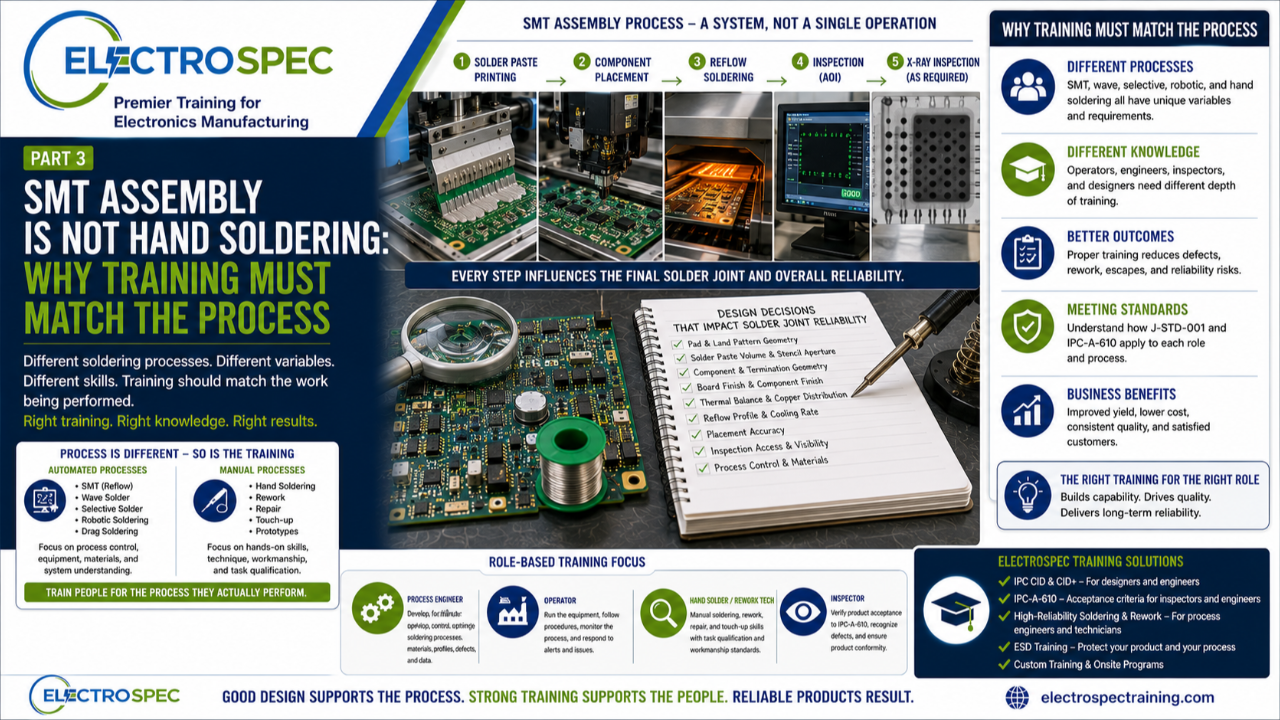
That point is especially important in modern electronics manufacturing because many solder joints are not produced by hand.
They are produced by controlled manufacturing processes.
Surface mount technology, reflow soldering, wave soldering, selective soldering, drag soldering, robotic soldering, and manual soldering all have different process variables.
They also require different training.
A person trained in hand soldering does not automatically understand SMT process control.
A person operating an SMT line does not automatically need the same hands-on soldering demonstration as someone performing manual soldering or rework.
Training must match the actual manufacturing process.
Surface Mount Assembly Is a Process System
Surface mount technology is built around repeatability.
The goal is not for an operator to manually form each solder joint.
The goal is to create a controlled process that consistently forms acceptable solder joints across the entire assembly.
A typical SMT process may include:
- solder paste storage and handling
- stencil setup
- solder paste printing
- paste inspection
- component placement
- reflow soldering
- automated optical inspection
- X-ray inspection where applicable
- cleaning where required
- final inspection and test
Each step affects the final solder joint.
That means SMT reliability depends heavily on design, materials, equipment, process control, and inspection.
Hand Soldering Is a Different Skill Set
Hand soldering is still important.
It may be used for:
- prototypes
- small production runs
- wires
- terminals
- through-hole components
- special assembly operations
- touch-up
- rework
- repair
- engineering changes
- field modifications
But hand soldering is not the same as SMT assembly.
A hand soldering operator controls the soldering iron, solder wire, flux application, heating time, solder volume, and visual workmanship directly.
In SMT assembly, those same outcomes are controlled through a different system:
- land pattern design
- solder paste volume
- stencil aperture
- placement accuracy
- reflow profile
- flux chemistry
- thermal balance
- board finish
- component finish
- process monitoring
Those are not the same training problem.
SMT Operators Need Process Awareness
An SMT operator may not need to know how to manually solder every component on the board.
But they do need to understand the process they are operating.
Useful SMT operator knowledge may include:
- solder paste handling requirements
- stencil cleanliness
- print quality
- component loading
- feeder setup
- placement verification
- polarity and orientation
- reflow profile awareness
- handling requirements
- ESD controls
- process alarms
- basic defect recognition
- when to stop and ask for support
That is different from asking the SMT operator to demonstrate manual soldering skill.
The SMT operator’s role is to help maintain a controlled process, not manually create each solder joint.
Process Engineers Need Deeper SMT Knowledge
For SMT, the process engineer often needs deeper knowledge than the operator.
The process engineer is usually responsible for understanding and controlling the relationship between:
- solder paste chemistry
- solder powder size
- stencil thickness
- aperture design
- area ratio
- transfer efficiency
- placement force
- component coplanarity
- reflow atmosphere
- soak time
- time above liquidus
- peak temperature
- cooling rate
- thermal mass
- board finish
- component finish
- cleaning requirements
- defect trends
This is where many training programs miss the real need.
The operator may need role-specific process awareness.
The inspector may need acceptance criteria knowledge.
But the process engineer needs to understand how the process actually creates the solder joint.
Through-Hole Processes Are Also Different
Through-hole soldering is not one single process either.
A through-hole solder joint may be created by:
- wave soldering
- selective soldering
- drag soldering
- robotic soldering
- manual soldering
Each process has different design and manufacturing needs.
For wave soldering, the designer and process engineer must consider:
- board orientation
- component shadowing
- thermal relief
- hole fill
- lead protrusion
- flux application
- preheat
- conveyor speed
- wave contact time
- drainage
- solder bridging
For selective soldering, they must consider:
- nozzle access
- keep-out areas
- component spacing
- localized heating
- flux targeting
- dwell time
- board support
- repeatability
For manual soldering, the focus shifts to operator technique, tool temperature, dwell time, solder volume, flux, cleaning, and workmanship.
These processes overlap, but they are not identical.
Training Should Follow the Work Being Performed
A common mistake is assigning one generic soldering or standards course to everyone involved in electronics assembly.
That may look simple on a training matrix, but it does not always match the work.
An SMT operator, wave solder operator, hand soldering technician, rework technician, inspector, process engineer, and designer do not need the same training emphasis.
A better approach is role-based training.
For example:
PCB Designer
Needs to understand manufacturability, land patterns, component selection, inspection access, and reliability.
Process Engineer
Needs to understand soldering process development, materials, process variables, defect prevention, and process control.
SMT Operator
Needs equipment-specific and process-specific training to run the line correctly.
Hand Soldering Technician
Needs hands-on soldering skill, tool control, workmanship practice, and task qualification.
Inspector
Needs acceptance criteria knowledge, defect recognition, and product-specific inspection training.
Different roles require different knowledge.
J-STD-001 and IPC-A-610 Serve Different Purposes
J-STD-001 and IPC-A-610 are both important, but they are not the same.
J-STD-001 focuses on requirements for soldered electrical and electronic assemblies, including materials, methods, process controls, and workmanship-related requirements.
IPC-A-610 focuses on acceptability of completed electronic assemblies.
For designers, process engineers, and inspectors, both documents may provide useful context.
But that does not mean every person needs the same training or certification.
A designer may need to understand how design decisions affect the ability to meet soldering and acceptance requirements.
A process engineer may need deeper process knowledge.
An inspector may need strong IPC-A-610 acceptance criteria knowledge.
A hand soldering operator may need task-specific soldering skill.
Training should be matched to the role and process.
Hand Soldering Certification Has a Specific Use Case
Hands-on soldering training can be valuable when employees actually perform manual soldering, rework, repair, touch-up, or special soldering operations.
In those cases, hands-on training and qualification make sense.
But if a person’s job is to run an SMT line, manage solder paste printing, review reflow data, or design land patterns, a hand soldering demonstration may not be the best measure of their actual job competence.
That does not make hand soldering unimportant.
It means the training requirement should match the work being performed.
Designers Must Understand Manufacturing Without Becoming Operators
Designers do not need to become SMT operators, wave solder operators, or hand soldering technicians.
But they should understand enough about each process to avoid designing products that are unnecessarily difficult to manufacture.
Designers should ask:
- Will this board be assembled by SMT, through-hole, or mixed technology?
- Will solder joints be formed by reflow, wave, selective, robotic, or manual soldering?
- Can the intended process access the joint?
- Can the joint be inspected?
- Can the process consistently create the required solder volume?
- Does the layout support thermal balance?
- Is rework possible if needed?
- Will the final product meet acceptance criteria?
Those questions prevent design decisions from becoming production problems.
Inspectors Must Understand the Output
Inspectors are often the people who see the final result.
They may not control stencil design or reflow profiles, but they need to understand what an acceptable product looks like.
For SMT, this may include:
- solder wetting
- component alignment
- end overhang
- side overhang
- solder fillets
- insufficient solder
- solder bridging
- tombstoning
- disturbed joints
- voiding where evaluated
- bottom termination inspection methods
- BGA inspection limitations
- polarity and orientation
- cleanliness and residues
Inspection training should focus on acceptance criteria and product-specific verification.
The inspector’s job is not to run the SMT line.
The inspector’s job is to verify whether the process produced acceptable product.
Final Thought
SMT assembly is not hand soldering.
Wave soldering is not selective soldering.
Selective soldering is not manual soldering.
Each manufacturing process has different variables, risks, controls, and training needs.
The strongest electronics manufacturers do not assign the same training to every role simply because solder is involved.
They train designers to design for the process.
They train process engineers to control the process.
They train operators to run the process.
They train hand soldering technicians to perform manual soldering where required.
They train inspectors to verify the finished product.
That is how training becomes relevant.
That is how manufacturing becomes capable.
Related ElectroSpec Training
ElectroSpec’s IPC CID and CID+ training programs help PCB designers understand how design decisions affect fabrication, assembly, solder joint reliability, inspection, and manufacturability.
ElectroSpec’s High-Reliability Soldering & Rework training helps process engineers, manufacturing teams, and technicians better understand soldering principles, workmanship expectations, and reliability concerns.
ElectroSpec also offers IPC-A-610 certification for personnel who need to understand electronic assembly acceptance criteria.
Coming Next
Through-Hole Design: Wave Solder, Selective Solder, and Process Reality
In the next article, we will examine why through-hole design depends heavily on the intended soldering process and how hole size, lead diameter, annular ring, thermal relief, component spacing, and solder access affect manufacturability and reliability.
Related Reading
- J-STD-001 Is a Process Standard—So Who Really Needs It?
- Why Solder Joint Reliability Starts with Design, Not the Soldering Operator
- Through-Hole Design: Wave Solder, Selective Solder, and Process Reality