
What Is iNARTE EMC Certification? Engineer vs. Technician, and Who Needs It
Jun 29, 2026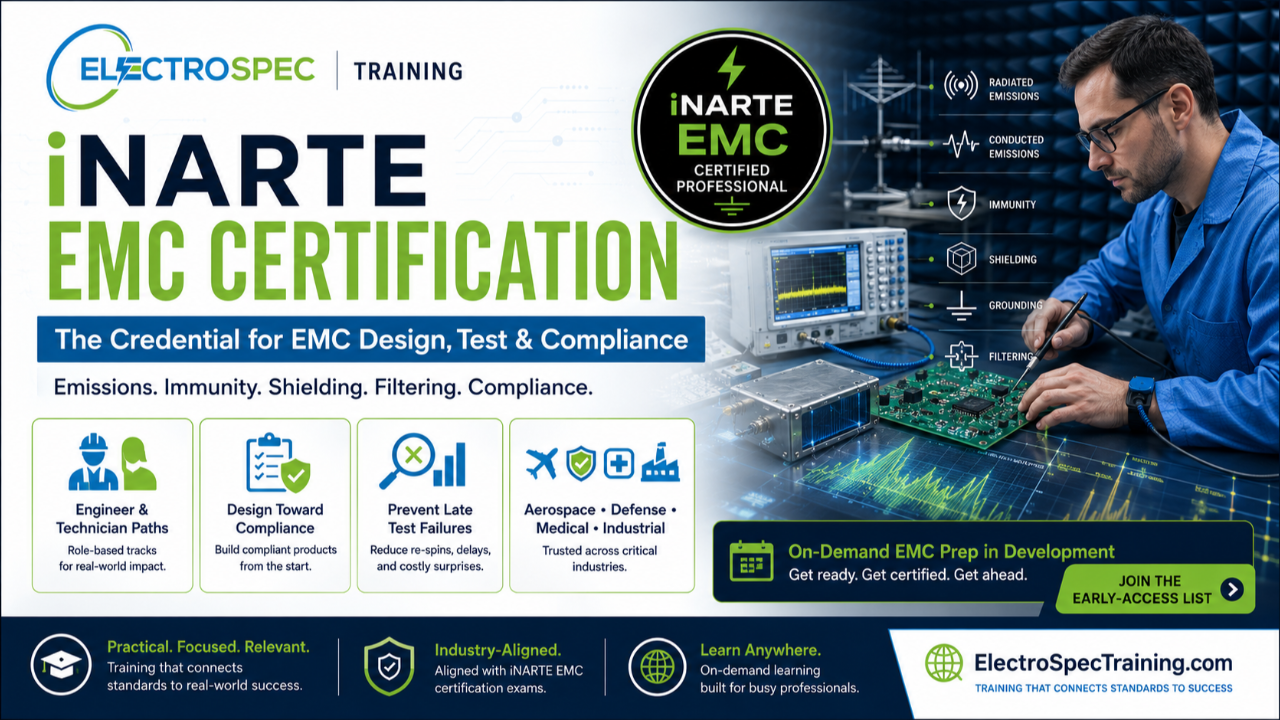
iNARTE ESD certification has become a recognized credential for ESD program leaders. The next certification in the same family is getting far less attention than it should: iNARTE EMC.
If your products have to pass EMC testing — and in aerospace, defense, medical, and most regulated electronics, they do — this is the credential that proves you understand why.
What iNARTE EMC Certification Is
EMC stands for electromagnetic compatibility: the ability of electronic equipment to operate correctly in its intended environment without causing or suffering from electromagnetic interference.
iNARTE EMC certification validates that a professional understands EMC at a working level — emissions, immunity, coupling paths, grounding and shielding, filtering, and the test methods used to demonstrate compliance.
It is a credential built for people who design, test, or troubleshoot electronics that must meet EMC requirements, not just people who have heard the term.
What EMC Testing Actually Involves
EMC requirements split into two halves, and a product has to satisfy both.
- Emissions — how much electromagnetic energy your product releases, measured as both radiated emissions (through the air) and conducted emissions (back onto power and signal lines). Limits exist so your device does not interfere with everything around it.
- Immunity (susceptibility) — how well your product keeps working when energy hits it from outside. This includes radiated immunity, conducted immunity, electrostatic discharge, electrical fast transients, and surge.
A product can be electromagnetically quiet and still fail immunity, or rugged against interference and still fail emissions. EMC competency means understanding both sides and the coupling paths — conducted, radiated, capacitive, and inductive — that connect a source of energy to a victim circuit.
The Standards That Drive EMC Work
EMC is not optional, because compliance is written into the rules for selling and fielding electronics. Which standards apply depends on your market:
- Commercial / consumer: FCC rules in the United States and the EU EMC Directive (CE marking) in Europe, often built on CISPR limits.
- Defense: MIL-STD-461 defines emissions and susceptibility requirements for military equipment.
- Aerospace: RTCA DO-160 covers environmental and EMC qualification for airborne equipment.
An engineer who understands how these frameworks are structured can design toward them from the start, instead of discovering a problem at the test lab.
Engineer vs. Technician
Like the ESD path, iNARTE EMC comes in two levels.
The Engineer level fits professionals with engineering responsibility — design engineers, test engineers, and EMC specialists who need to understand the physics, predict problems, and design for compliance from the start.
The Technician level fits hands-on personnel — test technicians, lab staff, and support engineers who run EMC tests, operate equipment, and need strong applied knowledge of how compliance is demonstrated.
Both prove real EMC competency. The right choice depends on your role and background.
Who Needs It
- Design and test engineers in regulated electronics
- EMC lab technicians and test personnel
- Compliance and certification engineers
- Quality and reliability professionals supporting EMC programs
- Aerospace, defense, medical, automotive, and industrial electronics teams
EMC failures are expensive and late — they often surface at the test lab, after the design is frozen and a re-spin means schedule slip and cost. A team that understands EMC early designs fewer of those failures in.
Why It Matters Now
EMC expertise is scarce, and demand keeps climbing as products get denser, faster, and more wireless. Higher clock speeds, switching power supplies, and densely packed boards all generate more energy in more bands, while shrinking enclosures leave less room for shielding and filtering. A recognized EMC credential signals that you can be trusted with that work.
ElectroSpec is building a focused, on-demand iNARTE EMC preparation path so professionals can earn the credential without travel or extended classroom commitments — the same model that made our iNARTE ESD program work.
Frequently Asked Questions
Is EMC the same as EMI?
No. EMI (electromagnetic interference) is the disturbance; EMC is the goal of operating correctly without causing or being disrupted by it. EMC is what you are trying to achieve, and controlling EMI is how you get there.
Do I need an EMC lab to benefit from the certification?
No. The credential validates understanding of EMC principles and test methods. That knowledge helps designers prevent problems and helps technicians run and interpret tests, whether the lab is in-house or external.
How is EMC certification different from ESD certification?
They are related but distinct. ESD focuses on protecting sensitive devices from electrostatic discharge; EMC covers the broader question of emissions and immunity across the electromagnetic spectrum. Many high-reliability professionals pursue both.
When will ElectroSpec’s EMC preparation be available?
It is in development now. Joining the early-access list is the best way to be notified the moment it opens.
Final Thought
EMC is not optional in modern electronics. The professionals who understand it are the ones who keep programs on schedule and out of compliance trouble.
If you want to be first in line when our iNARTE EMC preparation launches, join the early-access list.
Join the iNARTE EMC Early-Access List — ElectroSpec