
What Is IPC Certification and Who Needs It?
Sep 27, 2026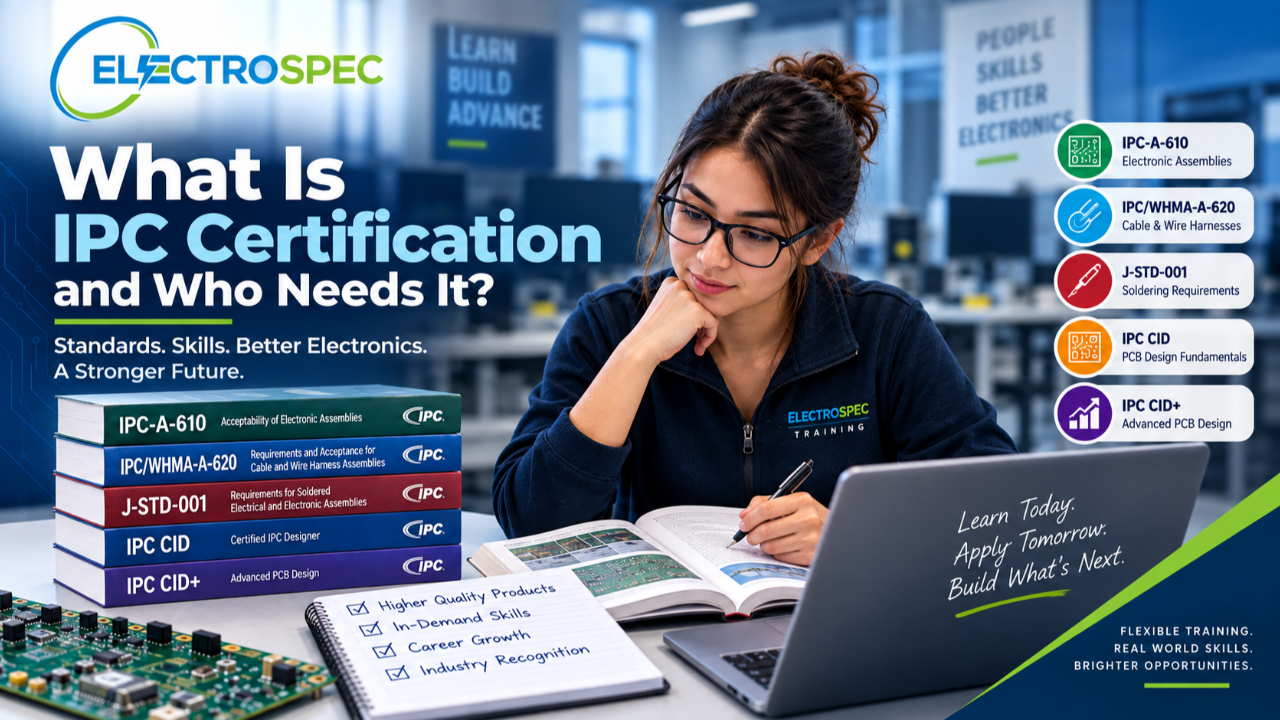
IPC certification is one of the most recognized training and credentialing pathways in electronics manufacturing and printed circuit board design.
Students often search for IPC certification because an employer, customer, auditor, job posting, quality requirement, or career goal points them toward it.
But many students are not completely sure what IPC certification means, which certification they need, whether it applies to their job, or how to prepare for the exam.
That is normal.
IPC certification can apply to many different roles, including operators, inspectors, trainers, engineers, quality personnel, auditors, and PCB designers.
The key is choosing the right certification for the role.
IPC Certification Provides Standards-Based Knowledge
IPC certification is built around industry standards used in electronics design and manufacturing.
These standards help create a common language for requirements, workmanship, acceptability, inspection, documentation, and product quality.
Depending on the certification, students may study topics related to electronic assembly acceptability, cable and wire harness acceptability, soldered electrical and electronic assemblies, printed board design, advanced PCB design, inspection criteria, manufacturing requirements, documentation, product class expectations, quality, and reliability.
The goal is not simply to memorize terms.
The goal is to understand how standards are used in real electronics manufacturing and design environments.
Who Needs IPC Certification?
IPC certification may be useful for many different people.
Operators may need certification when they perform work tied to standards-based requirements.
Inspectors may need certification when they evaluate product acceptability.
Quality personnel may need certification when they support audits, process control, customer requirements, or product acceptance.
Engineers may need certification to better understand how design and manufacturing decisions connect to standards.
Trainers may need certification when they are responsible for training or certifying other personnel.
PCB designers may need CID or CID+ certification preparation when they want to build stronger design knowledge and demonstrate professional growth in printed board design.
The right certification depends on what the person does.
Common IPC Certification Paths
IPC-A-610 is commonly associated with acceptability of electronic assemblies. It is often useful for inspectors, quality personnel, production personnel, process engineers, manufacturing engineers, and anyone who needs to understand how completed electronic assemblies are evaluated.
IPC/WHMA-A-620 is commonly associated with cable and wire harness assemblies. It is useful for people working with wire preparation, crimps, soldered terminations, connectors, cable assemblies, harnesses, inspection, and quality acceptance.
CID certification is focused on printed circuit board design. It is valuable for PCB designers, electrical engineers, manufacturing engineers, quality engineers, and technical professionals who need to understand PCB design fundamentals.
CID+ is the advanced PCB design certification path. It supports students who want to move deeper into advanced design topics such as fabrication and assembly, materials, rigid PCB design, flexible PCB design, HDI, RF/microwave, and environmental stress screening.
CIS and CIT Are Not the Same
Students often ask about the difference between CIS and CIT.
In simple terms, CIS certification is generally intended for people who need standards-based knowledge for their own work.
CIT certification is generally intended for trainers or instructors who need to teach and certify others within the scope of the certification program.
That distinction matters.
A production operator may need CIS.
An inspector may need CIS.
A company trainer may need CIT.
A quality or engineering leader may choose either depending on job responsibility.
Students should always match the certification level to the role they are expected to perform.
Certification Should Match the Job
Not every person in an electronics company needs the same IPC certification.
A soldering operator may need one type of training.
A final inspector may need another.
A cable harness builder may need IPC/WHMA-A-620.
A PCB designer may need CID or CID+.
A company instructor may need CIT.
A quality manager may need enough standards knowledge to support audits, customer requirements, and product acceptance.
The best certification choice starts with the question:
What does this person need to do with the standard?
IPC Certification Is Not the Same as Company Training
IPC certification can provide valuable standards-based knowledge, but it does not replace company-specific training.
Companies still need to train employees on internal procedures, equipment, work instructions, customer requirements, product-specific criteria, safety rules, quality systems, and process controls.
For example, an IPC-A-610 certification may help a student understand assembly acceptability criteria, but the company still needs to train that person on internal inspection procedures, product documentation, tools, reporting systems, and customer-specific flow-downs.
IPC certification and company training work best together.
Online and On-Demand Training Can Help Busy Students
Many students are working full-time while trying to complete certification training.
That can make traditional classroom scheduling difficult.
ElectroSpec provides flexible, on-demand training options designed for busy students, working professionals, and companies that need practical certification preparation without unnecessary travel or rigid classroom scheduling.
With online and self-paced training options, students can study around work schedules, revisit lessons, review difficult topics, and prepare for certification with a more flexible learning path.
Final Thought
IPC certification can be valuable for operators, inspectors, trainers, designers, engineers, quality personnel, and technical managers.
But the right certification depends on the role.
The best path begins with a simple question:
What do you need to do with the standard?
Once that answer is clear, training becomes more focused, more useful, and more valuable.
Coming Next
CIS vs. CIT Certification: What Is the Difference?
In the next article, we will explain the difference between CIS and CIT certification, who each path is intended for, and how students and employers should decide which certification level fits the job.
Related Reading
Continue Your Certification Path with ElectroSpec
- IPC CID Certification — ElectroSpec
- IPC CID+ Certification — ElectroSpec
- IPC CID/CID+ Bundle — Complete PCB Design Certification — ElectroSpec
- IPC-A-610 Certification & Training Course | ElectroSpec Training
- IPC/WHMA-A-620 Certification & Training Course | ElectroSpec Training
- IPC-A-600 CIS Certification — ElectroSpec