
ESD Control Plans: Turning Requirements into a Working Program
Oct 20, 2026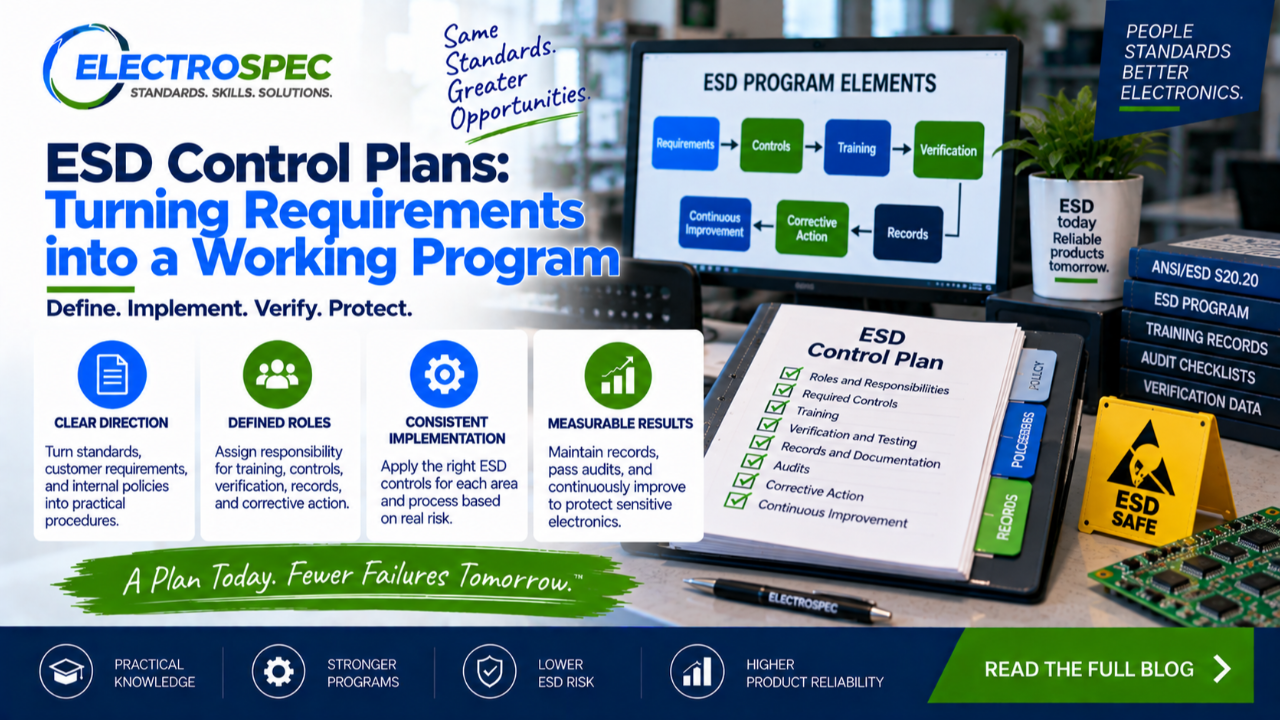
An ESD Control Plan is the central document that explains how an organization controls ESD risk.
It turns standards, customer requirements, and company procedures into a practical operating system.
Without a clear control plan, an ESD program can become inconsistent.
One department may follow one practice.
Another may follow something different.
A good ESD Control Plan creates alignment.
The Control Plan Defines the Program
An ESD Control Plan should describe what the program applies to, who is responsible, what controls are used, how those controls are verified, and what records must be maintained.
It should address the actual work being performed.
A repair bench, SMT line, kitting area, test station, receiving area, and packaging area may have different risks.
The control plan should account for those differences.
Roles and Responsibilities
An ESD program needs clear ownership.
The control plan should define responsibilities for program management, training, compliance verification, corrective action, audits, and daily use of controls.
Operators may be responsible for following procedures.
Technicians may be responsible for checks.
Quality may be responsible for records and audits.
Engineering may be responsible for technical decisions.
Management may be responsible for resources and enforcement.
When roles are unclear, the program weakens.
Required Controls
The control plan should identify the ESD controls used by the organization.
These may include personnel grounding, worksurfaces, floors, footwear, ionization, packaging, tools, carts, garments, equipment grounding, and protected area boundaries.
Each control should have a reason.
The plan should not be a random list of items.
It should explain how the selected controls protect the product.
Training Requirements
Training is part of program control.
Employees must understand what they are expected to do and why it matters.
The control plan should define who needs training, what training is required, how often training occurs, and how records are maintained.
Different roles may require different levels of training.
A production operator, ESD technician, quality auditor, and program manager may not need the same depth.
Verification and Records
An ESD program must be verified.
The control plan should describe test methods, verification frequency, acceptance limits, recordkeeping, and actions for failed checks.
Records prove that the program is being maintained.
They also support audits, customer reviews, and corrective action.
If a wrist strap tester fails, the program should define what happens next.
If a floor measurement is outside limits, the program should define containment and correction.
ElectroSpec’s Training Connection
ElectroSpec’s iNARTE ESD training helps students understand the ESD Control Plan as a living program document.
Students learn how controls, training, verification, records, packaging, and audits fit together.
This is especially important for ESD coordinators, engineers, technicians, quality personnel, and manufacturing leaders responsible for keeping the program effective.
Final Thought
An ESD Control Plan is not paperwork for paperwork’s sake.
It is the operating manual for the ESD program.
It defines the controls, responsibilities, verification methods, training, records, and corrective actions that protect sensitive electronics.
A strong plan makes the program consistent.
A weak plan leaves too much to interpretation.
Coming Next
Qualification and Compliance Verification: Proving the ESD Program Works
In the next article, we will explain how audits, compliance checks, verification records, and objective evidence prove that an ESD program is functioning as intended.