
ESD Models: HBM, CDM, MM, and Real-World Discharge Risk
Oct 16, 2026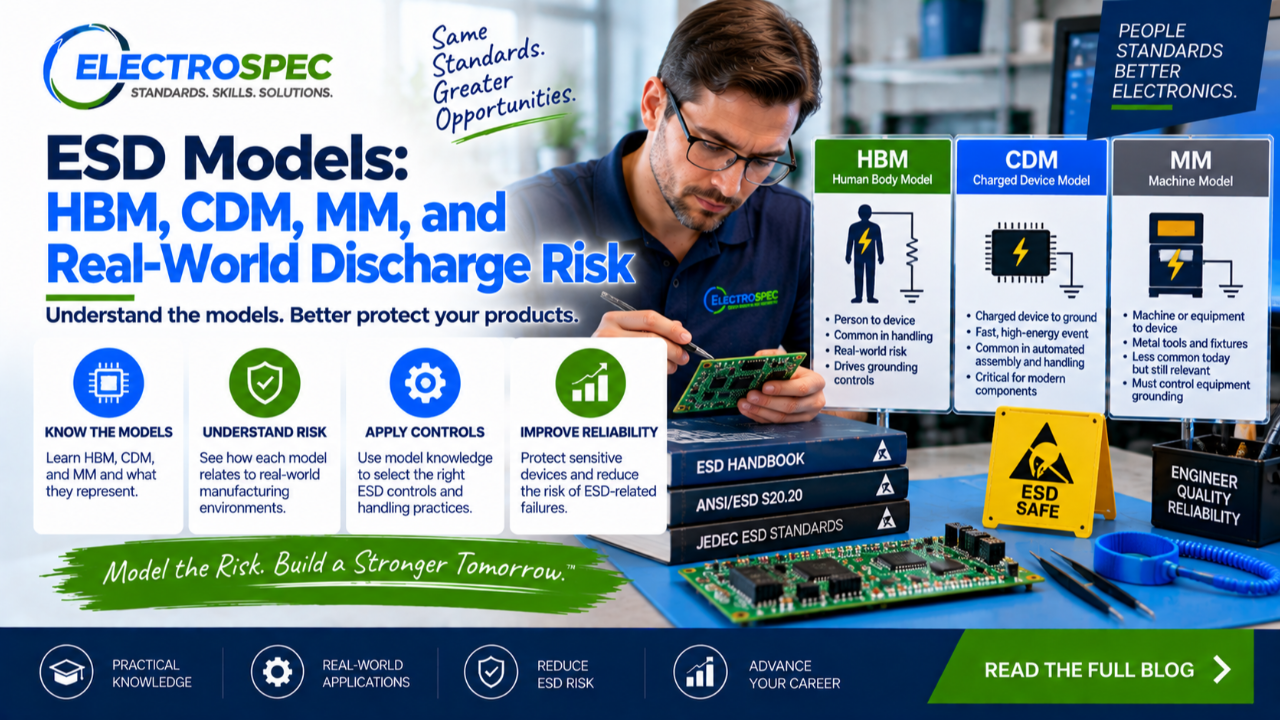
ESD models help engineers understand how sensitive devices may be damaged by different types of electrostatic discharge.
They are not perfect representations of every real-world event, but they provide a structured way to evaluate risk.
Students preparing for iNARTE ESD certification should understand why models exist and how they support device classification, handling controls, and program design.
Human Body Model
The Human Body Model, or HBM, represents discharge from a charged person into a device.
This is one of the most familiar ESD risks because people can generate charge through normal movement, clothing, footwear, seating, packaging, and workstation activity.
HBM helps explain why personnel grounding is so important.
Wrist straps, footwear, flooring, garments, and handling procedures all help control human-generated ESD risk.
Charged Device Model
The Charged Device Model, or CDM, represents a device that becomes charged and then discharges when it contacts another object.
CDM is especially important in automated manufacturing, component handling, placement, test, trays, feeders, and equipment interfaces.
In some modern electronics environments, CDM can be a major concern because devices can charge and discharge very quickly.
A person may be properly grounded, but the component itself can still become charged through handling or process movement.
Machine Model
Machine Model, or MM, represents discharge from a charged machine or conductive object into a device.
While MM is less emphasized in many modern device qualification discussions than HBM or CDM, the concept remains useful for understanding equipment-related discharge risk.
Machines, fixtures, metal tools, carts, and automated handling equipment must be controlled so they do not become sources of damaging discharge.
Why Models Matter
ESD models help answer practical questions.
- How sensitive is the device?
- What type of discharge risk is most likely?
- Which controls are most important?
- How should the product be handled?
- What should the ESD protected area be designed to prevent?
Without models, ESD risk becomes vague.
With models, engineers can think more clearly about how damage may occur.
Models Are Not the Whole Program
A model is a tool, not the entire ESD program.
Real manufacturing environments include people, tools, packaging, workstations, carts, floors, automated equipment, insulators, humidity variation, and process movement.
A strong ESD professional understands the models but also evaluates the real process.
The question is not only, “What model applies?”
The better question is, “What discharge paths can occur in this actual environment?”
Device Sensitivity Drives Controls
Highly sensitive devices require stronger discipline.
If a component is sensitive to low-voltage discharge events, the ESD program must control personnel, equipment, packaging, and process conditions more carefully.
Device sensitivity should influence handling procedures, packaging selection, work-area controls, and verification frequency.
The more sensitive the product, the less room there is for casual handling.
ElectroSpec’s Training Connection
ElectroSpec’s iNARTE ESD training helps students connect ESD models to practical program control.
The course supports both technician-level understanding and engineer-level judgment by explaining how models relate to real electronics manufacturing risk.
Students can use the on-demand format to revisit difficult concepts and build confidence before certification testing.
Final Thought
ESD models are important because they organize risk.
HBM helps explain personnel discharge.
CDM helps explain charged-device discharge.
MM helps explain equipment or machine-related discharge.
But real protection requires more than knowing the model names.
Students must understand how each model relates to actual handling, process flow, device sensitivity, and program controls.
Coming Next
ESD Standards: Why ANSI/ESD S20.20 and Other Requirements Matter
In the next article, we will explain why ESD standards create a common framework for program control, audits, compliance, and customer confidence.