
ESD Fundamentals: What Every Electronics Professional Should Understand
Oct 13, 2026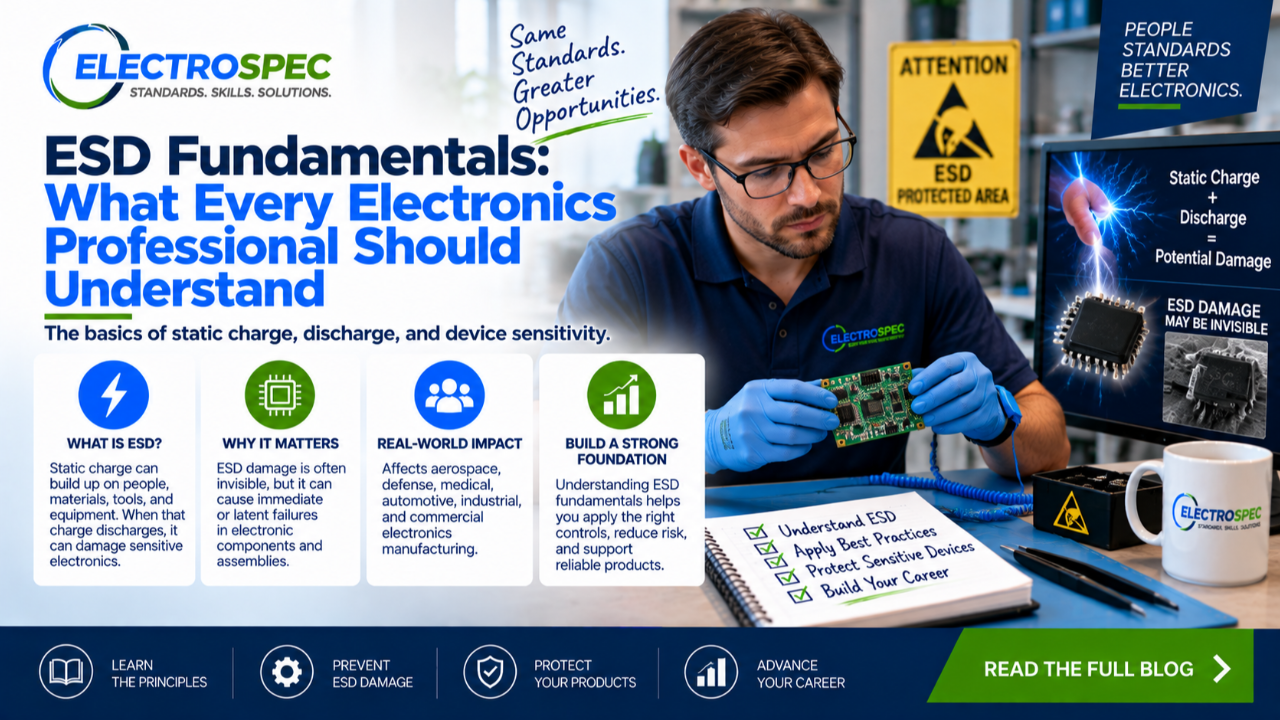
ESD begins with a simple idea:
Electrical charge can build up on people, tools, materials, packaging, furniture, or equipment.
When that charge suddenly moves from one object to another, an electrostatic discharge can occur.
In everyday life, ESD may feel like a small shock after walking across carpet.
In electronics manufacturing, that same type of event can damage sensitive components.
Static Charge Is Common
Static charge is created when materials contact and separate.
This can happen when a person walks, removes a garment, slides a tray, peels tape, handles packaging, or moves a component across a surface.
The amount of charge generated depends on the materials involved, humidity, contact area, separation speed, and the electrical properties of the surfaces.
Some materials hold charge easily.
Others allow charge to drain away.
Understanding the difference is one of the foundations of ESD control.
ESD Damage May Be Invisible
One of the most dangerous assumptions in electronics manufacturing is that ESD damage must be visible.
It often is not.
An ESD event may damage a device internally without leaving external marks.
The product may still pass initial test, but the component may be weakened.
That weakness can show up later as intermittent behavior, reduced margin, early-life failure, or unexplained field return.
This is why ESD control cannot depend on visual inspection alone.
Sensitive Devices Need Protection
Modern electronic devices can be highly sensitive to ESD.
Integrated circuits, microprocessors, memory devices, sensors, RF components, and many other parts may be damaged by discharge levels that humans cannot even feel.
A person may create a damaging discharge without any sensation of a shock.
This is why ESD control programs focus on prevention, not reaction.
The absence of a visible spark does not mean the product is safe.
ESD Risk Depends on the Environment
ESD risk is affected by the work environment.
Low humidity can increase charge generation.
Insulative materials can hold charge.
Improper packaging can expose sensitive devices.
Ungrounded tools or fixtures can create discharge paths.
Workstations, floors, garments, carts, chairs, and equipment all influence risk.
A strong ESD professional learns to look at the whole environment, not only the operator.
Basic Controls Reduce Risk
Common ESD controls include wrist straps, footwear, flooring, grounded worksurfaces, common point grounds, dissipative materials, ionization, shielding packaging, and controlled handling procedures.
But these controls only work when properly selected, used, maintained, and verified.
A wrist strap that is worn incorrectly does not provide reliable protection.
A bench mat that is not connected to ground does not perform as intended.
Packaging that looks “ESD safe” may not provide shielding unless it is the correct type.
ESD Training Builds Judgment
The purpose of ESD training is not only to tell people what to do.
It is to help them understand why the controls matter.
When students understand static charge, discharge paths, device sensitivity, and hidden damage, they are more likely to follow procedures correctly.
They are also better prepared to identify risky conditions before damage occurs.
ElectroSpec’s Flexible ESD Training
ElectroSpec provides online and on-demand iNARTE ESD training to help students build practical understanding around real manufacturing needs.
Students can study at their own pace, revisit difficult topics, and prepare for certification while balancing work schedules.
This flexibility is useful for engineers, technicians, quality personnel, manufacturing personnel, and ESD coordinators who need more than basic awareness.
Final Thought
ESD fundamentals are the foundation of every effective ESD control program.
If students do not understand charge generation, discharge behavior, device sensitivity, and invisible damage, the rest of the program becomes a checklist without meaning.
Strong ESD control starts with understanding the physics.
Once that foundation is clear, students can better understand materials, grounding, packaging, verification, and program management.
Coming Next
Conductive, Dissipative, and Insulative Materials in ESD Control
In the next article, we will explain how different materials behave in an ESD program and why material selection affects benches, floors, tools, packaging, garments, and handling.