
ESD Safety for Aerospace, Defense, Ordnance, and High-Reliability Electronics
Oct 26, 2026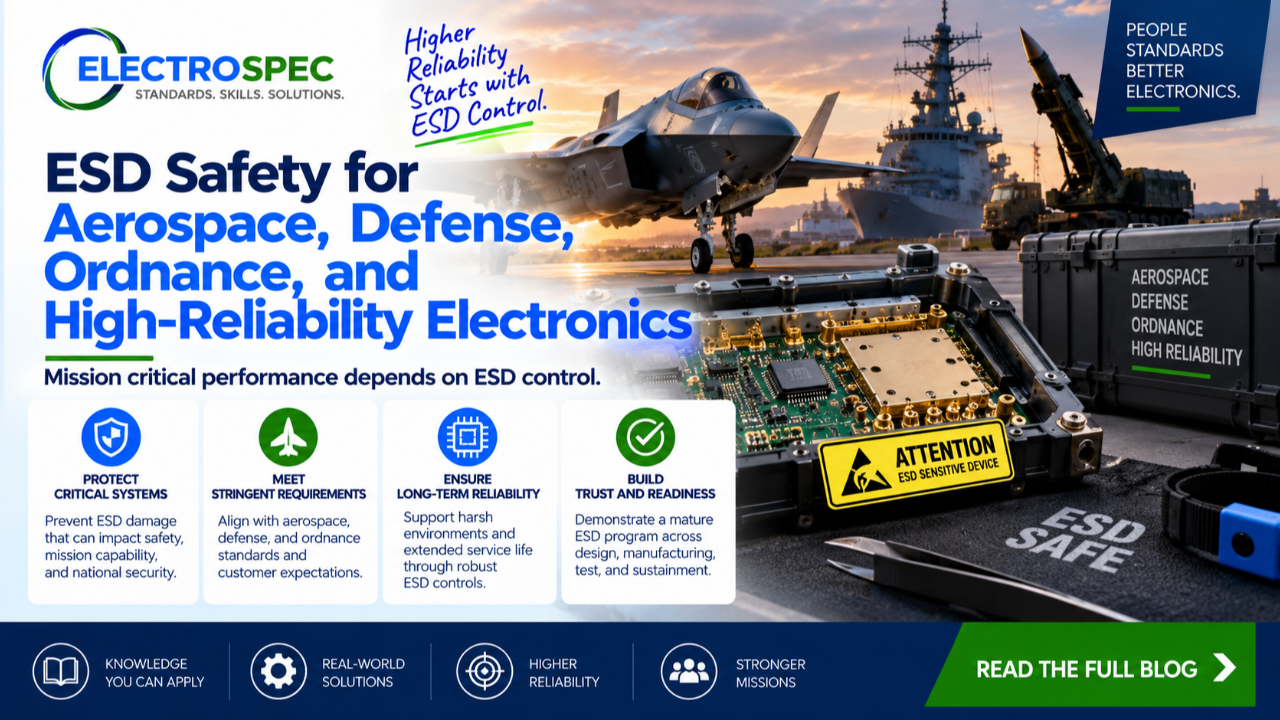
Some products carry higher consequences than others.
An ESD event in a low-risk consumer product may create cost, inconvenience, or warranty concern.
An ESD event in aerospace, defense, medical, ordnance, industrial safety, or mission-critical electronics can create much more serious consequences.
That is why high-reliability environments require disciplined ESD control.
Consequence Drives Discipline
The level of ESD control should reflect product risk.
When failure could affect mission success, safety, medical function, defense readiness, transportation systems, or critical infrastructure, casual ESD practices are not acceptable.
These environments often require stronger documentation, stricter handling, better traceability, more frequent verification, and tighter process control.
The goal is not only to prevent immediate failure.
The goal is to reduce latent damage that may appear later.
ESD and Latent Risk
Latent damage is especially concerning in high-reliability electronics.
A component may pass initial inspection and test, but ESD damage can weaken it.
That weakness may become a failure during thermal cycling, vibration, humidity exposure, power cycling, or field use.
For mission-critical products, a failure that appears months later may be far more serious than a failure found during manufacturing.
This is why prevention matters.
Specialty Environments Require Qualified Personnel
Areas involving ordnance, ammunition, explosives, or other high-consequence materials require strict adherence to approved procedures and qualified personnel.
ESD control in these environments should never be improvised.
The purpose of training is to understand risk, program discipline, verification, and the importance of following controlled procedures.
Safety, authority, and approved process control come first.
Aerospace and Defense Electronics
Aerospace and defense electronics often face vibration, shock, temperature extremes, humidity, altitude, long storage life, and limited repair access.
ESD-related weakness may combine with these stresses to create field failures.
A strong ESD program helps protect sensitive components during fabrication, assembly, test, storage, transport, and installation.
For these industries, ESD control is part of the broader reliability system.
Medical and Industrial Applications
Medical and industrial products may also require strong ESD control.
A medical device may need long-term reliability and predictable performance.
Industrial controls may operate in harsh environments with limited downtime tolerance.
ESD-sensitive components in these systems must be protected throughout manufacturing and service.
A weak ESD program can undermine product reliability even if the design itself is sound.
Documentation and Evidence Matter
High-reliability customers often expect objective evidence.
Training records, compliance verification, audit results, packaging controls, material traceability, equipment checks, and corrective action records may all be reviewed.
Documentation helps prove that the program was not just described, but actually followed.
In high-reliability work, records are part of product confidence.
ElectroSpec’s Training Connection
ElectroSpec’s iNARTE ESD training helps students understand ESD control from a technical and program-management perspective.
That knowledge is valuable for companies supporting aerospace, defense, medical, industrial, and other high-reliability applications.
Students learn why ESD controls must be selected, documented, verified, and maintained as part of a complete product protection system.
Final Thought
High-reliability electronics demand more than casual ESD awareness.
They require disciplined controls, trained personnel, objective evidence, and a system-level understanding of risk.
When product consequences are high, ESD control must be treated as a serious technical program.
The cost of prevention is small compared with the cost of failure.
Coming Next
ESD Control Is a Program, Not a Wrist Strap
In the final article of this series, we will bring the full ESD certification path together and explain why successful ESD control depends on knowledge, discipline, verification, and program ownership.