
How to Become an IPC CIT: Requirements, Process, and What the Certification Actually Gets You
May 19, 2026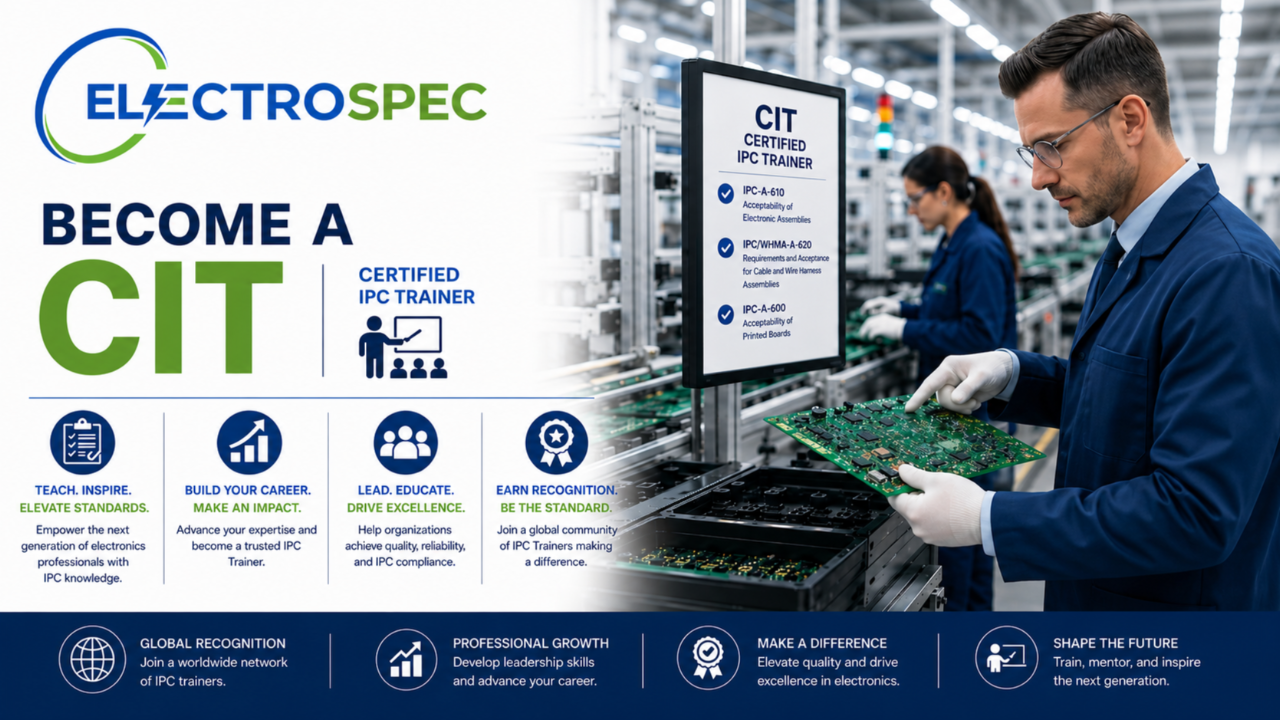
CIT stands for Certified IPC Trainer. It is the certification that qualifies you to train and administer the CIS exam to individuals. If you are the person at your company who runs the inspection certification program, or if you want to become that person, CIT is the path. This article covers the full picture: what CIT authorizes you to do, the prerequisites and process, what the qualification looks like, and how CIT certification changes your role in an organization.

What a CIT Is Actually Qualified to Do
A Certified IPC Trainer is authorized to:
- Teach the IPC standard they are certified in to other personnel at their organization or through a licensed program
- Administer the CIS (Certified IPC Specialist) exam to candidates
- Issue CIS certifications to candidates who pass, through the authorized licensing structure
- Run in-house IPC certification programs, including initial certification and recertification
A CIT is NOT authorized to certify other CITs. That function belongs to Master IPC Trainers (MITs) at the licensed training center level. A CIT's scope is CIS certification, producing qualified inspectors and specialists, not other trainers.
What CIT is not: CIT is not a promotion or advancement of CIS. It is a different certification for a different function. A CIS certifies that you can apply the standard. A CIT certifies that you can teach someone else to apply it. The skills overlap but are not the same. Many excellent inspectors are not good teachers, and vice versa.
The Business Case for Having an In-House CIT
Here is the math that drives most CIT enrollments: companies with more than 8-10 inspectors who need to certify and recertify annually find that an in-house CIT pays for itself quickly.
If your company sends 15 inspectors to an outside provider for CIS certification each year at $1,000 per person, that is $15,000 annually before travel and lost production time. An in-house CIT who can certify all 15 of them eliminates that spend. The one-time CIT certification cost (under $2,000 at ElectroSpec) plus the time involved in running the program costs far less in year one and in subsequent years. For larger manufacturers, defense contractors, and contract manufacturers with high inspection headcount, the ROI calculation is straightforward. The CIT certification is often the most economically rational investment in an IPC certification program.
The break-even point: Most organizations with 8 or more inspectors who certify on any regular cycle break even on a CIT investment within the first year. If you are certifying 10+ people annually, the in-house CIT path almost always wins on total cost.
CIT Prerequisites: What You Need Before You Start
IPC does not define a formal teaching experience requirement, but a successful CIT will have instructional ability in addition to standards knowledge. CIT candidates who have never facilitated adult learning before sometimes find the instructional aspects more challenging than the technical content itself. If you have experience training new hires, leading technical meetings, or running procedure walkthroughs, that background translates directly. If formal instruction is entirely new territory, some preparation for teaching is worthwhile.
ElectroSpec's CIT Certification Process
Step 1: Complete CIT exam preparation
The CIT program at ElectroSpec includes a proprietary exam preparation course designed to get you ready for both the open book and closed book exams. It includes hundreds of practice questions designed to test your knowledge and identify any gaps before you take the official IPC CIT exams.
Step 2: Complete the official IPC CIT exams
After you complete the CIT exam preparation course, ElectroSpec will schedule your exams to whatever date, time, and time zone you prefer. You can take your exam remotely anywhere in the world using the IPC Remote Proctor system. An 80% or better is required to pass the open book and closed book exams. ElectroSpec gives you the maximum time allowable of 8 hours to complete each exam and includes a free retake of each exam if you do not pass on your initial attempt.
Step 3: Receive your CIT certification
Upon successful completion of your open book and closed book exams, your CIT certification is issued through IPC Edge. You will obtain serialized, downloadable certificate valid for 2 years. At this point, you can immediately view the CIS training materials, purchase exam credits, and schedule exams for CIS students.
CIT vs. CSE: Which One Does Your Role Actually Need?
CIT and CSE are both advanced certifications beyond CIS, but they serve very different functions:
- CIT is for the person running the certification program - the instructor who certifies inspectors and manages certification records.
- CSE (Certified Standards Expert) is for engineers and quality managers who interpret and apply the standard at a technical level, resolving compliance questions, writing product specifications, and supporting customer audits.
If you manage the IPC certification program for your company, you want CIT. If you make engineering decisions that reference the standard, you want CSE. If you do both, holding both is not uncommon.
Maintaining Your CIT Certification
CIT recertification follows the same two-year cycle as CIS. ElectroSpec's remote recertification process successfully certifies candidates with no class schedule required.
A practical note: Set a calendar reminder 6 months before your CIT expiration date. If your CIT lapses, your CIT eligibility lapses with it for 90 days, meaning you will be unable to certify students as a CIS during this timeframe.
Frequently Asked Questions
How long does it take to become a CIT?
The timeline depends on your current certification status and study schedule. If you hold an active CIT, most candidates complete the CIT exam only for recertification. ElectroSpec can schedule these exams as soon as 1 business day after purchasing the exam only. If you require some time to study and review the standard, then plan for up to 1 week using ElectroSpec's exam preparation system.
Can a CIT certify inspectors for multiple IPC standards?
No. A CIT certification is standard-specific. An IPC-A-610 CIT can certify IPC-A-610 CIS candidates. To certify IPC/WHMA-A-620 CIS candidates, you need IPC/WHMA-A-620 CIT, which is a separate certification. Some professionals hold CIT in two or more standards; ElectroSpec supports both IPC-A-610 and IPC/WHMA-A-620 CIT certifications.
Can a CIT certify people at other companies, not just their own?
Yes. A CIT can certify CIS candidates irregardless of which company they work for. Contact ElectroSpec for details on the scope of CIT authorization and how to expand it if you need to certify people outside your direct organization.
What happens to my CIS certifications if my CIT lapses?
CIS certifications issued by a CIT during the period when the CIT was active remain valid. The expiration of the CIT does not retroactively invalidate the CIS certifications they issued. However, a lapsed CIT cannot issue new CIS certifications or administer new CIS exams until they successfully recertify.
Does CIT certification require any ongoing continuing education?
No. The formal requirement is recertification every two years through a passing recertification exams. IPC does not currently mandate structured continuing education between recertification cycles, though CITs are expected to stay current with standard revisions that affect the certification program they run.
Related Reading
Ready to Become a CIT?
ElectroSpec offers fully remote CIT certification programs with flexible scheduling and free exam retakes included. Learn more about our IPC-A-610 and IPC/WHMA-A-620 CIT certification options.