
How to Study for an IPC Certification Exam
Oct 01, 2026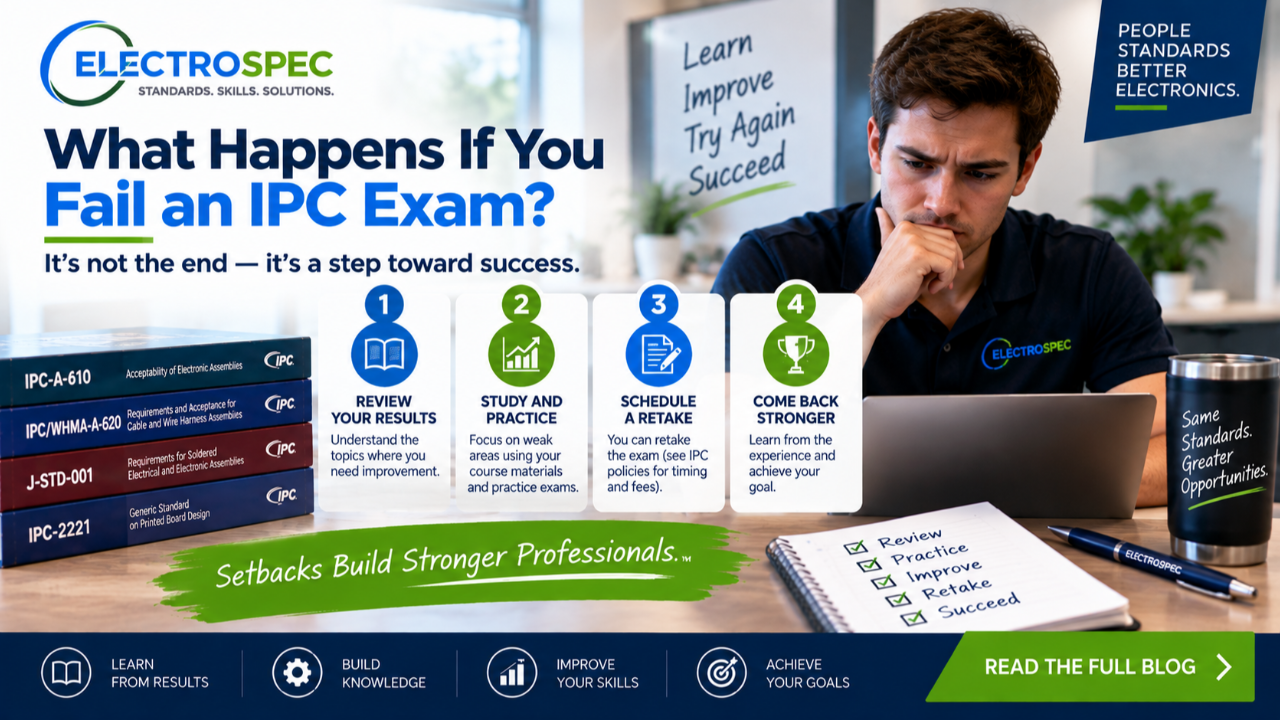
Studying for IPC certification is not just about reading pages.
It is about learning how the standard is organized, how requirements are written, and how to apply information correctly.
Many students can improve their results by changing how they study.
The goal is not to memorize every sentence.
The goal is to understand the structure, language, and logic of the standard.
Start with the Course Structure
Before diving into details, understand the course structure.
- Which certification are you taking?
- Which modules are required?
- Are there optional modules?
- Are you taking CIS, CIT, CID, or CID+?
- Is the exam online, remote proctored, or in person?
Knowing the structure helps you plan your study time.
Learn the Standard’s Organization
One of the most important study skills is navigation.
Students should learn where major topics are located and how the standard is organized.
Look for:
- scope
- definitions
- general requirements
- product classes
- figures
- tables
- notes
- exceptions
- appendices
- inspection criteria
- process requirements
When students know where information lives, they can find answers more efficiently.
Understand the Language of Requirements
Standards use careful language.
Students should pay attention to words such as shall, should, acceptable, defect, requirement, class, evidence, inspection, and criteria.
Small wording differences matter.
A student who reads too quickly may miss the key word that changes the answer.
Slow, careful reading is one of the best exam strategies.
Study the Why, Not Only the What
Students should ask why a requirement exists.
- What risk is it controlling?
- What problem does it prevent?
- How does it affect product quality?
- How does it relate to inspection, manufacturing, design, or reliability?
When students understand the reason behind a requirement, they are more likely to apply it correctly.
Use Practice Questions Properly
Practice questions are useful, but they should not become memorization drills only.
After each question, ask:
- Why is this answer correct?
- Where is the requirement found?
- What section supports it?
- What did I misunderstand?
- Could I find the answer again?
This approach builds skill instead of short-term memory.
Create a Study Rhythm
Many students do better with shorter, repeated study sessions than one long cram session.
On-demand training can help because students can pause, replay, and revisit difficult topics.
A good study rhythm may include watching a lesson, reviewing the standard, answering practice questions, reviewing missed questions, and returning to weak sections.
Consistency matters.
Prepare for the Testing Process
Do not wait until test day to understand the testing process.
Students should know:
- where to log in
- what browser or software is required
- whether remote proctoring applies
- what materials are allowed
- what time zone is used
- what identification is required
- what happens after submission
- how certificates are downloaded
- what happens if a retake is needed
A student who understands the process can focus on the exam.
Avoid Common Study Mistakes
Common mistakes include:
- waiting until the last minute
- relying only on work experience
- memorizing answers without understanding
- ignoring definitions
- skipping tables and figures
- not practicing standard navigation
- assuming all exams work the same
- ignoring technology setup for online testing
Avoiding these mistakes improves confidence.
ElectroSpec’s Flexible Training Helps
ElectroSpec provides online and on-demand training options that help students study around work schedules.
Students can revisit lessons, review difficult topics, and prepare at a pace that fits their needs.
That flexibility is especially useful for working professionals, companies with multiple shifts, and students who need more time with technical material.
Final Thought
The best way to study for IPC certification is to learn how to use the standard.
Know the structure.
Understand the language.
Practice carefully.
Prepare for the testing process.
Ask better questions.
Certification is not only about passing an exam.
It is about becoming more confident using standards in real electronics work.
Coming Next
What Happens If You Fail an IPC Exam?
In the next article, we will explain retakes, cool-down periods, failed portions, 90-day timing, and how students should recover if they do not pass the first time.
Related Reading
Continue Your Certification Path with ElectroSpec
- IPC CID Certification — ElectroSpec
- IPC CID+ Certification — ElectroSpec
- IPC CID/CID+ Bundle — Complete PCB Design Certification — ElectroSpec
- IPC-A-610 Certification & Training Course | ElectroSpec Training
- IPC/WHMA-A-620 Certification & Training Course | ElectroSpec Training
- IPC-A-600 CIS Certification — ElectroSpec