Are IPC Certification Exams Open Book?
Sep 30, 2026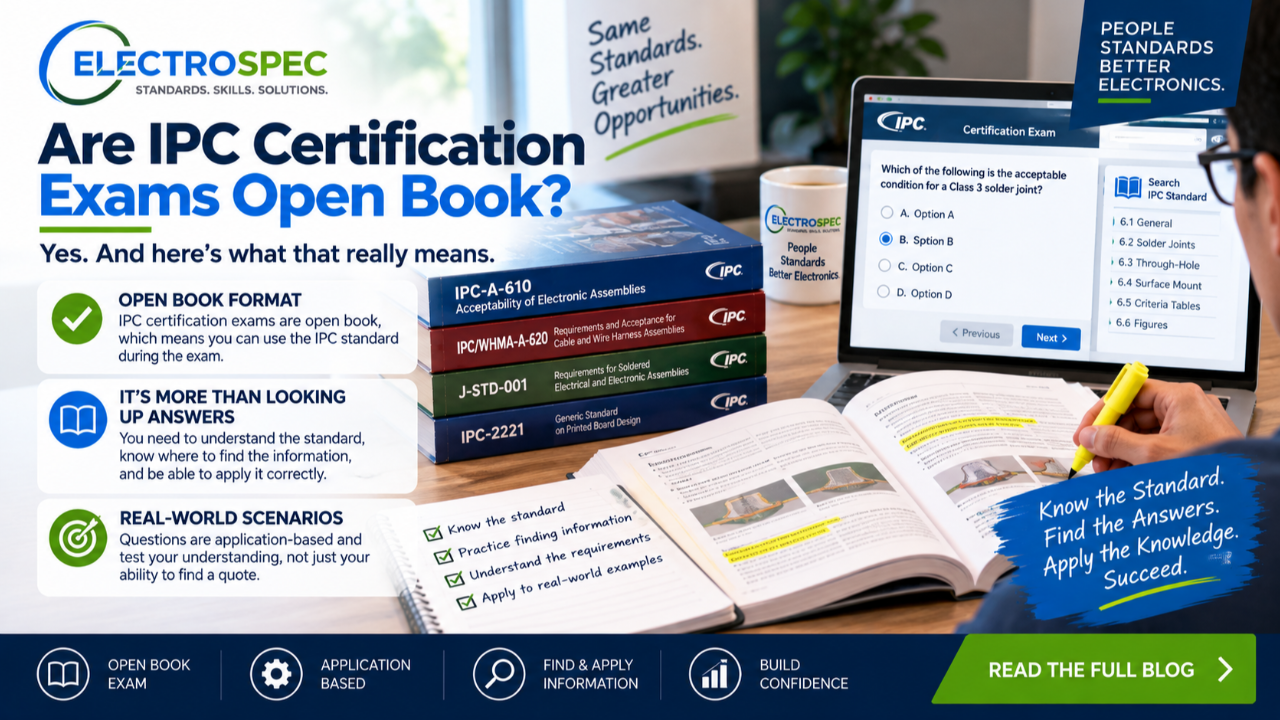
Students often ask whether IPC certification exams are open book.
The best answer is:
Do not assume.
IPC certification exams are governed by program rules, exam type, certification level, proctor instructions, and current policies and procedures.
Some exams or modules may allow use of approved standards or reference materials under proctor-controlled conditions. Other testing situations may have different rules. Instructor-level testing may also include requirements that differ from specialist-level testing.
The safest approach is to confirm the rules before exam day.
Know What Materials Are Allowed
Students should never bring unauthorized materials into a certification exam.
That includes notes, phones, extra devices, screenshots, copied exam content, unauthorized files, or outside references unless specifically allowed.
Exam security matters.
Certification exams are controlled assessments, and students should follow all proctor instructions.
If a student is not sure whether something is allowed, they should ask before testing begins.
The Standard Is Still Central
Even when an exam allows use of a standard, that does not make the exam easy.
Students still need to know how to use the standard.
They should understand:
- where topics are located
- how sections are organized
- how product classes are applied
- how figures and tables support requirements
- how notes and exceptions work
- how definitions affect interpretation
- how to read questions carefully
An open-reference exam is not the same as an unprepared exam.
The student still needs to understand the material.
Why Students Still Need to Study
A common mistake is thinking, “If I can use the book, I do not need to study.”
That is a bad strategy.
Time matters.
Reading comprehension matters.
Navigation matters.
A student who has never studied the standard may waste time searching, misread requirements, or choose answers from the wrong section.
Studying helps students know where to look and what the requirement means.
Hard Copy and Digital Standards
Depending on the training and exam setup, students may use hard copy or electronic standards when permitted.
Students should understand which format they will use before the course begins.
Digital standards may require specific software, licensing, access, or device setup.
Hard copy standards may have restrictions on markings or alterations.
Students should follow the instructions from their training center and current certification policies.
Remote Testing Requires Extra Discipline
Remote testing can be convenient, but it also requires careful control.
Students may need a webcam, microphone, broadband connection, approved browser or LockDown Browser, and a quiet testing environment.
Remote proctoring may involve video and audio monitoring, identity verification, and restrictions on devices, programs, communication, and workspace materials.
Students should prepare the room and technology before exam day.
The Proctor Controls the Testing Environment
The proctor is responsible for maintaining exam integrity.
Students should expect the proctor to verify identity, review the environment, enforce rules, and stop the exam if misconduct or a serious issue occurs.
Students should not argue with the proctor during testing.
If there is a concern, follow the official help desk, grievance, or appeal process after the exam.
What Students Should Ask Before Testing
Before exam day, students should ask:
- What exam format will be used?
- What materials are allowed?
- Will the standard be hard copy or digital?
- Are notes permitted?
- Is a LockDown Browser required?
- What computer and camera setup is needed?
- What time zone will the exam be scheduled in?
- What happens if there is a technical issue?
- What is the retake policy?
These questions prevent confusion.
ElectroSpec Helps Students Prepare
ElectroSpec’s flexible training options help students understand what to expect before testing.
On-demand coursework allows students to review the material, revisit difficult sections, and prepare around work schedules.
For many students, that flexibility makes the certification process less stressful.
A better-prepared student is more confident during the exam.
Final Thought
IPC certification exams should not be approached with assumptions.
Students should know the exam rules, allowed materials, proctor requirements, technology setup, and current policies before testing.
Even when reference materials are permitted, students still need to study.
The goal is not just to have the standard available.
The goal is to know how to use it correctly.
Coming Next
How to Study for an IPC Certification Exam
In the next article, we will give students a practical study strategy for learning the standard, preparing for exam questions, and building confidence before test day.
Related Reading
Continue Your Certification Path with ElectroSpec
- IPC CID Certification — ElectroSpec
- IPC CID+ Certification — ElectroSpec
- IPC CID/CID+ Bundle — Complete PCB Design Certification — ElectroSpec
- IPC-A-610 Certification & Training Course | ElectroSpec Training
- IPC/WHMA-A-620 Certification & Training Course | ElectroSpec Training
- IPC-A-600 CIS Certification — ElectroSpec