
IPC CID+ Certification: What Advanced Designers Should Know
Oct 07, 2026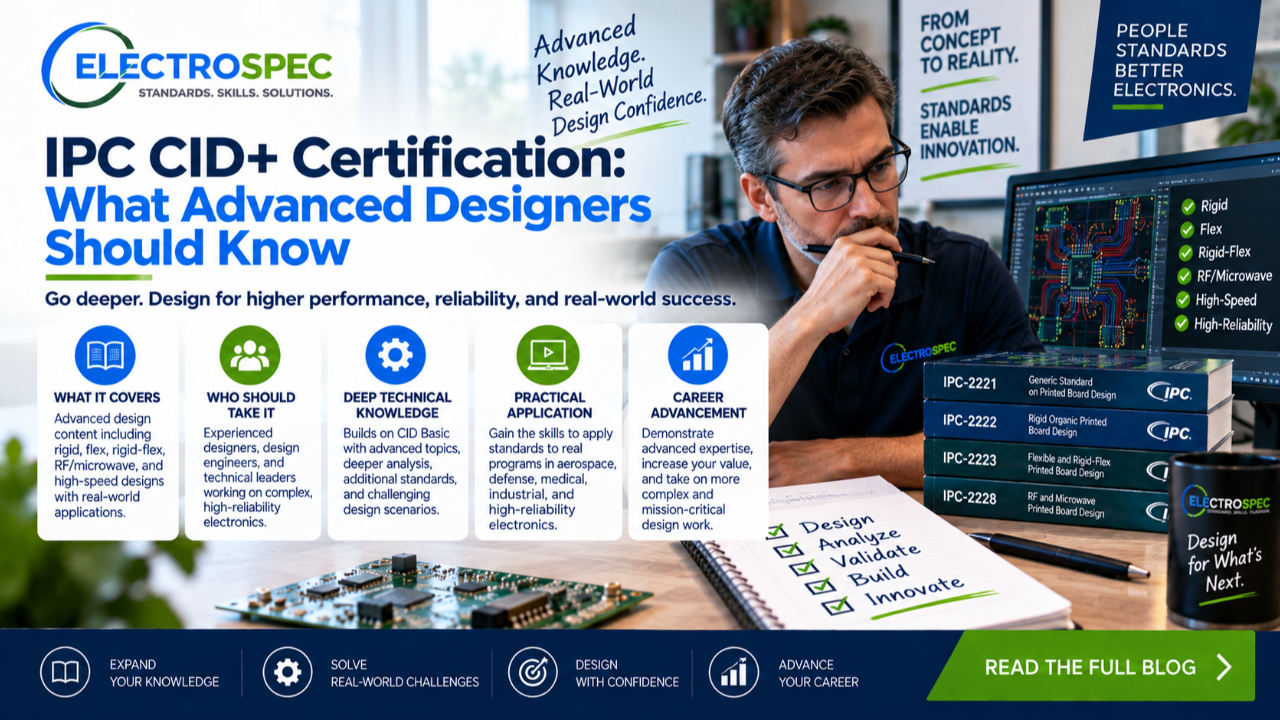
CID+ is the advanced PCB design certification path.
It builds beyond foundational PCB design knowledge and moves into more complex design decisions.
Students preparing for CID+ should understand that advanced PCB design is not one subject.
It is a connected set of technical domains involving materials, fabrication, assembly, rigid board design, flex and rigid-flex design, HDI, RF/microwave, environmental stress, reliability, documentation, and standards-based judgment.
CID+ Builds on CID
CID+ preparation should not be treated as a shortcut around the fundamentals.
Advanced design depends on the foundation.
A designer who does not understand materials, layout, mechanical and electrical considerations, fabrication, documentation, and quality will struggle when the design becomes more advanced.
CID+ builds on CID-level thinking.
Advanced Design Requires Manufacturing Awareness
Advanced PCB designs often push fabrication and assembly capability.
HDI structures, fine lines and spaces, controlled impedance, RF materials, flex constructions, tight tolerances, and Class 3 expectations can all increase risk.
Advanced designers need to understand what suppliers can build reliably.
They should also understand how design decisions affect assembly, inspection, test, qualification, and objective evidence.
Materials Become More Important
Material selection becomes more critical in advanced design.
RF and microwave boards may require low-loss materials.
Flex circuits may require specialized base films, copper types, coverlay, and stiffeners.
HDI may require materials that support sequential lamination and microvia reliability.
Harsh-environment products may require material decisions tied to thermal cycling, humidity, vibration, shock, and long service life.
Advanced designers must understand how materials behave.
HDI Requires Special Judgment
HDI is not just dense routing.
It may involve microvias, blind vias, buried vias, via-in-pad, sequential lamination, fine features, and tight supplier capability.
These choices affect fabrication cost, yield, inspection, test, and reliability.
CID+ students should understand HDI as a fabrication and reliability topic, not only a routing strategy.
RF and Microwave Design Requires Control
RF and microwave design depends on materials, stackup, dielectric properties, copper roughness, impedance, routing geometry, connectors, launches, fabrication tolerance, and measurement.
A trace at high frequency is not just a connection.
It is a controlled structure.
Advanced designers must understand how performance is designed, fabricated, measured, and controlled.
Flex and Rigid-Flex Require Mechanical Thinking
Flex and rigid-flex design requires understanding bend areas, static versus dynamic flexing, copper fatigue, coverlay, stiffeners, transition zones, fabrication, assembly handling, and inspection.
A flex circuit does not succeed because it can bend.
It succeeds because it was designed to bend correctly.
Environmental Stress Screening Matters
Environmental stress screening and qualification thinking help designers understand real-world use.
Products may experience thermal cycling, vibration, shock, humidity, contamination, transportation, storage, and long service life.
Advanced designers should understand how these stresses affect materials, interconnections, solder joints, connectors, coatings, and documentation.
ElectroSpec CID Advanced Supports Preparation
ElectroSpec’s CID Advanced training includes specialized courses in PCB Fabrication & Assembly, PCB Materials, Rigid PCB Design, Flexible PCB Design, HDI PCB Design, RF/Microwave PCB Design, and Environmental Stress Screening.
This structure helps students prepare for CID+ concepts while also building practical design judgment.
Students can study at their own pace, revisit lessons, and connect advanced topics to real-world product decisions.
Final Thought
CID+ preparation is not just about advanced terminology.
It is about understanding how advanced PCB designs become real products.
Materials, fabrication, assembly, flex, HDI, RF, ESS, documentation, and reliability all connect.
A strong advanced designer understands that connection.
Coming Next
Do You Need the IPC Standard Book for Certification?
In the next article, we will discuss why standards access matters, how students should think about hard copy and digital standards, and why knowing how to navigate the standard is critical.