
Preparing for the IPC CID Exam: A Realistic Self-Study Plan
Jul 03, 2026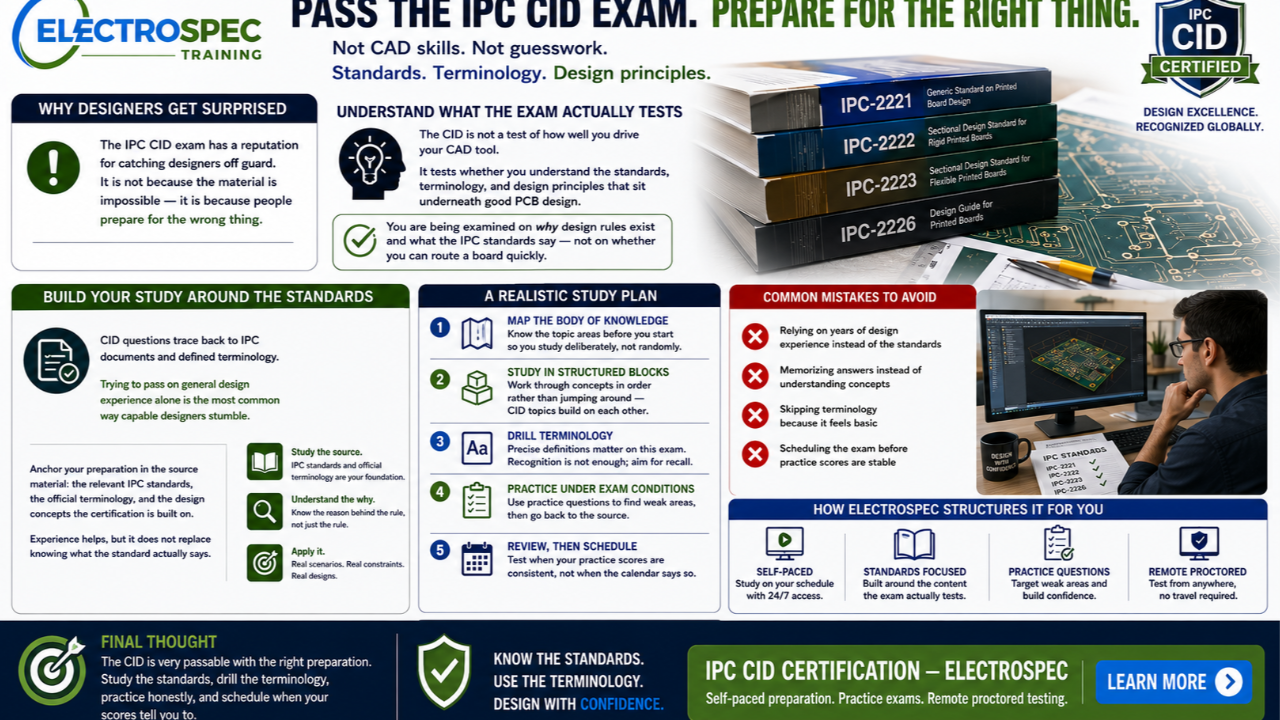
The IPC CID exam has a reputation for catching designers off guard. It is not because the material is impossible — it is because people prepare for the wrong thing.
Here is a realistic way to study for it.
Understand What the Exam Actually Tests
The CID is not a test of how well you drive your CAD tool. It tests whether you understand the standards, terminology, and design principles that sit underneath good PCB design.
That is the first mindset shift: you are being examined on why design rules exist and what the IPC standards say — not on whether you can route a board quickly.
Build Your Study Around the Standards
CID questions trace back to IPC documents and defined terminology. Trying to pass on general design experience alone is the most common way capable designers stumble.
Anchor your preparation in the source material: the relevant IPC standards, the official terminology, and the design concepts the certification is built on. Experience helps, but it does not replace knowing what the standard actually says.
A Realistic Study Plan
- Map the body of knowledge. Know the topic areas before you start so you study deliberately, not randomly.
- Study in structured blocks. Work through concepts in order rather than jumping around — CID topics build on each other.
- Drill terminology. Precise definitions matter on this exam. Recognition is not enough; aim for recall.
- Practice under exam conditions. Use practice questions to find weak areas, then go back to the source.
- Review, then schedule. Test when your practice scores are consistent, not when the calendar says so.
Common Mistakes to Avoid
- Relying on years of design experience instead of the standards
- Memorizing answers instead of understanding concepts
- Skipping terminology because it feels basic
- Scheduling the exam before practice scores are stable
How ElectroSpec Structures It for You
ElectroSpec’s CID preparation is self-paced and built around the standards and terminology the exam actually tests, with practice questions and remote proctored exam coordination. You study on your schedule and test when you are ready — no travel, no fixed classroom date.
Sample Study Schedule
Every candidate is different, but a structured plan helps. For a working designer studying part-time, a realistic approach looks like this:
- Weeks 1–2: Review the full body of knowledge, fundamentals, terminology, and the role of the IPC design standards.
- Weeks 3–4: Work through materials, board structures, electrical and mechanical design considerations, and fabrication requirements.
- Weeks 5–6: Cover assembly, testability, documentation, and quality topics, with practice questions after each section.
- Final week: Take full practice exams, review every missed question against the source material, and schedule once scores are consistent.
Candidates with more available time or strong existing knowledge may move faster. The key is steady progress rather than cramming.
How to Use Practice Questions Correctly
Practice questions are a diagnostic tool, not a memorization tool. When you miss a question, go back to the concept and learn why the correct answer is correct and why the other options are wrong. Memorizing a practice answer does not help when the exam asks about the same concept in a different way.
Track your weak topics. If the same area keeps showing up in missed questions, that is where your study time should go.
Terminology Deserves Real Time
Experienced designers often use informal shop language for concepts that have precise IPC definitions. On the exam, those precise definitions matter. Build a personal glossary as you study and review it regularly. Many candidates find that terminology review produces some of the fastest score improvements.
Preparing for a Remote Proctored Exam
- Test your computer, webcam, microphone, and internet connection ahead of time.
- Install and check any required lockdown browser software before exam day.
- Choose a quiet, well-lit room and clear your desk.
- Schedule at a time of day when you are alert and will not be interrupted.
If You Do Not Pass the First Time
A missed exam is useful information. Review the areas that gave you trouble, return to the source material, and retake when your practice scores are solid. ElectroSpec CID tracks include a free retake, which can be taken as soon as 24 hours after the initial attempt or up to 90 days later.
Final Thought
The CID is very passable with the right preparation. Study the standards, drill the terminology, practice honestly, and schedule when your scores tell you to.
IPC CID Certification — ElectroSpec