
System-Level ESD Assessments: Looking Beyond the Workstation
Oct 25, 2026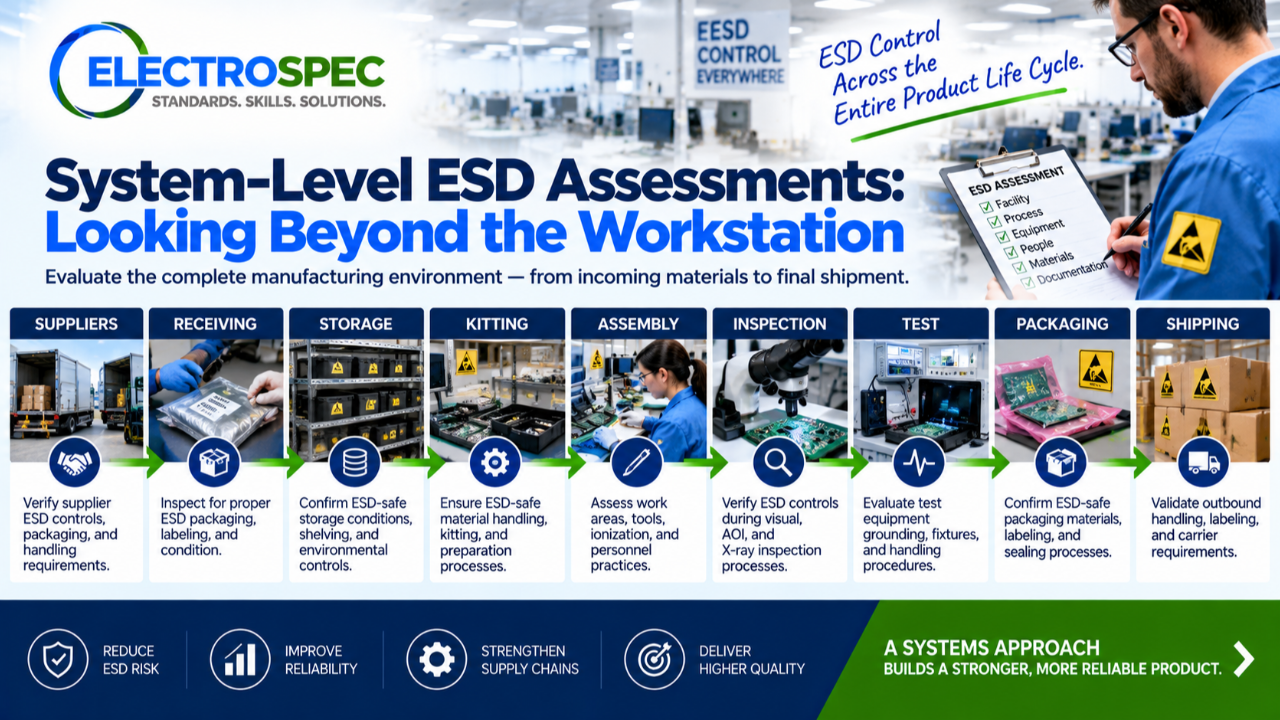
Many ESD problems happen outside the obvious workstation.
A bench may be compliant.
The operator may be trained.
The wrist strap may pass.
But the product may still be exposed during receiving, kitting, movement, inspection, test, packaging, shipping, or supplier handling.
That is why ESD assessments must look at the full system.
Product Flow Creates Risk
Sensitive electronics move through many areas before reaching the customer.
A typical flow may include receiving, incoming inspection, stockroom storage, kitting, assembly, in-process inspection, test, rework, final inspection, packaging, and shipping.
Each step creates opportunities for ESD exposure.
The product is only protected if the controls follow the product.
Receiving and Stockroom Controls
ESD protection should begin when sensitive parts enter the facility.
Receiving personnel must recognize ESD-sensitive materials and handle them properly.
Stockroom controls should maintain packaging integrity, labeling, segregation, and handling discipline.
A part stored incorrectly can be damaged before it ever reaches production.
Kitting and Internal Movement
Kitting areas are common risk points.
Parts may be removed from protective packaging, placed into bins, transferred to carts, or handled by employees who are not thinking about ESD exposure.
Internal movement also matters.
Carts, trays, totes, shelves, and temporary staging areas must support the ESD control plan.
Assembly, Inspection, and Test
Assembly areas often receive the most attention, but inspection and test areas can be just as important.
A board may be exposed while being probed, reworked, measured, programmed, or visually inspected.
Test equipment, fixtures, cables, chairs, carts, and tools can all create risk.
ESD control must include every area where sensitive product is exposed.
Packaging and Shipping
Packaging is the final opportunity to maintain protection before the product leaves the facility.
Improper packaging can expose the product to uncontrolled environments during transport.
Shipping personnel should understand ESD markings, packaging requirements, and the importance of keeping sensitive items protected.
A product should not lose protection at the last step.
Suppliers Are Part of the System
If suppliers handle ESD-sensitive items, their controls matter too.
Incoming materials may already have been exposed to risk before arrival.
Supplier quality teams should consider ESD requirements, packaging, marking, handling, and records as part of supplier management.
A company’s ESD program is stronger when suppliers understand and follow compatible controls.
ElectroSpec’s Training Connection
ElectroSpec’s iNARTE ESD training helps students think beyond the workstation.
Students learn that ESD control must follow the product across departments, suppliers, processes, and handoffs.
This system-level mindset is especially valuable for engineers, ESD program managers, quality personnel, manufacturing leaders, and supplier quality teams.
Final Thought
A workstation assessment is important, but it is not enough.
ESD risk follows the product.
Receiving, storage, kitting, assembly, inspection, test, rework, packaging, shipping, and suppliers all influence product protection.
A strong ESD professional looks at the complete system.
That is how hidden risk is found and controlled.
Coming Next
Ordnance, Ammunition, Explosives, Aerospace, and High-Reliability ESD Safety
In the next article, we will discuss why ESD discipline becomes even more important when the product, environment, or mission consequences are severe.