
What Is iNARTE ESD Certification and Who Needs It?
Oct 12, 2026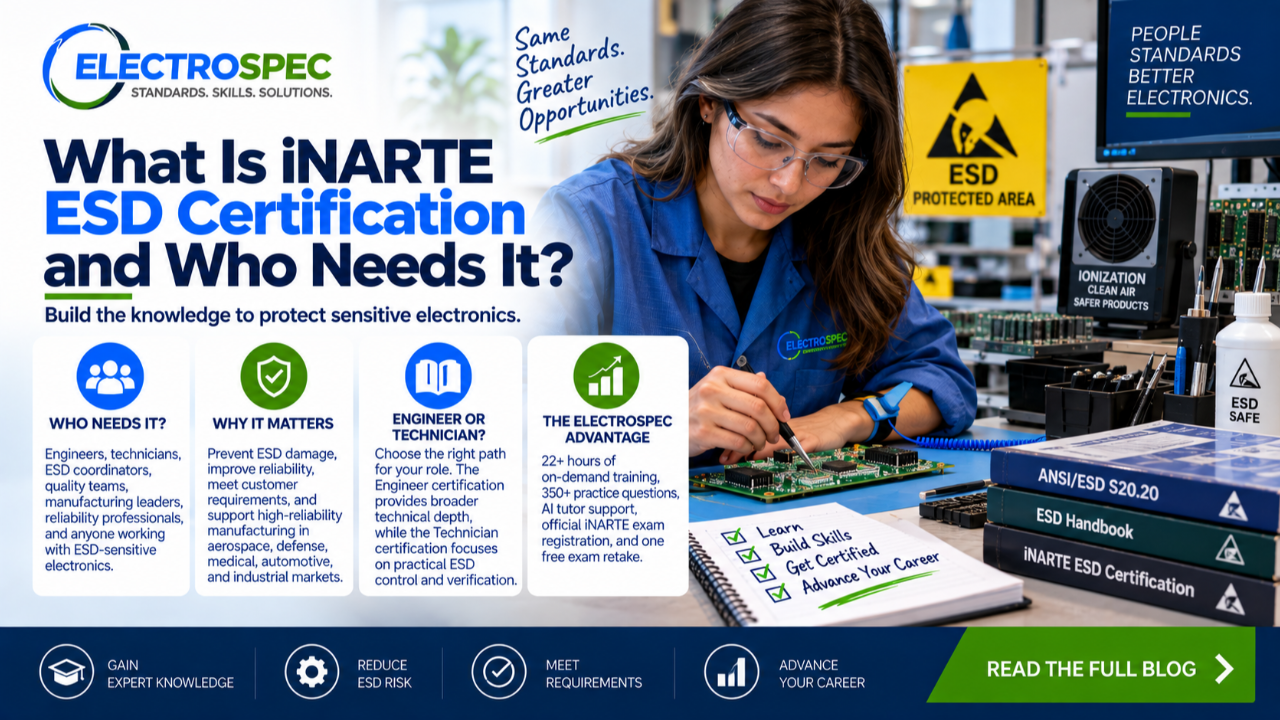
Electrostatic discharge, or ESD, is one of the most misunderstood risks in electronics manufacturing.
Many people think ESD control means wearing a wrist strap, using a mat, or placing parts in a special bag.
Those items matter, but they are only part of the larger system.
A strong ESD program requires knowledge of static charge, materials, grounding, ionization, packaging, verification, manufacturing behavior, personnel safety, and program management.
That is where iNARTE ESD certification can help.
ESD Certification Is About More Than Awareness
Basic ESD awareness training is useful for operators and employees who handle sensitive electronics.
But awareness training is not the same as professional ESD program knowledge.
A person responsible for an ESD control program must understand how the controls work, how to verify them, how to interpret test results, how to identify risk, and how to maintain compliance over time.
An ESD coordinator, engineer, technician, quality lead, manufacturing engineer, reliability engineer, or technical manager may need a much deeper understanding than a production operator.
iNARTE ESD certification supports that deeper level of professional knowledge.
Who Should Consider iNARTE ESD Certification?
iNARTE ESD certification may be valuable for people who support or manage ESD-sensitive work.
That may include:
- ESD program managers
- ESD coordinators
- quality engineers
- manufacturing engineers
- reliability engineers
- process engineers
- test personnel
- failure analysis personnel
- compliance personnel
- technical leads
- electronics technicians
- inspection and production support personnel
The right path depends on the person’s role.
An ESD Technician may need strong practical understanding of controls, verification, work areas, packaging, and safe handling.
An ESD Engineer may need broader technical depth, including models, calculations, program design, qualification, compliance verification, and system-level assessment.
Why ESD Knowledge Matters
ESD damage is not always visible.
A device can be damaged without obvious burn marks, broken leads, or visible physical evidence.
In some cases, the damage may weaken a component and create a latent failure that appears later during test, customer use, or field operation.
That is why ESD control is so important in aerospace, defense, medical, automotive, industrial, and high-reliability electronics.
A product does not need to fail immediately for ESD to be a serious risk.
The purpose of an ESD control program is to reduce that risk before damage occurs.
ESD Control Is a System
An effective ESD program is not built on one control.
It is built on a system of controls.
That system may include personnel grounding, equipment grounding, ESD worksurfaces, flooring, footwear, ionization, packaging, labeling, training, audits, verification testing, documentation, and corrective action.
Each control must be selected, used, and verified properly.
A wrist strap that is not tested is only an assumption.
A mat that is not grounded is only a surface.
A bag that is not the correct type may not protect the product.
A strong ESD professional understands the system, not just the parts.
ElectroSpec’s iNARTE ESD Training Path
ElectroSpec’s iNARTE ESD Engineer and Technician training is designed for working professionals who need flexible, practical preparation.
The course is online, self-paced, and on-demand, so students can study around work schedules instead of being locked into rigid classroom timing.
Students can revisit lessons, review difficult topics, use practice questions, and build confidence before testing.
This is especially valuable for companies with multiple shifts, remote personnel, production demands, or employees who need more time with technical content.
Engineer vs. Technician
The Engineer and Technician paths are related, but they are not identical in purpose.
The Technician path is more focused on practical ESD control knowledge, verification, handling, and work-area discipline.
The Engineer path is broader and more technical. It supports students who need to understand ESD program design, models, calculations, risk, standards, qualification, compliance, and system-level assessment.
Both roles matter.
A technician helps ensure the controls are used properly.
An engineer or program manager helps ensure the controls are selected, justified, documented, verified, and improved.
Final Thought
ESD certification is valuable because ESD control is a technical discipline.
It is not just a checklist.
It is not just a wrist strap.
It is not just a sign on the wall.
A real ESD program protects products through knowledge, discipline, verification, and accountability.
For students, iNARTE ESD certification can help build that knowledge and demonstrate a stronger professional foundation in electronics manufacturing and reliability.
Coming Next
ESD Fundamentals: What Every Electronics Professional Should Understand
In the next article, we will explain the basic physics of ESD, including static charge, charge generation, discharge events, and why ESD damage can be invisible.