CIS vs. CIT Certification: What Is the Difference?
Sep 28, 2026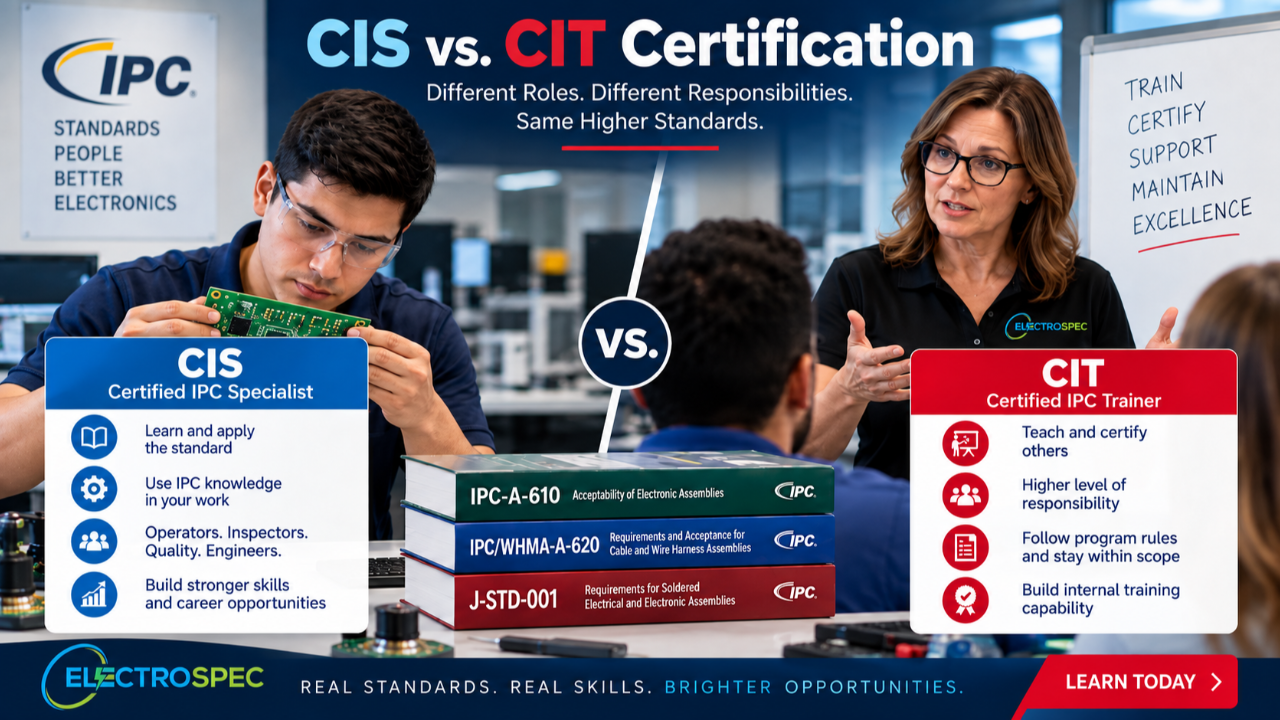
Students often ask whether they need CIS or CIT certification.
That is one of the most important questions to answer before enrolling in IPC training.
CIS and CIT are not the same. They serve different purposes, support different responsibilities, and are intended for different roles.
Choosing the wrong level can waste time, money, and effort.
Choosing the right level helps students and employers align training with the work that actually needs to be performed.
What Is CIS Certification?
CIS stands for Certified IPC Specialist.
CIS certification is generally intended for people who need to understand and apply an IPC standard within their own work.
That may include operators, inspectors, quality personnel, manufacturing personnel, process technicians, and technical staff who need standards-based knowledge.
A CIS student may need to understand how the standard is organized, how requirements are applied, what product classes mean, what conditions are acceptable or defective, and how the standard supports product quality.
CIS is often the right path when the student needs to use the standard, but does not need to train or certify other people.
What Is CIT Certification?
CIT stands for Certified IPC Trainer.
CIT certification is generally intended for individuals who will train, administer, or certify CIS students within the scope of the certification program.
A CIT has a higher responsibility because they are not only learning for themselves. They may also be responsible for supporting other students.
That means CIT candidates should be comfortable with the standard, the training process, student questions, certification rules, and exam administration requirements.
CIT is usually the right path when a company needs an internal trainer or when an individual is expected to conduct CIS training.
The Main Difference Is Responsibility
The simplest way to understand the difference is this:
CIS is for people who need to apply the standard in their work.
CIT is for people who need to teach or certify others.
That does not mean CIT is always better.
It means CIT is different.
A production operator may not need CIT.
A final inspector may not need CIT.
A company trainer probably does.
A quality manager may choose CIT if they need instructor-level capability, but CIS may be enough if they only need standards awareness for their role.
The certification level should match the responsibility.
CITs Must Stay Within Their Scope
Instructor-level certification comes with boundaries.
A trainer should only train, proctor, or support certifications within the endorsements or programs they are properly qualified to handle.
This matters because IPC certification is standards-specific.
A person certified to teach one program should not assume that authority automatically applies to every IPC program.
Students and employers should understand the scope of the trainer’s certification before scheduling training.
Which One Should an Operator Choose?
Most operators do not need CIT.
They usually need training that helps them perform their assigned tasks correctly.
Depending on the job, that may mean CIS certification, task-specific company training, workmanship training, process training, or a combination.
For example, a soldering operator may need to understand workmanship requirements and company work instructions.
A cable harness builder may need IPC/WHMA-A-620-related training.
A PCB assembly inspector may need IPC-A-610 certification.
The right answer depends on the work performed.
Which One Should an Inspector Choose?
Inspectors often benefit from CIS certification because inspection depends on standards-based acceptability criteria.
An inspector should understand how to navigate the standard, how product classes affect requirements, how to evaluate conditions, and how to communicate findings clearly.
Some inspection leaders or internal trainers may need CIT.
But not every inspector needs instructor-level certification.
The question is whether the person is inspecting product, training others, or both.
Which One Should a Company Trainer Choose?
A company trainer who is expected to certify internal personnel usually needs CIT.
CIT supports the ability to conduct CIS training within the correct program and scope.
This can be valuable for companies with recurring training needs, multiple shifts, or a large number of employees who must maintain certification.
However, companies should still remember that IPC certification does not replace product-specific training, equipment training, company procedures, or customer flow-down training.
How ElectroSpec Helps Students Choose
ElectroSpec supports students and companies by helping them choose the certification path that fits the role.
Some students need CIS.
Some need CIT.
Some need CID or CID+ because their work is focused on PCB design rather than assembly inspection or workmanship.
ElectroSpec’s flexible training options help busy students and working professionals prepare for certification without unnecessary scheduling barriers.
When training is aligned with the job, students get more value from the course.
Final Thought
CIS and CIT are both valuable, but they are not interchangeable.
CIS supports people who need standards-based knowledge for their own work.
CIT supports people who need instructor-level capability to train or certify others.
The best choice depends on the role, responsibility, company need, and standard involved.
Before enrolling, ask:
Do I need to use the standard, or do I need to teach it?
That answer usually points you in the right direction.
Coming Next
How Hard Is an IPC Certification Exam?
In the next article, we will discuss why IPC exam difficulty depends on preparation, reading comprehension, familiarity with the standard, exam structure, and the student’s ability to apply requirements.
Related Reading
Continue Your Certification Path with ElectroSpec
- IPC CID Certification — ElectroSpec
- IPC CID+ Certification — ElectroSpec
- IPC CID/CID+ Bundle — Complete PCB Design Certification — ElectroSpec
- IPC-A-610 Certification & Training Course | ElectroSpec Training
- IPC/WHMA-A-620 Certification & Training Course | ElectroSpec Training
- IPC-A-600 CIS Certification — ElectroSpec