
ESD Control Is a Program, Not a Wrist Strap
Oct 27, 2026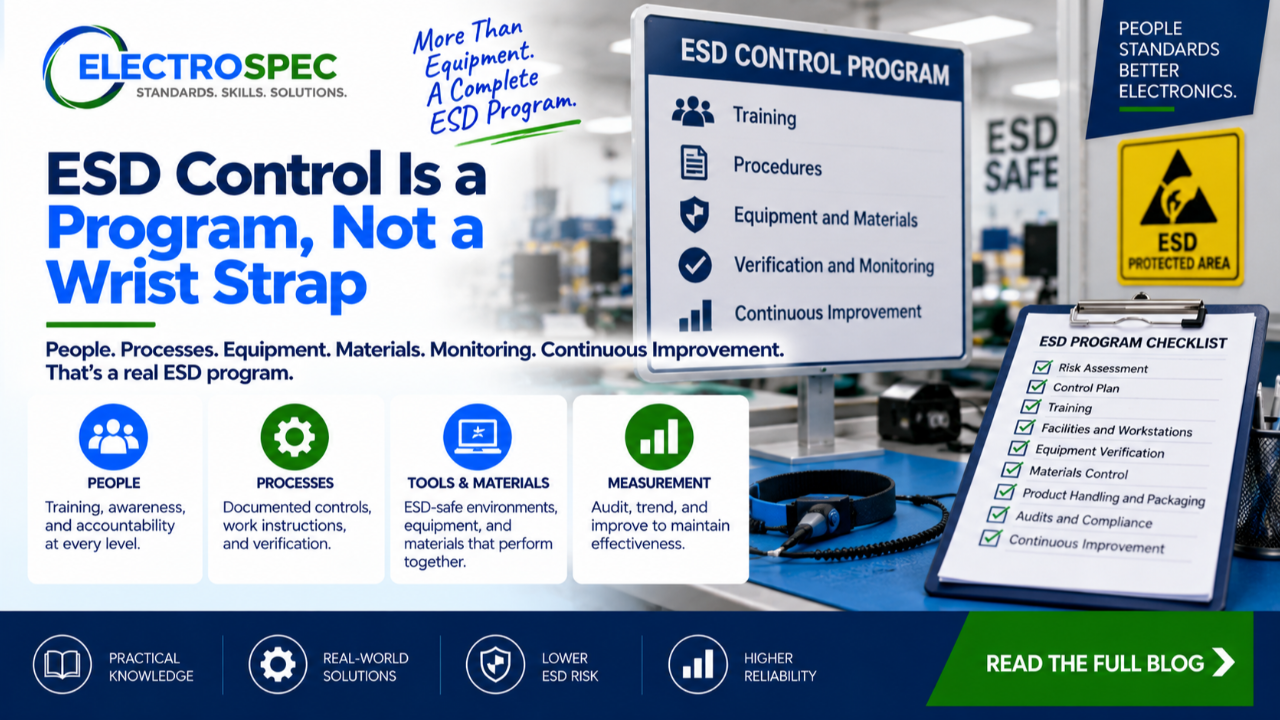
A wrist strap is important.
A grounded mat is important.
An ESD bag is important.
But none of those items, by themselves, create an ESD control program.
A real ESD program is a managed system that protects sensitive electronics through training, procedures, materials, grounding, packaging, verification, records, audits, and accountability.
That is the central lesson of this series.
ESD Starts with Fundamentals
Students must first understand what ESD is.
Static charge can build up during normal work.
Discharge can damage sensitive electronics.
Damage may be invisible.
A product can pass initial test and still carry latent weakness.
Understanding these fundamentals helps people respect the controls instead of treating them as unnecessary rules.
Materials Matter
Conductive, dissipative, and insulative materials behave differently.
A material that looks harmless may hold charge.
A surface that looks protective may fail if not verified.
A package that looks “ESD safe” may not provide shielding.
Material knowledge helps ESD professionals make better decisions.
Grounding Matters
Personnel grounding, equipment grounding, worksurface grounding, floors, footwear, carts, tools, and fixtures must work together.
Grounding must be intentional and verified.
A disconnected cord, failed wrist strap, contaminated floor, or floating cart can weaken the program.
Grounding is the backbone, but it must be maintained.
Ionization Fills a Critical Gap
Not every hazard can be grounded.
Insulators and isolated conductors may require ionization.
Ionizers must be placed correctly, maintained, and verified.
Ionization is not a shortcut.
It is a targeted control used when grounding is not enough.
Packaging Extends Protection
ESD protection must follow the product beyond the bench.
Receiving, storage, kitting, assembly, inspection, test, packaging, shipping, and supplier handling all create risk.
Packaging and marking communicate requirements and help protect sensitive items as they move through the system.
Verification Builds Trust
An ESD program must prove that it works.
Training records, compliance checks, audit results, equipment verification, corrective actions, and control plan records provide objective evidence.
Without verification, the program depends on assumptions.
With verification, the program earns confidence.
Program Ownership Matters
Every successful ESD program needs ownership.
Someone must define requirements, maintain the control plan, verify controls, review records, train personnel, respond to failures, and improve the system.
This may involve technicians, engineers, quality personnel, manufacturing leaders, and management.
ESD control is a team effort, but it still needs clear responsibility.
ElectroSpec’s iNARTE ESD Training Path
ElectroSpec’s iNARTE ESD Engineer and Technician training is built for students and professionals who need a structured path through ESD fundamentals, materials, calculations, models, standards, safety, grounding, control plans, verification, ionization, packaging, manufacturing assessments, system-level assessment, and high-reliability safety considerations.
The online, self-paced, on-demand format helps students study around work schedules, revisit difficult topics, and prepare with greater confidence.
For companies, flexible ESD training can support distributed teams, multiple shifts, technical staff, quality personnel, and employees responsible for program control.
Final Thought
ESD control is not a wrist strap.
It is not a mat.
It is not a sign.
It is not a one-time class.
ESD control is a technical program that must be understood, implemented, verified, and maintained.
When the program works, sensitive electronics are protected before damage occurs.
That is the value of real ESD knowledge.
Coming Next
This completes the iNARTE ESD Certification Guide series.
Together, these articles explain how ESD fundamentals, materials, calculations, models, standards, personnel safety, grounding, control plans, verification, ionization, packaging, manufacturing assessment, system-level review, and high-reliability safety all connect into one complete ESD control program.