IPC-A-610 Certification: What Students Should Know Before Enrolling
Oct 04, 2026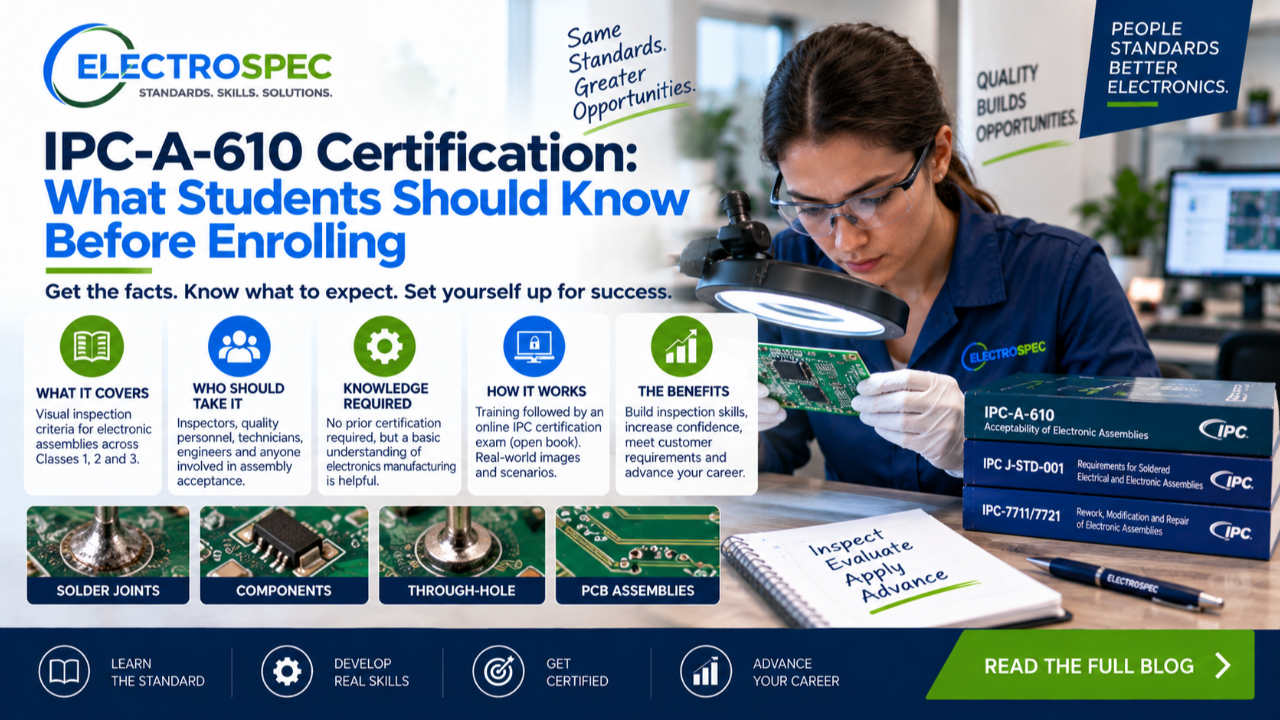
IPC-A-610 is one of the most common IPC certification paths in electronics manufacturing.
Students often take IPC-A-610 because they inspect, build, review, audit, or support electronic assemblies.
Before enrolling, it helps to understand what the certification is for and how it fits the job.
IPC-A-610 focuses on acceptability of electronic assemblies.
That makes it especially useful for people who need to understand how finished assemblies are evaluated.
IPC-A-610 Is About Acceptability
IPC-A-610 is not a PCB design course.
It is not a general electronics theory course.
It is not a complete replacement for company training.
It is a standards-based acceptability course.
Students should expect to learn how assembly conditions are evaluated and how product class affects acceptability.
This may include solder joints, component mounting, cleanliness, damage, marking, wires, terminals, hardware, conformal coating, and other assembly conditions depending on the modules involved.
Who Should Consider IPC-A-610?
IPC-A-610 may be useful for:
- inspectors
- quality personnel
- manufacturing personnel
- production leads
- process engineers
- manufacturing engineers
- auditors
- trainers
- operators who need standards awareness
- managers responsible for product acceptance
The course is especially valuable for anyone who needs to evaluate completed electronic assemblies or understand how product acceptability is determined.
Inspectors Need Clear Criteria
Inspection should not be based on opinion.
Inspectors need defined criteria.
IPC-A-610 helps inspectors understand how to evaluate conditions against standards-based expectations.
This improves consistency, communication, and confidence.
When inspectors use a common standard, they can better explain why a condition is acceptable or defective.
Operators Can Benefit Too
Operators may not need the same depth as inspectors, but many operators benefit from understanding what the final product must meet.
When operators understand acceptance expectations, they can better recognize quality concerns during production.
However, IPC-A-610 certification should still be paired with company-specific training.
Operators also need work instructions, equipment training, process training, safety training, and product-specific requirements.
Engineers and Quality Teams Benefit from Standards Awareness
Engineers and quality teams often need IPC-A-610 knowledge to support process decisions, customer discussions, audits, nonconformances, corrective actions, and supplier communication.
A process engineer may use IPC-A-610 knowledge to understand recurring assembly defects.
A quality engineer may use it to support inspection planning or customer requirements.
A design engineer may benefit from understanding how design decisions affect final assembly acceptance.
Product Class Matters
One of the important ideas students encounter is product class.
Different product classes reflect different performance and reliability expectations.
Students should not treat all assemblies the same.
A condition that may be acceptable for one class may not be acceptable for another.
Understanding product class helps students apply the standard correctly.
IPC-A-610 Does Not Replace J-STD-001
Students sometimes confuse IPC-A-610 and J-STD-001.
They are related, but they do not serve the same role.
IPC-A-610 focuses on acceptability of completed electronic assemblies.
J-STD-001 addresses soldered electrical and electronic assembly requirements.
A company may use both.
Students should understand which standard applies to their role and requirement.
Online and On-Demand Training Helps
ElectroSpec provides flexible training options that help students prepare for certification around work schedules.
Students can study, review, and revisit difficult content instead of trying to absorb everything at once.
For busy inspectors, operators, engineers, and quality personnel, flexible training can make certification preparation more practical.
Questions to Ask Before Enrolling
Before enrolling, students should ask:
- Do I need CIS or CIT?
- Which revision applies?
- Which modules do I need?
- Is this for inspection, production, quality, or training?
- Will testing be online, remote, or in person?
- Do I have access to the correct standard?
- What happens if I need a retake?
- How will my certificate be downloaded and verified?
These questions help avoid confusion.
Final Thought
IPC-A-610 certification can be valuable for students who work with electronic assemblies.
It supports a common understanding of acceptability, inspection criteria, product class, and quality expectations.
The goal is not simply to pass an exam.
The goal is to become more confident evaluating electronic assemblies against defined requirements.
Coming Next
IPC/WHMA-A-620 Certification: What Students Should Know Before Enrolling
In the next article, we will explain what IPC/WHMA-A-620 certification covers, who should take it, and why cable and wire harness acceptability knowledge matters.