
Why IPC-A-610 Is the Right Certification for Rework and Repair Operators, Not IPC-7711/7721
Jun 09, 2026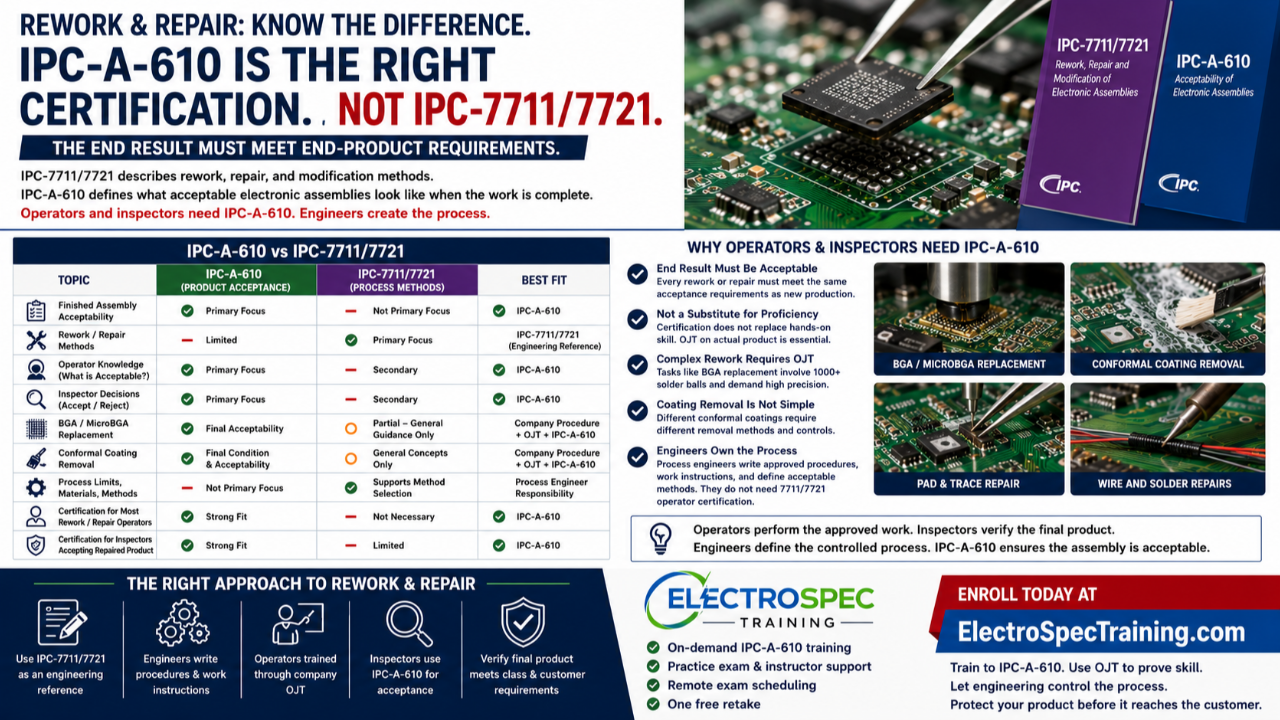
Rework and repair are some of the most misunderstood areas in electronics manufacturing training.
Many companies assume that if someone performs rework or repair, they must be certified to IPC-7711/7721.
That sounds logical at first.
IPC-7711/7721 is the standard most associated with rework, repair, and modification of electronic assemblies.
But for many operators and inspectors, IPC-A-610 is actually the more important certification.
Why?
Because the final result of any rework or repair must still meet end-product acceptance requirements.
A repaired solder joint must be acceptable.
A replaced component must be acceptable.
A cleaned area must be acceptable.
A repaired pad, wire jumper, splice, coating touch-up, or modified assembly must still result in product that meets customer, drawing, class, and acceptance requirements.
That is IPC-A-610 territory.
IPC-7711/7721 may help define rework and repair methods, but IPC-A-610 defines what acceptable electronic assembly product looks like after the work is complete.
Rework and Repair Must End in Acceptable Product
The goal of rework and repair is not simply to perform a technique.
The goal is to return product to an acceptable condition.
That means the finished hardware must meet applicable requirements before it can move forward, ship, or return to service.
A rework operator may remove and replace a component correctly from a process standpoint, but the final assembly still needs to be evaluated for acceptability.
Are the solder joints acceptable?
Is the component properly aligned?
Was the laminate damaged?
Was solder mask damaged?
Was conformal coating removed and restored properly?
Were adjacent components disturbed?
Was cleanliness maintained?
Did the rework create new defects?
Does the assembly still meet Class 1, Class 2, or Class 3 expectations?
These are product acceptance questions.
IPC-A-610 is the standard that helps operators and inspectors understand those finished-product requirements.
IPC-7711/7721 Is Not the Same as Production Proficiency
IPC-7711/7721 training can be useful.
It introduces common rework, repair, and modification methods. It can help students understand general techniques for component removal, replacement, lifted pads, damaged lands, jumper wires, trace repair, and other repair situations.
But certification alone does not make someone proficient in real production rework.
Rework and repair proficiency depends on actual product, actual materials, actual damage condition, actual board construction, actual component type, actual thermal mass, actual tooling, actual customer restrictions, and actual company procedures.
A certification exercise cannot represent every production repair condition.
That is especially true for complex, high-reliability, high-density, conformally coated, fine-pitch, or BGA assemblies.
Certification supports baseline exposure.
OJT and company qualification prove actual production capability.
BGA and MicroBGA Replacement Proves the Point
Consider BGA or microBGA replacement.
A BGA replacement process may involve hundreds or even more than a thousand solder balls. The operator must control removal, site preparation, solder paste or flux application, component placement, thermal profile, alignment, reflow, inspection, cleanliness, and verification.
That is not a simple classroom exercise.
That is a highly specialized process requiring careful equipment setup, process control, operator skill, and often x-ray or other inspection methods.
A person can complete a general rework certification and still not be ready to perform BGA or microBGA replacement on high-reliability production hardware.
The risk is too high.
One misalignment, one open, one bridge, one void concern, one damaged pad, one overheated board, or one uncontrolled process can create failure.
BGA and microBGA replacement require company-specific procedure, equipment-specific training, process validation, and operator proficiency.
That proficiency is not proven by IPC-7711/7721 certification alone.
The operator still needs to understand IPC-A-610 because the finished assembly must meet product acceptance requirements after the rework is complete.
Conformal Coating Removal Is Another Example
Another excellent example is conformal coating removal.
Product returns, factory test failures, and fielded assemblies often require rework or repair on coated hardware.
Before the component can be replaced, the conformal coating may need to be removed. But coating removal can vary widely depending on coating type, thickness, cure state, board design, component density, access, masking, tooling, chemical compatibility, and customer restrictions.
Removing acrylic coating is not the same as removing silicone, urethane, parylene, or other coating systems.
Some coatings are scraped.
Some are softened.
Some are thermally removed.
Some require micro-abrasion.
Some may need specialized chemical methods.
Some removal methods may damage solder mask, components, labels, wires, laminate, or nearby hardware if not controlled.
A basic IPC-7711/7721 course cannot fully train every operator on every coating removal method used across industry.
That training must come from company-specific procedures and OJT.
The process engineer or technical authority must define approved removal methods, tooling, materials, masking, inspection steps, and restoration requirements.
The operator must be trained to those procedures.
The inspector must verify final product acceptability.
And again, IPC-A-610 is essential because after rework, the assembly must still meet end-product requirements.
Process Engineers Should Own Rework and Repair Procedures
Rework and repair should not be left to operator preference.
Operators should not be expected to invent the method.
Inspectors should not be expected to define the process.
The process engineer, manufacturing engineer, product engineer, or technical authority should establish approved rework and repair procedures.
That includes:
Approved methods
Approved tools
Thermal limits
Material controls
Flux and cleaning requirements
ESD controls
Coating removal and restoration requirements
Inspection points
Customer approval requirements
Class restrictions
Risk controls
Documentation requirements
Verification steps
These are engineering responsibilities.
IPC-7711/7721 can be a valuable reference for engineers when building rework and repair procedures, but operators and inspectors still need clear work instructions that apply to actual product.
This is why many process engineers use rework and repair standards as technical references without necessarily taking operator-level certification courses.
The engineer’s job is to define the controlled process.
The operator’s job is to perform the approved process.
The inspector’s job is to verify the finished product meets requirements.
Operators Need IPC-A-610 and OJT
Rework and repair operators need two things more than generic certification:
They need to understand what acceptable product looks like.
They need to be proficient in the specific rework or repair tasks they are assigned.
IPC-A-610 supports the first requirement.
Company-specific OJT supports the second requirement.
If an operator replaces components, repairs wires, touches up solder joints, removes coating, restores coating, performs jumper wire installation, or supports product returns, that operator needs to know the finished condition required by IPC-A-610.
But skill must be proven through OJT.
OJT should use actual or representative hardware, actual tools, actual materials, actual process instructions, actual inspection criteria, and actual company controls.
For rework and repair, this is critical.
The risk of damage is often higher during rework than during original assembly. The product has already been built, tested, coated, handled, or possibly failed. Rework must be controlled, documented, and verified.
Certification alone is not enough.
Inspectors Need IPC-A-610 for Rework and Repair Acceptance
Inspectors must evaluate the final product condition.
That makes IPC-A-610 critical.
After rework or repair, inspectors need to determine whether the assembly meets applicable class requirements and acceptance criteria.
They may need to inspect solder joints, component alignment, lead conditions, board damage, laminate condition, cleanliness, coating condition, wire repairs, jumper wires, staking, adhesive, hardware, marking, or other visible conditions.
That is IPC-A-610 work.
IPC-7711/7721 may describe how a repair can be performed, but IPC-A-610 helps determine whether the finished assembly is acceptable.
For inspectors, IPC-A-610 is the more universal certification because it supports acceptance decisions across the electronic assembly.
IPC-7711/7721 Still Has Value, But It Should Be Used Correctly
This does not mean IPC-7711/7721 has no value.
It absolutely does.
IPC-7711/7721 is valuable for process engineers, manufacturing engineers, repair technicians, rework specialists, and technical teams who need to understand standard rework, repair, and modification methods.
It can support procedure development.
It can provide common terminology.
It can help define acceptable methods.
It can support repair planning.
It can guide technical decisions.
But it should not be treated as a blanket certification requirement for every rework or repair operator and inspector.
The better approach is:
Use IPC-7711/7721 as an engineering and technical process reference.
Use written work instructions to control actual rework and repair activity.
Use OJT to prove operator proficiency on assigned tasks.
Use IPC-A-610 to verify final product acceptability.
That aligns certification and training with actual responsibility.
Gap Analysis: IPC-A-610 vs IPC-7711/7721 for Rework and Repair Personnel
| Topic | IPC-A-610 | IPC-7711/7721 | Best Fit |
|---|---|---|---|
| Finished electronic assembly acceptability | Primary focus | Not primary focus | IPC-A-610 |
| Rework and repair methods | Limited | Primary focus | IPC-7711/7721 for engineering/procedure reference |
| Operator acceptance knowledge | Primary focus | Secondary | IPC-A-610 |
| Inspector acceptance decisions | Primary focus | Secondary | IPC-A-610 |
| Component replacement technique | Acceptance outcome | Method guidance | Procedure + OJT |
| BGA or microBGA replacement | Final acceptability | General rework reference, not full process qualification | Company procedure + OJT + IPC-A-610 |
| Conformal coating removal | Final condition and acceptability | May support repair method concepts | Company procedure + OJT + IPC-A-610 |
| Process limits and approved methods | Not primary focus | Supports method selection | Process engineer responsibility |
| Operator proficiency | Must be supported by OJT | Must be supported by OJT | Company OJT |
| Best certification for most rework/repair operators | Strong fit | Only when specifically required | IPC-A-610 |
| Best certification for inspectors accepting repaired product | Strong fit | Limited | IPC-A-610 |
Do Not Confuse Method Training with Product Acceptance
This is the key point.
IPC-7711/7721 is about rework, repair, and modification methods.
IPC-A-610 is about product acceptability.
Operators and inspectors working rework and repair need to understand product acceptability because the end result must conform to requirements.
A perfectly executed method is not enough if the final product is not acceptable.
Likewise, a certified operator is not automatically qualified for every rework task.
BGA replacement, coating removal, fine-pitch repair, pad repair, jumper installation, and high-reliability rework all require specific training, approved procedures, and demonstrated proficiency.
That is why IPC-A-610 plus company OJT is often more practical than requiring IPC-7711/7721 certification for everyone.
Recommended Training Strategy
For most rework and repair environments, the best training strategy is:
Certify operators and inspectors to IPC-A-610 so they understand finished product acceptance requirements.
Use IPC-7711/7721 as an engineering reference for rework, repair, and modification methods.
Have process engineers or technical authorities write approved procedures and work instructions.
Train operators through company-specific OJT on actual rework tasks.
Verify proficiency before operators perform high-risk rework on production hardware.
Use inspection and test to confirm final product conforms to requirements.
This approach puts the right responsibility in the right place.
Operators perform controlled work.
Inspectors verify product acceptability.
Engineers define the process.
OJT proves skill.
IPC-A-610 provides common acceptance language.
Bottom Line
Rework and repair must end with acceptable product.
That is why IPC-A-610 is critical for rework and repair operators and inspectors.
IPC-7711/7721 is valuable, but it is not the same as product acceptance certification and it does not automatically prove operator proficiency for complex production rework.
BGA replacement, microBGA replacement, conformal coating removal, high-density component repair, field return rework, and factory test failure repair all require company-specific procedures, process engineering ownership, and OJT.
Operators and inspectors should not be expected to define those processes.
Process engineers and product engineers should establish approved rework and repair methods through standards, procedures, work instructions, and qualification requirements.
Operators should be trained to perform assigned tasks.
Inspectors should verify finished product acceptability.
For rework and repair personnel, IPC-A-610 should be the primary certification.
IPC-7711/7721 should support engineering, procedure development, and specialized task training where needed.
Related Reading
Get IPC-A-610 Certified with ElectroSpec
ElectroSpec provides IPC-A-610 training and certification for rework and repair operators, inspectors, technicians, engineers, and quality personnel who need to understand finished product acceptance requirements.
Our IPC-A-610 course helps students understand what acceptable electronic assemblies look like after original build, rework, repair, modification, inspection, and final product release.
With ElectroSpec, students receive flexible on-demand training, practice exam support, instructor support, remote exam scheduling, and certification preparation designed around real electronics manufacturing needs.
If your team performs rework or repair, make sure they understand the standard that determines whether the finished product is acceptable.
Train to IPC-A-610.
Use OJT to prove skill.
Let engineering control the process.
Protect your product before it reaches the customer.
Enroll today at ElectroSpecTraining.com.
IPC-A-610 CIS Certification — ElectroSpec