
IPC Certification vs. Company Training: What Is the Difference?
Oct 10, 2026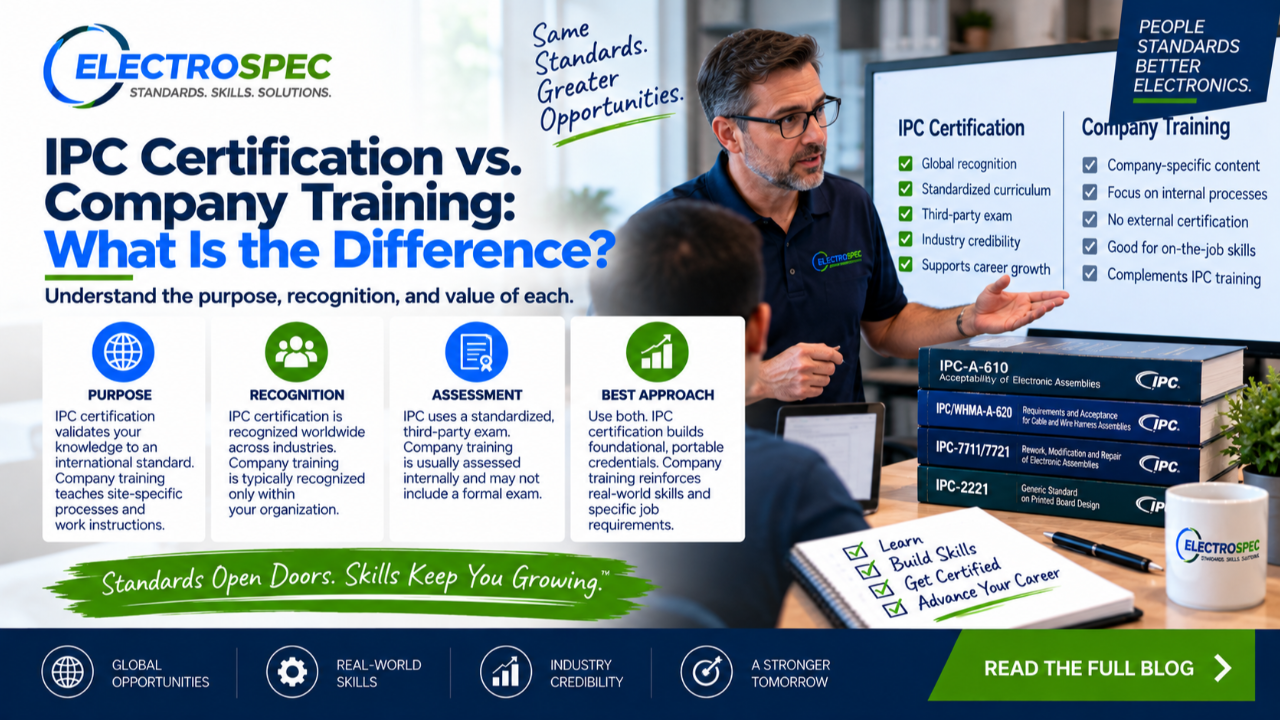
IPC certification and company training are both important.
But they are not the same thing.
Students and employers sometimes confuse them.
IPC certification supports standards-based knowledge.
Company training supports the specific way an organization builds, inspects, tests, documents, and controls its own products.
A strong training program often needs both.
IPC Certification Provides Standards Knowledge
IPC certification helps students understand standards, terminology, product classes, requirements, acceptability criteria, and how to use the standard.
That knowledge can support consistency across operators, inspectors, engineers, quality personnel, and trainers.
It gives teams a common language.
For example, IPC-A-610 can help inspectors understand assembly acceptability criteria.
IPC/WHMA-A-620 can help cable and harness personnel understand harness acceptability.
CID and CID+ can help designers understand PCB design requirements and advanced design concepts.
Company Training Provides Product-Specific Knowledge
Company training is different.
It tells employees how the company performs the work.
That may include:
- work instructions
- equipment operation
- tooling
- inspection forms
- customer flow-downs
- product-specific requirements
- safety rules
- ESD controls
- process parameters
- quality records
- routing procedures
- software systems
- approval authority
- nonconformance reporting
IPC certification cannot replace that information because every company and product may be different.
Certification Does Not Automatically Qualify Someone for Every Task
A person may hold an IPC certification and still need task-specific qualification.
For example, a certified student may understand acceptance criteria, but still need company training on microscopes, inspection stations, torque tools, crimp tools, soldering irons, test fixtures, coating equipment, or internal reporting systems.
Certification supports knowledge.
Qualification confirms readiness for a specific task or process.
Operators Need Role-Based Training
Operators should be trained for the work they actually perform.
A soldering operator may need process training, workmanship awareness, safety, ESD controls, work instructions, and product-specific requirements.
A cable builder may need wire preparation, crimping, harness routing, tool setup, and inspection criteria.
An operator does not always need the same certification as an inspector, engineer, or trainer.
Training should match the role.
Inspectors Need Criteria and Process Knowledge
Inspectors need to understand acceptance criteria, but they also need company inspection procedures.
They should know what standard applies, what class applies, what customer requirements apply, what records are needed, how to document findings, and when to escalate issues.
IPC certification helps with the standard.
Company training helps with the internal process.
Engineers Need System Awareness
Engineers may use IPC certification to understand how design and manufacturing decisions affect real products.
But engineers also need internal design rules, supplier requirements, customer specifications, test plans, qualification requirements, and documentation procedures.
For designers, CID and CID+ preparation can be especially valuable because PCB design decisions affect manufacturing, inspection, test, and reliability.
Quality Teams Need Both
Quality personnel often need both standards knowledge and company system knowledge.
They may support audits, customer requirements, corrective actions, nonconformance review, supplier quality, training records, and product acceptance.
IPC certification can help quality teams understand the standard.
Company training helps them apply it inside the organization’s quality system.
ElectroSpec Supports Flexible Certification Preparation
ElectroSpec provides flexible training options that help students prepare for certification while companies maintain their own internal training systems.
On-demand training can be useful when companies need to train busy employees, multiple shifts, remote staff, or students with different learning speeds.
The goal is practical readiness.
Final Thought
IPC certification and company training should not compete.
They should support each other.
IPC certification helps students understand the standard.
Company training teaches them how to perform the company’s work.
A strong training system connects both.
That is how organizations build competent people, consistent processes, and reliable products.
Coming Next
The Best Way to Prepare for IPC Certification Online
In the final article of this series, we will bring together course selection, study strategy, online training, remote testing, retakes, standards access, and certification planning.
Related Reading
Continue Your Certification Path with ElectroSpec
- IPC CID Certification — ElectroSpec
- IPC CID+ Certification — ElectroSpec
- IPC CID/CID+ Bundle — Complete PCB Design Certification — ElectroSpec
- IPC-A-610 Certification & Training Course | ElectroSpec Training
- IPC/WHMA-A-620 Certification & Training Course | ElectroSpec Training
- IPC-A-600 CIS Certification — ElectroSpec