
IPC Operator Training vs. IPC Certification: What Is the Difference?
Jul 18, 2026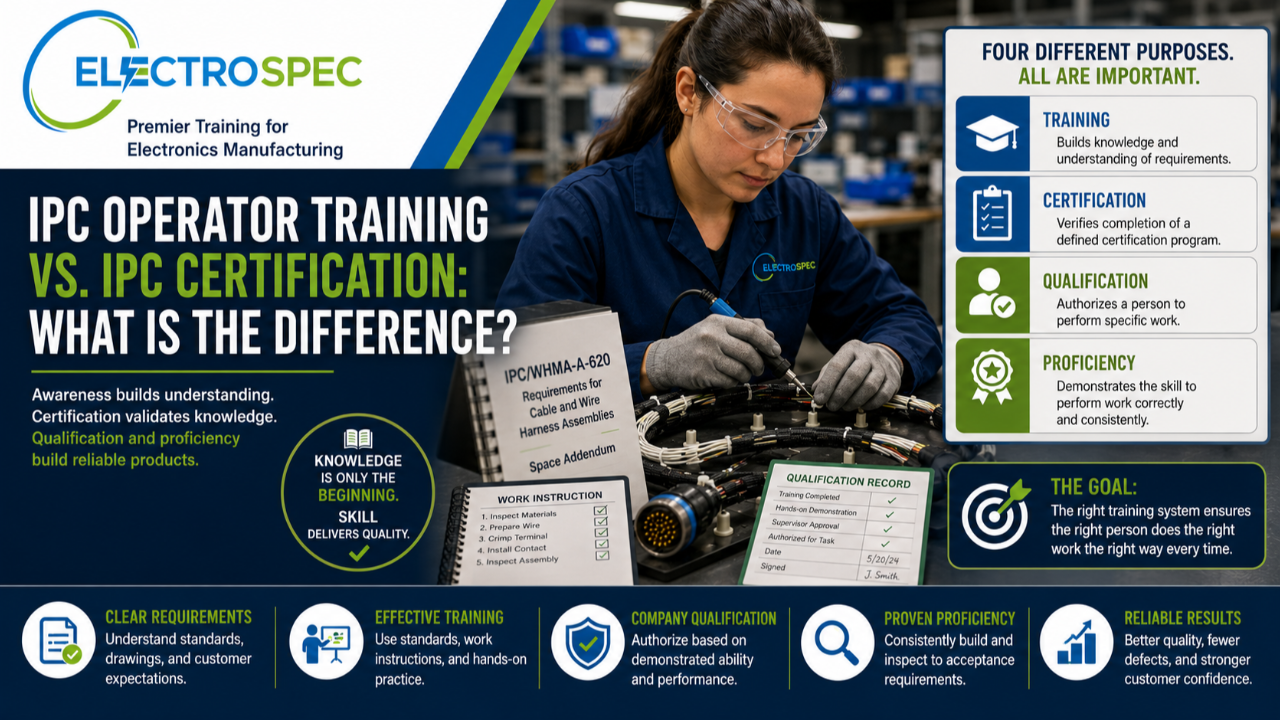
In the previous article, we explained that training, certification, qualification, and proficiency are not the same thing.
That distinction matters because many companies are now trying to decide whether employees need operator awareness training, formal IPC certification, internal company qualification, or all of the above.
This question comes up often with:
- IPC-A-610
- IPC/WHMA-A-620
- J-STD-001
- IPC/WHMA-A-620 Space Addendum
- J-STD-001 Space Addendum
The confusion usually begins when someone asks:
“Do our operators need IPC certification, or do they just need IPC training?”
The answer depends on the role, the product, the contract, and the company’s internal training system.
Operator Training and Certification Serve Different Purposes
Operator training is generally intended to help employees understand requirements, terminology, workmanship expectations, and basic concepts.
Certification is a formal program that verifies a person completed a defined certification path and met the testing requirements of that program.
Those are not the same thing.
Operator training may support awareness.
Certification may support standards knowledge.
Neither automatically proves that a person is qualified or proficient to perform a specific manufacturing task on a specific product.
What Operator Training Can Do
Operator training can be useful when it helps employees understand:
- Common workmanship expectations
- Product acceptance terminology
- ESD awareness
- Handling requirements
- Common defects
- Process discipline
- Why work instructions matter
- Why customer requirements matter
- How defects affect reliability
This type of training can help operators understand the “why” behind the work.
That is valuable.
Operators who understand the importance of their work are often better prepared to follow procedures, recognize problems, and ask the right questions.
What Operator Training Cannot Do by Itself
Generic operator training does not automatically teach someone how to perform a company-specific process.
It does not automatically qualify someone to:
- Solder a specific assembly
- Crimp a specific terminal
- Assemble a specific connector
- Build a space-grade cable harness
- Terminate coaxial or RF cable
- Perform rework or repair
- Operate company-specific equipment
- Use company-specific tooling
- Inspect a product line without supervision
Those abilities require company-specific training, supervised practice, and task qualification.
A generic online course may explain requirements, but it cannot fully replicate the company’s actual product, equipment, tools, materials, process controls, and work instructions.
What IPC Certification Can Do
IPC certification can help demonstrate that a person has completed a formal certification program and can use the applicable standard to interpret conditions and apply requirements.
That can be useful for:
- Inspectors
- Quality personnel
- Engineers
- Trainers
- Manufacturing leaders
- Operators when certification is required by contract or company procedure
Certification can create common language across the organization.
It can also support customer confidence when the certification requirement is clearly defined.
What IPC Certification Cannot Do by Itself
Certification does not automatically prove product conformance.
Certification does not automatically prove workmanship proficiency.
Certification does not automatically qualify someone for every task associated with the standard.
For example, a person may pass an IPC/WHMA-A-620 exam and understand cable and wire harness requirements, but still need hands-on training before performing a specific crimp, shield termination, coaxial cable assembly, or connector installation.
A person may understand IPC-A-610 acceptance criteria, but still need company-specific training before performing final inspection on a particular product.
A person may understand J-STD-001 requirements, but still need process-specific training before soldering production hardware.
The Missing Piece: Company-Specific Work Instructions
The most important document for an operator is usually not the IPC standard itself.
It is the company work instruction.
Company work instructions translate engineering requirements, customer flow-downs, materials, equipment, tooling, and process controls into the actual steps the operator must perform.
Standards may define what an acceptable product looks like.
Work instructions define how your company builds that product.
That distinction is critical.
Operators should not be expected to figure out the manufacturing process from a standard during production.
They should be trained to follow approved company procedures that already incorporate applicable requirements.
When Operators May Need IPC Certification
There are legitimate situations where operator certification may be appropriate or required.
Examples include:
- The contract explicitly requires certified personnel
- Customer quality clauses require certification
- Internal company procedures require certification
- Operators perform self-inspection
- Operators perform formal acceptance decisions
- Operators work in high-reliability environments where certification is part of the training system
- The company uses certification as a baseline knowledge requirement
In these situations, certification can be part of a strong training system.
The key is that the requirement should be intentional, documented, and tied to the role.
When Operator Awareness May Be Enough
In other cases, operators may not need formal certification.
They may need:
- Company work instruction training
- Product-specific training
- ESD awareness
- Tooling training
- Process training
- Hands-on practice
- Supervised performance
- Internal qualification
- Periodic reassessment
This may be especially true when operators are not making formal acceptance decisions and are working under controlled procedures with trained inspectors verifying product acceptability.
The right answer depends on the manufacturing system.
The Real Question
The best question is not:
“Should every operator be IPC certified?”
The better question is:
“What knowledge, training, qualification, and evidence are required for this operator to perform this specific work correctly and consistently?”
That question forces the company to think beyond certificates.
It connects training to the actual product, process, customer requirement, and risk.
Operator Training Should Support Product Reliability
The goal of operator training is not simply to complete a course.
The goal is to help operators build reliable products.
That requires a system that includes:
- Clear work instructions
- Trained supervisors
- Qualified operators
- Controlled processes
- Proper tools
- Verified materials
- ESD protection
- Process feedback
- Inspection results
- Continuous improvement
Training works best when it supports the actual manufacturing process.
Final Thought
IPC operator training and IPC certification are both useful when applied correctly.
But neither should be confused with company-specific qualification or task-specific proficiency.
Generic operator training may build awareness.
Certification may demonstrate standards knowledge.
Company-specific training and qualification ensure operators can perform the actual work required by the organization.
In high-reliability electronics manufacturing, the strongest programs combine all three when appropriate:
Standards knowledge.
Company work instructions.
Demonstrated task proficiency.
That is how training becomes manufacturing capability.
Need Help Choosing the Right Training Path?
ElectroSpec offers IPC/WHMA-A-620 base CIS certification and IPC-A-610 certification for organizations that need formal certification.
For companies trying to decide between operator awareness, IPC certification, internal qualification, or product-specific training, ElectroSpec can help clarify the training path based on role, product type, customer requirement, and manufacturing risk.
Coming Next
Why IPC Certification Alone Does Not Prove Workmanship Skill
In the next article, we will look more closely at workmanship, hands-on ability, and why knowing an acceptance requirement is not the same as consistently producing acceptable product.
IPC-A-610 CIS Certification — ElectroSpec
IPC/WHMA-A-620 CIS Certification — ElectroSpec