
IPC CID Certification: What Designers Should Know Before Testing
Oct 06, 2026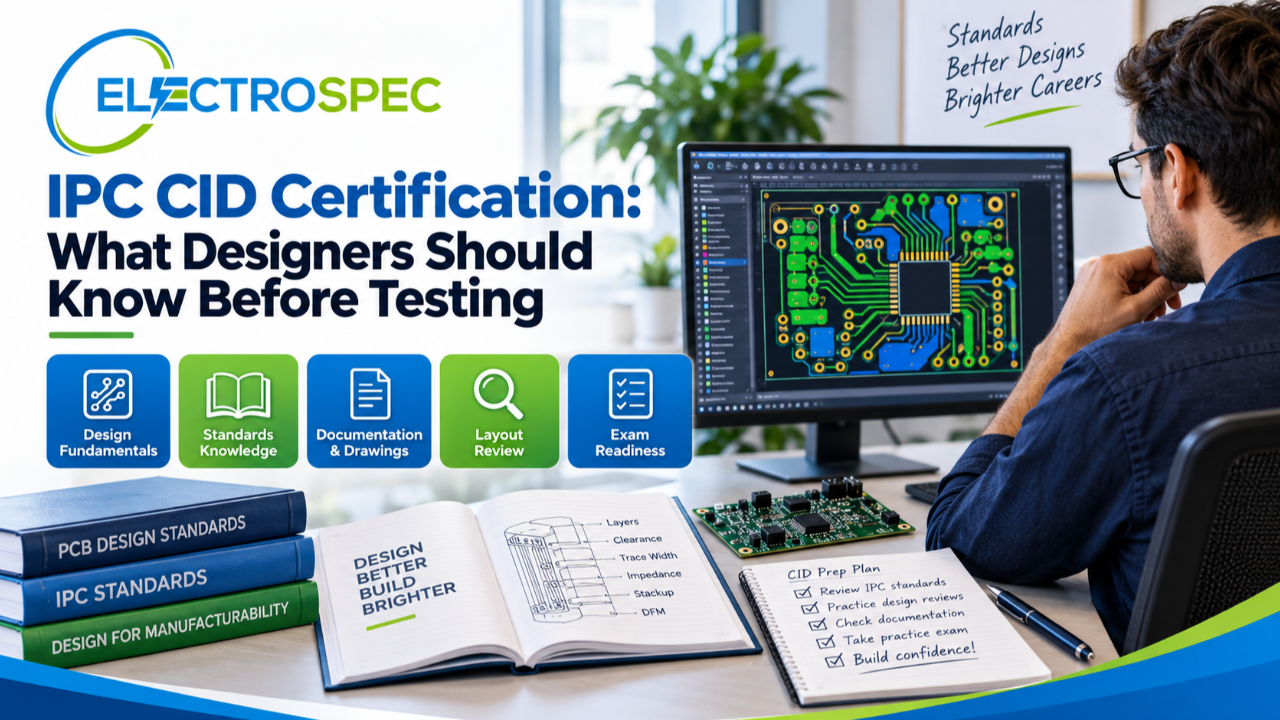
IPC CID certification is different from assembly inspection certification.
CID is focused on printed circuit board design.
That makes it valuable for PCB designers, electrical engineers, manufacturing engineers, quality engineers, and technical professionals who need a stronger foundation in how printed boards are designed, documented, fabricated, assembled, and accepted.
Before testing, students should understand that CID is not just about routing traces.
It is about PCB design as a complete engineering discipline.
CID Is About PCB Design Fundamentals
CID helps students build a foundation in design concepts that affect the full product lifecycle.
That includes materials, layout principles, mechanical and electrical considerations, thermal management, component technologies, interconnections, fabrication requirements, documentation, quality assurance, manufacturability, and standards-based design thinking.
A designer who understands these areas can make better decisions before a product reaches manufacturing.
Design Is More Than CAD
CAD skill is important, but it is not enough by itself.
A PCB layout must support electrical function, mechanical fit, fabrication, assembly, inspection, test, documentation, and reliability.
A student preparing for CID should think beyond the layout screen.
Every trace, pad, via, material, note, and drawing decision can affect the final product.
Materials Matter
PCB designers should understand materials before layout.
Laminates, copper, solder mask, surface finish, dielectric behavior, thermal expansion, moisture resistance, and fabrication compatibility all affect the design.
A board is not just copper on green material.
It is an engineered material system.
Fabrication Requirements Matter
The PCB supplier must build the design.
That means designers need awareness of stackup, copper thickness, hole sizes, plated through-holes, vias, annular ring, solder mask, surface finish, tolerances, and supplier capability.
A design that looks good in CAD may still be difficult to fabricate if manufacturing realities are ignored.
Documentation Matters
CID students should understand that design intent must be communicated clearly.
Fabrication drawings, assembly drawings, BOMs, notes, standards callouts, material requirements, inspection requirements, and test requirements all help transfer the design to manufacturing.
Poor documentation creates assumptions.
Assumptions create risk.
Quality and Acceptance Matter
Design affects inspection and product acceptance.
A designer should consider whether the product can be built, inspected, tested, documented, and trusted.
This is especially important for high-reliability products, Class 3 products, aerospace, defense, medical, industrial, and harsh-environment applications.
ElectroSpec CID Training Supports Preparation
ElectroSpec’s CID Fundamentals course provides 22+ hours of self-paced, on-demand PCB design training across 12 structured modules.
Students can study around work schedules, revisit difficult lessons, and build confidence before testing.
The course is designed to support CID certification preparation while also strengthening real-world PCB design judgment.
What Students Should Do Before Testing
Before testing, students should:
- review the course structure
- understand major design topics
- learn standards-based terminology
- study materials and fabrication concepts
- review documentation expectations
- practice with exam-style questions
- understand the testing process
- confirm schedule and access
- prepare technology if testing online
A prepared student is more confident.
Final Thought
CID certification preparation is valuable because PCB design affects the entire product.
Designers do not only create layouts.
They create products that must be fabricated, assembled, inspected, tested, documented, and trusted.
CID helps designers build that foundation.
Coming Next
IPC CID+ Certification: What Advanced Designers Should Know
In the next article, we will explain how CID+ builds beyond CID into advanced topics such as fabrication and assembly, materials, rigid, flex, HDI, RF/microwave, and environmental stress screening.