
Why ElectroSpec Built CID and CID Advanced as Standards-Based Design Pathways
Aug 13, 2026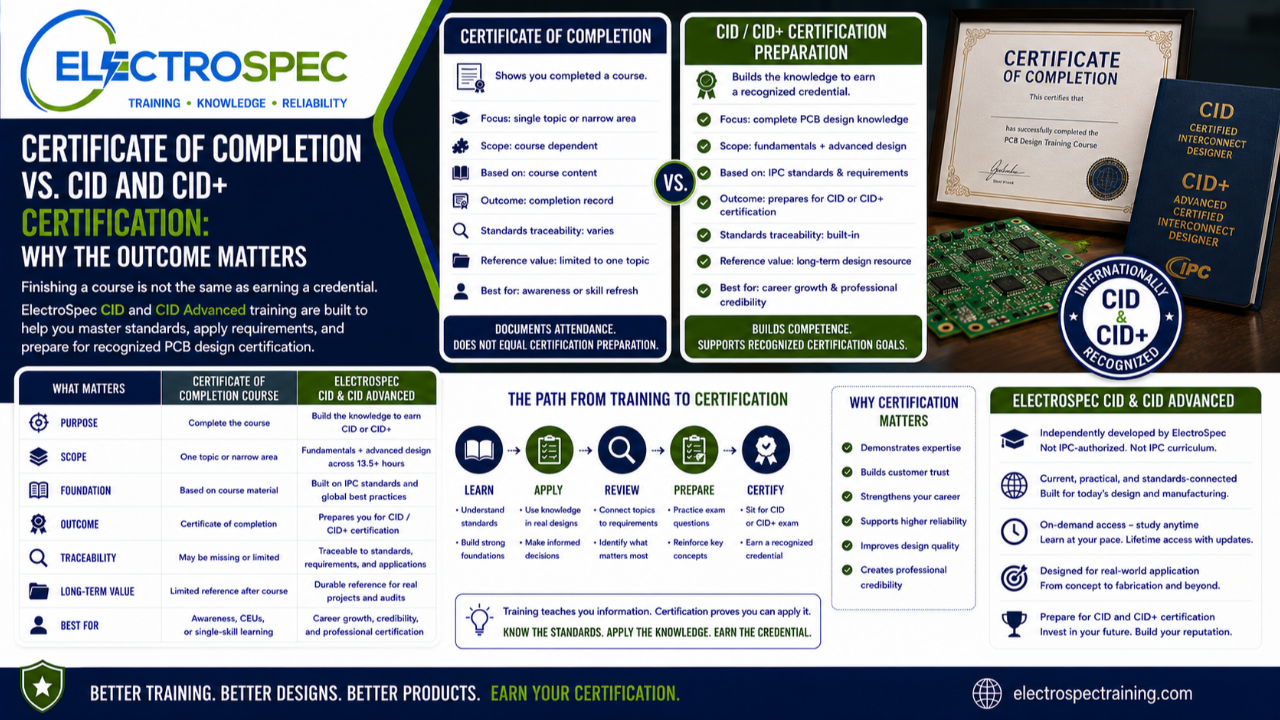
Throughout this comparison series, we have looked at PCB design training from several angles.
Introductory PCB design courses.
Design for manufacturability courses.
Fabrication and materials courses.
Flex and rigid-flex courses.
RF and signal integrity courses.
HDI and advanced design courses.
Military, aerospace, and extreme environment courses.
ECAD, MCAD, and constraint courses.
Certificate of completion courses.
Each of those topics can have value.
But ElectroSpec built its CID and CID Advanced training around a different idea:
PCB designers do not need scattered topic exposure alone. They need a standards-based design pathway that connects knowledge back to requirements, supports long-term reference value, and prepares them for recognized certification goals.
That is the purpose of ElectroSpec CID and CID Advanced.
Designers Need a Framework, Not Just Course Fragments
PCB design is not one skill.
It is a connected technical discipline.
A designer must understand how design decisions affect fabrication, assembly, inspection, test, acceptance, qualification, and reliability.
A short topic course may teach one area.
That may be useful when the need is narrow.
But real PCB design requires integration.
A layout decision may affect fabrication.
A material decision may affect solderability.
A stackup decision may affect impedance and reliability.
A pad decision may affect solder joint formation.
A via decision may affect yield and long-term performance.
A documentation decision may affect supplier interpretation.
A test access decision may affect acceptance evidence.
That is why ElectroSpec built CID and CID Advanced as connected pathways instead of disconnected lessons.
ElectroSpec CID Builds the Foundation
ElectroSpec’s CID Fundamentals course is a 22+ hour on-demand PCB Fundamentals Course.
It includes 12 structured modules covering core design knowledge such as:
- PCB materials
- layout principles
- mechanical considerations
- electrical considerations
- thermal management
- component technologies
- interconnections
- fabrication requirements
- documentation
- quality assurance
- manufacturability
- standards-based design thinking
The goal is not only to introduce PCB design.
The goal is to help students build a complete foundation and approach the CID exam with greater confidence.
CID Fundamentals is designed for designers, engineers, and technical professionals who need more than a quick introduction.
It is for people who need the “why” behind the design choices.
ElectroSpec CID Advanced Builds the Advanced Path
ElectroSpec’s CID Advanced training expands into advanced PCB design topics through 13.5+ hours of specialized on-demand content.
The current advanced track includes:
- PCB Fabrication & Assembly, 4.5 hours
- PCB Materials, 1.75 hours
- Rigid PCB Design, 1 hour
- Flexible PCB Design, 1 hour
- HDI PCB Design, 1.5 hours
- RF/Microwave PCB Design, 1.75 hours
- Environmental Stress Screening, 2 hours
These topics were selected because advanced PCB design requires more than one specialty.
A designer working at the CID+ level needs to understand materials, fabrication, assembly, rigid board design, flex design, HDI, RF and microwave design, environmental stress, and high-reliability considerations.
ElectroSpec’s CID Advanced course is built to connect those topics into one advanced design pathway.
Additional courses may be added over time, and comprehensive track enrollees receive access to new content as it is released during their access window.
Standards Traceability Is the Core Difference
One of the strongest reasons ElectroSpec built these courses is standards traceability.
When designers learn a rule, recommendation, design limit, or best practice, they should be able to ask:
- Where does this come from?
- Is it tied to a standard?
- Is it tied to a material requirement?
- Is it tied to fabrication capability?
- Is it tied to assembly requirements?
- Is it tied to inspection or acceptance criteria?
- Is it tied to Class 3 expectations?
- Is it tied to customer flow-downs?
- Is it tied to qualification or environmental stress?
- Is it a requirement, a guideline, a supplier preference, or engineering judgment?
That matters.
A designer who only memorizes tips may struggle when a customer, supplier, auditor, or failure analysis team asks why a design decision was made.
A designer who understands traceability can explain the design basis.
That is a professional skill.
Courses Come and Go, But Requirements Remain
Training catalogs change.
Course names change.
Courses are renamed, repackaged, added, or removed.
That is normal.
But design requirements remain.
Materials still matter.
Fabrication still matters.
Assembly still matters.
Inspection still matters.
Class 3 still matters when invoked.
Customer flow-downs still matter.
Qualification requirements still matter.
Designers need a durable reference framework they can use after the course is over.
ElectroSpec CID and CID Advanced are built to provide that kind of reference value.
The training is intended to help students return to the material, connect concepts back to standards, and apply the information to real design work.
Current Training Matters
PCB design changes over time.
Standards change.
Materials change.
Fabrication capabilities change.
Assembly processes change.
Customer expectations change.
Training should not be frozen in an older revision era.
Before selecting any CID or CID+ preparation course, students should ask what technical references, standards assumptions, and curriculum structure the course is built around.
Some legacy training materials in the marketplace may still reflect older 2015 or 2016-era content structures.
That does not automatically mean every older course is useless.
But designers should verify that the training they choose supports the current design environment, current exam expectations, current manufacturing realities, and current standards framework they need to understand.
ElectroSpec’s goal is to keep CID and CID Advanced practical, relevant, and standards-connected.
Topic Courses Can Be Useful, But They Are Not the Same Outcome
Topic courses can be helpful.
A designer may need a short course on flex.
Another may need RF.
Another may need ECAD and MCAD workflow training.
Another may need a quick introduction to manufacturability.
Those needs are real.
But topic exposure is not the same as a complete design pathway.
A topic course may answer one question.
A pathway helps the designer understand how the questions connect.
That is why ElectroSpec’s approach is built around CID and CID+ preparation.
The goal is not just to complete a class.
The goal is to build professional PCB design knowledge that supports a recognized certification path.
Certificate of Completion Is Not the Same as Certification Preparation
A certificate of completion may show that a student completed a course.
That has value for internal records or professional development.
But completion is not the same as certification preparation.
ElectroSpec CID and CID Advanced are designed to support preparation for CID and CID+ certification.
That changes the purpose of the training.
The student is not only receiving exposure to a topic.
The student is building a foundation for a recognized design credential.
That matters for designers.
It matters for employers.
It matters for customers.
It matters when credibility and technical confidence are important.
Price Should Be Compared to Scope and Outcome
Price matters.
But price should not be compared without scope and outcome.
A single topic course may cost less than a full certification preparation pathway.
That may make sense if the student only needs one narrow topic.
But many PCB design topics are interconnected.
A student who purchases separate courses in manufacturability, fabrication, materials, flex, HDI, RF, signal integrity, military and aerospace applications, and tool workflows may spend significantly more while still not having a unified certification preparation path.
ElectroSpec CID and CID Advanced are commonly positioned in the $995 to $1,495 range, depending on the offering.
A broader pathway built from multiple individual topic courses can reach $2,500+.
The better question is:
Is the student buying isolated topic exposure, or investing in a standards-based pathway toward CID or CID+ certification?
What ElectroSpec Built
ElectroSpec built CID and CID Advanced around five major ideas.
| What Matters | ElectroSpec CID and CID Advanced Approach |
|---|---|
| Scope | Broad fundamentals plus advanced design domains |
| Traceability | Concepts connected back to standards and requirements |
| Reference value | Designed for long-term use and real project application |
| Practical application | Manufacturing-aware, design-focused, and reliability-centered |
| Outcome | Supports CID and CID+ certification preparation |
That is the value proposition.
Not scattered topics.
Not buzzwords.
Not course completion alone.
A structured pathway.
The Role of IPC and Other Standards
IPC remains an important part of the electronics design and manufacturing standards ecosystem.
But IPC is not the only standards system designers may encounter.
Depending on the product, designers may also need to understand customer requirements, military specifications, NASA requirements, ESA requirements, IEC standards, company specifications, material requirements, environmental qualification requirements, and contract flow-downs.
ElectroSpec’s design training does not treat standards as isolated documents.
It treats them as part of the design decision process.
The designer must understand what applies, why it applies, and how to use it.
That is standards literacy.
Standards Provide the Rules, Designers Create the Product
Standards do not replace design judgment.
They define requirements, constraints, boundaries, and expectations.
The designer still creates the product.
The designer still makes tradeoffs.
The designer still chooses materials, layout structure, interconnections, stackup, component placement, inspection access, test strategy, and reliability approach.
Standards provide the puzzle pieces.
The designer creates the picture.
That is why good training must do more than repeat requirements.
It must help designers think.
Independently Developed by ElectroSpec
ElectroSpec’s CID and CID Advanced courses are independently developed by ElectroSpec.
They are not IPC-authorized training and they are not official IPC curriculum.
ElectroSpec built these courses to provide practical, standards-connected, manufacturing-aware training for designers pursuing CID and CID+ certification preparation.
The purpose is to help designers understand standards, apply requirements, make better decisions, and prepare for recognized PCB design certification goals.
Final Thought
ElectroSpec built CID and CID Advanced because PCB designers need more than course fragments.
They need a foundation.
They need standards traceability.
They need practical manufacturing awareness.
They need durable reference value.
They need advanced design context.
They need a pathway that supports recognized certification preparation.
A topic course may teach a slice of PCB design.
ElectroSpec CID and CID Advanced are built to help designers understand the whole design system.
From materials to fabrication.
From layout to assembly.
From inspection to reliability.
From standards to certification.
From rules to real products.
That is the ElectroSpec approach.
Related ElectroSpec Training
ElectroSpec’s CID Fundamentals course provides 22+ hours of on-demand PCB design training across 12 structured modules.
ElectroSpec’s CID Advanced training includes PCB Fabrication & Assembly, PCB Materials, Rigid PCB Design, Flexible PCB Design, HDI PCB Design, RF/Microwave PCB Design, and Environmental Stress Screening.
Together, these courses provide a standards-connected pathway for designers preparing for CID and CID+ certification.
Series Wrap-Up
This comparison series covered:
- IPC PCB design courses vs. ElectroSpec CID and CID Advanced
- Intro PCB design courses vs. ElectroSpec CID Fundamentals
- PCB design for manufacturability
- PCB fabrication and materials
- Flex and rigid-flex training
- RF and signal integrity training
- HDI and advanced PCB design
- Military, aerospace, and extreme environments
- ECAD, MCAD, and constraint courses
- Certificate of completion vs. CID and CID+ certification
- Why ElectroSpec built CID and CID Advanced as standards-based design pathways
The message is simple:
Know the standards. Apply the knowledge. Earn the certification.
IPC CID Certification — ElectroSpec
IPC CID+ Certification — ElectroSpec
IPC CID/CID+ Bundle — Complete PCB Design Certification — ElectroSpec