
Intro PCB Design Courses vs. ElectroSpec CID Fundamentals: Exposure or Certification Pathway?
Aug 04, 2026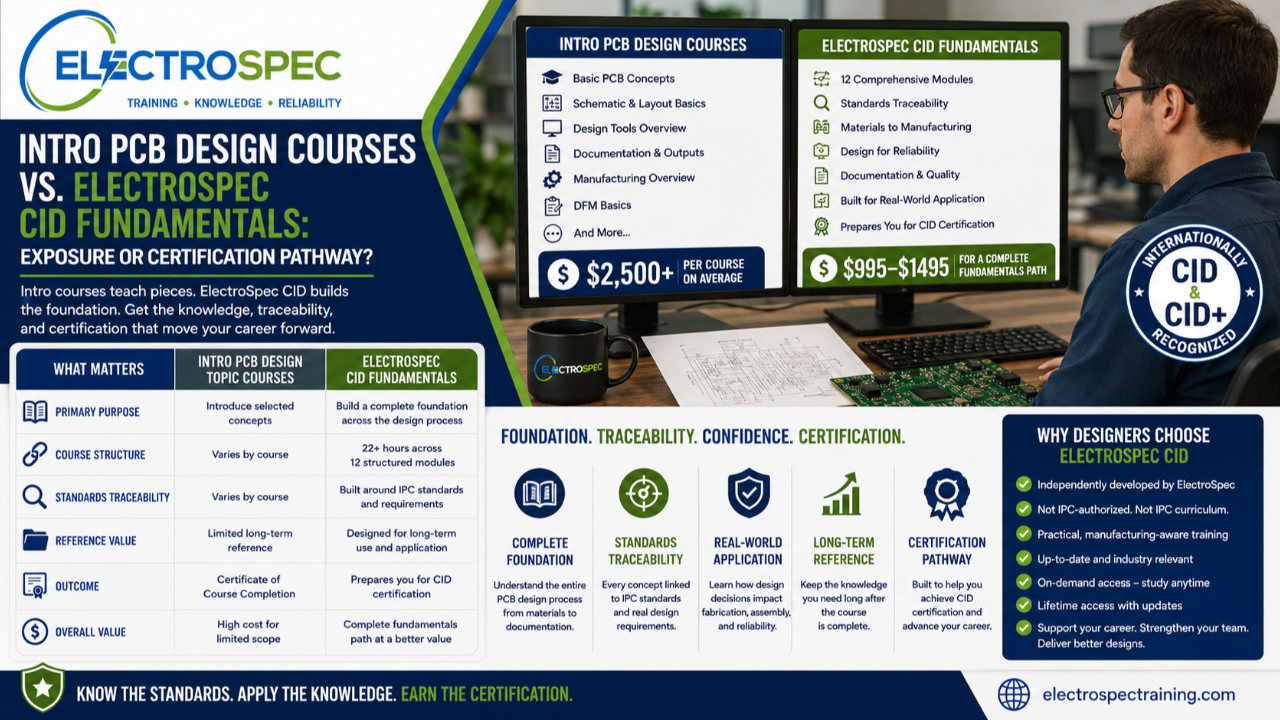
Introductory PCB design courses can be useful.
They can help engineers, technicians, managers, and new designers understand the basic language of printed circuit board design. They may introduce schematics, layout concepts, documentation, fabrication, manufacturability, and the overall process of turning an electronic concept into a physical product.
That has value.
But introductory exposure is not the same as a complete standards-based design foundation.
And it is not the same as a training pathway built to support a recognized PCB design certification.
That is the important comparison.
The Real Question
When selecting PCB design training, the question is not simply:
Does this course teach PCB design?
The better question is:
Does this course build a designer’s foundation, connect information back to standards, provide long-term reference value, and support a certification outcome?
That is where ElectroSpec’s CID Fundamentals course is different.
ElectroSpec CID is not built as a short topic introduction.
It is a 22+ hour on-demand PCB Fundamentals Course designed to help students build broad design knowledge and approach the CID exam with greater confidence.
Introductory Courses Usually Teach a Slice
Based on the course catalog examples reviewed, introductory PCB design training may appear in several forms.
Some courses are survey courses for non-designer engineers. Others are entry-level design courses focused on schematic creation, documentation, layout strategy, or moving a design into manufacturing.
Those courses can help students understand pieces of the design process.
But a designer preparing for professional PCB design work needs more than pieces.
They need a framework.
They need to understand how the pieces connect.
A schematic decision affects layout.
A layout decision affects fabrication.
A fabrication decision affects assembly.
An assembly decision affects inspection.
Inspection and test affect acceptance.
Acceptance and qualification affect customer confidence.
PCB design is not one isolated skill.
It is a connected technical discipline.
ElectroSpec CID Builds the Foundation Across 12 Modules
ElectroSpec’s CID Fundamentals course includes 12 structured modules covering the major building blocks of PCB design.
The course includes:
- materials
- layout principles
- mechanical considerations
- electrical considerations
- thermal management
- component technologies
- interconnections
- fabrication requirements
- documentation
- quality assurance
- manufacturability
- standards-based design thinking
The goal is not only to explain PCB design terms.
The goal is to help students understand how design decisions affect the product through fabrication, assembly, inspection, acceptance, and reliability.
That is the difference between a topic introduction and a design foundation.
Standards Traceability Matters
One of the biggest weaknesses in many short design courses is that the student may learn a concept without understanding where that concept comes from.
For example, a course may tell a student to use a certain spacing, material consideration, documentation practice, or design approach.
But the student still needs to know:
- Is this tied to a standard?
- Is this tied to a fabrication requirement?
- Is this tied to an assembly process?
- Is this tied to acceptability?
- Is this tied to reliability?
- Is this tied to Class 2 or Class 3 expectations?
- Is this tied to customer flow-downs?
- Is this tied to the operating environment?
That traceability matters.
Designers do not only need to know what to do.
They need to know why it matters and where the requirement belongs.
ElectroSpec CID is built to help students connect PCB fundamentals back to the standards and requirements that govern real design decisions.
Courses Come and Go, But Requirements Remain
Training catalogs change.
Course titles change.
Topics are renamed, repackaged, expanded, reduced, or removed.
That is normal.
But the designer still needs a durable reference framework.
The student should leave training with knowledge they can return to later, not just a memory of a course title.
ElectroSpec CID is designed to give students a structured foundation they can reference as they continue to grow in PCB design.
That matters because real design work does not end when the course ends.
Designers may need to revisit material choices, layout decisions, documentation requirements, fabrication notes, tolerance issues, acceptability concerns, and quality expectations months or years later.
A good course should support that long-term need.
Certification Outcome Matters
A certificate of completion can show that a person completed a class.
That may be useful.
But it is not the same as preparing for a recognized PCB design certification.
ElectroSpec CID Fundamentals is built to support preparation for the CID certification.
That changes the purpose of the training.
The course is not simply intended to expose the student to PCB design.
It is intended to help the student build the knowledge base needed for a recognized professional design credential.
That difference matters to designers, employers, customers, and technical managers.
Price Should Be Compared to Scope and Outcome
Price matters, but it should be compared honestly.
A short introductory survey course may cost less than a full CID preparation course. That makes sense because the scope and outcome are different.
However, some longer introductory PCB design courses can be priced much higher, especially when purchased as separate courses.
Based on the catalog examples reviewed, introductory PCB design courses may range from lower-cost survey pricing to higher-priced individual courses. Some listed examples reached $2,000 to $2,500 for a single course.
ElectroSpec CID is positioned differently.
ElectroSpec provides a broad, 22+ hour, on-demand fundamentals pathway designed to support CID certification preparation, with simplified pricing commonly positioned in the $995 to $1,495 range depending on the offering.
The better comparison is not simply price.
The better comparison is value:
| Question | Intro PCB Topic Course | ElectroSpec CID Fundamentals |
|---|---|---|
| Primary purpose | Introduce selected PCB design concepts | Build a broad PCB design foundation |
| Structure | Course dependent | 22+ hours across 12 modules |
| Standards traceability | Varies by course | Built around standards and requirements |
| Reference value | May be limited to course topic | Designed as a durable learning framework |
| Outcome | Often certificate of completion | Supports CID certification preparation |
| Best fit | General exposure or one knowledge gap | Designers seeking a stronger foundation and credential path |
Topic Exposure Has a Place
This comparison does not mean introductory topic courses have no value.
They do.
A short PCB design course may be useful for:
- non-designer engineers
- managers who need basic awareness
- technicians supporting design teams
- buyers or planners who need vocabulary
- students exploring the field
- engineers filling a narrow knowledge gap
But if the goal is to build professional PCB design capability, prepare for CID certification, and understand how design requirements connect to standards and manufacturing, then a broader pathway is needed.
That is what ElectroSpec CID is designed to provide.
Independently Developed by ElectroSpec
ElectroSpec’s CID Fundamentals course is independently developed by ElectroSpec.
It is not IPC-authorized training and it is not official IPC curriculum.
ElectroSpec developed the course to provide a practical, standards-connected, manufacturing-aware preparation path for designers pursuing CID certification.
That independence allows ElectroSpec to focus on real-world design understanding, standards traceability, manufacturability, documentation, reliability, and exam preparation.
Final Thought
Introductory PCB design courses can teach useful concepts.
But designers need more than an introduction.
They need a foundation.
They need standards traceability.
They need reference value.
They need to understand how design decisions affect fabrication, assembly, inspection, acceptance, and reliability.
And many designers need a training path that supports a recognized certification outcome.
That is the purpose of ElectroSpec CID Fundamentals.
A topic course may introduce PCB design.
ElectroSpec CID helps build the designer.
Related ElectroSpec Training
ElectroSpec’s CID Fundamentals course provides 22+ hours of on-demand PCB design training across 12 structured modules.
The course is designed for students preparing for CID certification and for professionals who need a stronger foundation in PCB materials, layout, fabrication, documentation, manufacturability, quality, and standards-based design thinking.
Coming Next
PCB Design for Manufacturability: Standalone Topic or Standards-Based Design Skill?
In the next article, we will compare manufacturability-focused PCB design courses with ElectroSpec’s CID and CID Advanced approach, showing why DFM is not one isolated topic but a design discipline connected to standards, materials, fabrication, assembly, inspection, and reliability.
IPC CID Certification — ElectroSpec
IPC CID+ Certification — ElectroSpec
IPC CID/CID+ Bundle — Complete PCB Design Certification — ElectroSpec