
Is IPC Certification Worth It? What It Does for Your Career and Your Company
Oct 14, 2026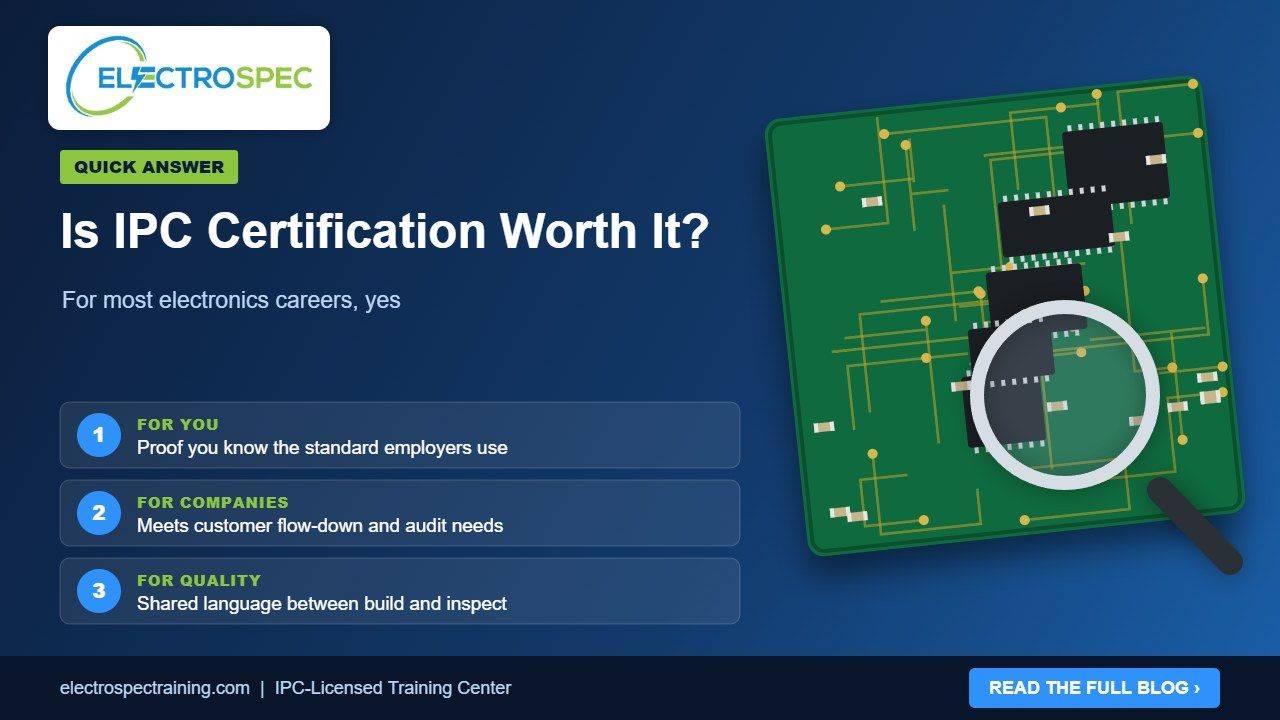
For most people working in electronics manufacturing, yes.
IPC certification is one of the few credentials recognized across the whole industry, from contract manufacturers to aerospace primes.
What IPC Certification Does for You
- Shows employers you know the standard they build and inspect to
- Helps you move from operator to inspector, lead or trainer
- Travels with you from company to company
- Gives you confidence when you make an accept or reject call
You do not need a college degree to earn it. Many people start their electronics career with an IPC-A-610 or IPC/WHMA-A-620 certification.
What It Does for a Company
- Meets customer and contract requirements that call for IPC-certified personnel
- Gives auditors objective evidence of training
- Creates a shared language between design, production and inspection
- Reduces arguments over what is acceptable
What IPC Certification Does Not Do
Certification proves you know the standard. It does not prove hands-on skill by itself.
Good companies pair certification with on-the-job training, work instructions and skill verification.
Which Certification Should You Start With?
- Building or inspecting circuit board assemblies: IPC-A-610 CIS
- Building or inspecting cables and harnesses: IPC/WHMA-A-620 CIS
- Fabricating or inspecting bare boards: IPC-A-600 CIS
- Designing printed boards: IPC CID, then CID+
The Bottom Line
IPC certification costs a few days of study and an exam. In return, you get a credential the whole industry recognizes.
For most technicians, inspectors, engineers and designers, that is a good trade.