
Why IPC Certification Alone Does Not Prove Workmanship Skill
Jul 19, 2026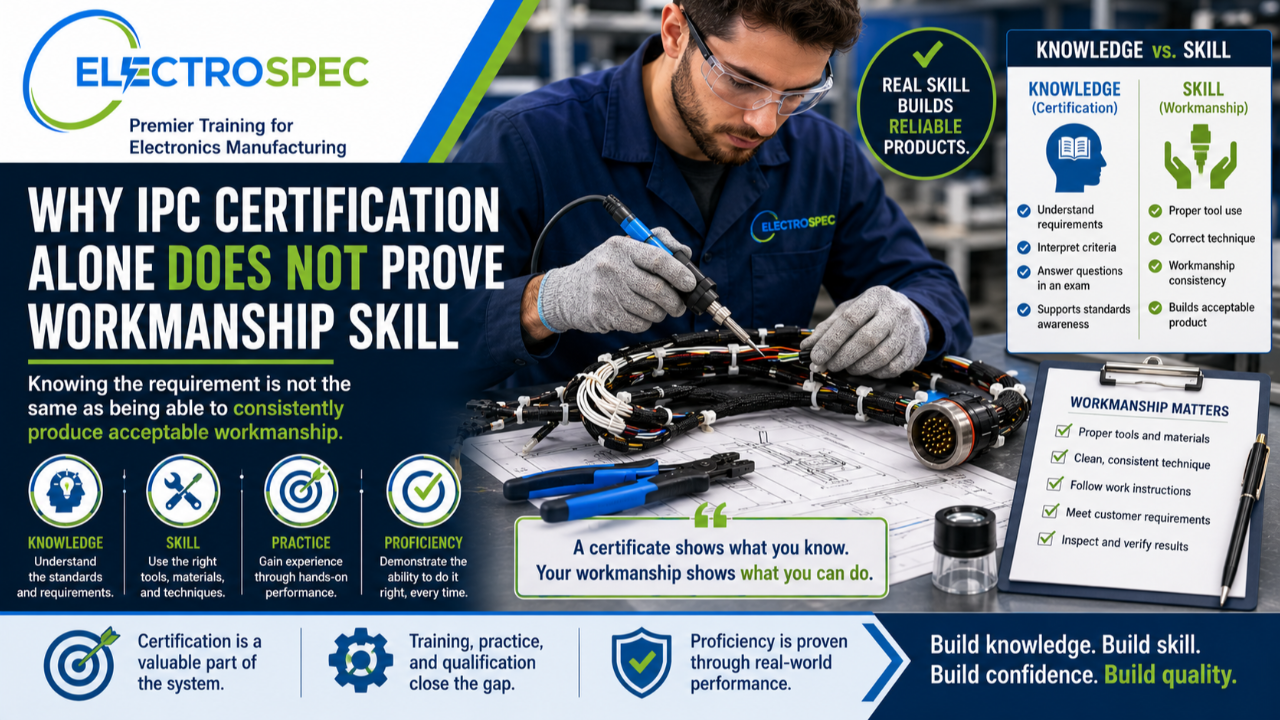
In the previous articles in this series, we explained that IPC certification does not prove product conformance and that training, certification, qualification, and proficiency are not the same thing.
Now we need to address one of the most important points in electronics manufacturing:
Knowing the requirement is not the same as being able to consistently produce acceptable workmanship.
This distinction matters in every area of electronics manufacturing, but it becomes especially important for high-reliability soldering, cable and wire harness assembly, rework, repair, and Space Addendum work.
Certification Supports Standards Knowledge
IPC certification can be valuable.
It helps students understand the structure of a standard, locate requirements, interpret conditions, and apply acceptance criteria.
That knowledge matters.
An inspector who understands IPC-A-610 can evaluate electronic assembly conditions more consistently.
A cable and harness technician who understands IPC/WHMA-A-620 can better recognize workmanship expectations.
A quality engineer who understands J-STD-001 can better discuss soldering requirements and process expectations.
However, standards knowledge is only one part of manufacturing capability.
A person may know what an acceptable condition looks like and still not be able to consistently create that condition with their hands.
Workmanship Skill Is Demonstrated Through Performance
Workmanship skill is practical.
It is demonstrated by performing the task correctly and consistently using the actual tools, materials, equipment, drawings, and work instructions required for the job.
That may include the ability to:
- Strip wire without damaging conductors
- Crimp terminals with the correct tooling
- Assemble connectors correctly
- Prepare coaxial or RF cable
- Terminate shields properly
- Route and dress wires
- Install sleeving or strain relief
- Solder to required workmanship standards
- Perform rework or repair without causing damage
- Clean assemblies properly
- Handle products using ESD controls
- Document the work accurately
These are hands-on skills.
They are not proven by a written exam alone.
The Space Addendum Example
The IPC/WHMA-A-620 Space Addendum provides a useful example.
A person may be able to pass an open-book test on Space Addendum requirements.
That does not automatically mean that person should be released to build a space-grade cable or harness assembly.
Space-related cable and harness work may involve:
- Multiple wire types
- Shielding
- Coaxial cable
- RF cable
- Solid and stranded conductors
- Specialized connectors
- Crimping
- Soldering
- Lacing and tying
- Harness routing
- Strain relief
- Identification and marking
- Documentation
- Detailed inspection
The ability to answer a question about a requirement is not the same as the ability to build that hardware correctly.
A person can understand the standard and still need hands-on training, supervised practice, workmanship demonstration, and company-specific qualification.
A Certificate Does Not Replace Product-Specific Qualification
Every manufacturer has different products, materials, tooling, processes, and customer requirements.
For example, two companies may both build cable harnesses to IPC/WHMA-A-620 Class 3, yet their products may be completely different.
One company may build simple point-to-point harnesses.
Another may build dense aerospace harnesses with shielding, coaxial cable, backshells, lacing, complex routing, and strict documentation requirements.
The same certification does not automatically qualify a person for both environments.
Product-specific qualification should consider the actual work being performed.
Inspectors Also Need Practical Skill
This issue does not apply only to operators.
Inspectors also need practical ability.
An inspector may know the acceptance criteria but still need experience to consistently identify subtle defects, workmanship variation, process indicators, or conditions that affect reliability.
Inspection skill may include:
- Proper use of magnification
- Understanding lighting and viewing conditions
- Recognizing process indicators
- Distinguishing acceptable from nonconforming conditions
- Understanding product-specific requirements
- Reviewing documentation
- Applying customer flow-downs
- Knowing when to escalate
- Avoiding defect escapes
- Avoiding unnecessary rejection of acceptable product
Inspection is not simply reading a book.
It requires judgment developed through training, experience, and product familiarity.
Operators Should Not Be Set Up to Fail
Operators are often blamed when workmanship problems occur.
Sometimes that blame is misplaced.
Operators may struggle because:
- Work instructions are unclear
- Tooling is inadequate
- Materials are inconsistent
- Process parameters are not controlled
- Training is too generic
- Qualification is incomplete
- Product design is difficult to manufacture
- Supervisors lack technical support
- Inspection feedback is poor
In those cases, the problem is not simply operator skill.
The problem is the manufacturing system.
A strong organization does not rely on certification alone. It builds a system that helps operators succeed.
What a Strong Workmanship Qualification System Looks Like
A strong workmanship qualification system may include:
- Standards awareness
- Company-specific work instruction training
- Tooling and equipment training
- Material handling training
- ESD training
- Hands-on practice
- Supervised production work
- Workmanship demonstration
- Inspection feedback
- Qualification records
- Periodic reassessment
- Corrective action when defects occur
Certification can be part of that system.
But it should not be mistaken for the whole system.
The Better Question
Instead of asking only:
“Is this person certified?”
Ask:
“Has this person demonstrated the ability to perform this specific work correctly and consistently?”
That question changes the conversation.
It moves the organization from paper compliance to real manufacturing capability.
It also helps quality, engineering, and production teams understand what evidence is actually needed.
Final Thought
IPC certification can support standards knowledge.
It can help personnel understand requirements, terminology, and acceptance criteria.
But workmanship skill is proven through performance.
Knowing the requirement is not the same as consistently producing acceptable product.
In high-reliability electronics manufacturing, companies need both knowledge and demonstrated ability.
The goal is not simply to hold a certificate.
The goal is to build and verify reliable products that meet customer, drawing, and mission requirements.
Need Help Strengthening Workmanship Training?
ElectroSpec offers IPC/WHMA-A-620 base CIS certification, IPC-A-610 certification, and high-reliability soldering and rework training to help organizations build standards knowledge and practical manufacturing understanding.
For companies developing internal qualification programs, ElectroSpec can also help think through role-based training, work instruction alignment, and workmanship expectations for operators, inspectors, and engineering teams.
Coming Next
Does a Drawing Note Require Every Operator and Inspector to Be IPC Certified?
In the next article, we will address one of the most common audit and compliance questions: when a drawing calls out IPC Class 3 or Space Addendum requirements, does that automatically mean every person touching the product must be IPC certified?
IPC-A-610 CIS Certification — ElectroSpec
IPC/WHMA-A-620 CIS Certification — ElectroSpec