
Qualification and Compliance Verification: Proving the ESD Program Works
Oct 21, 2026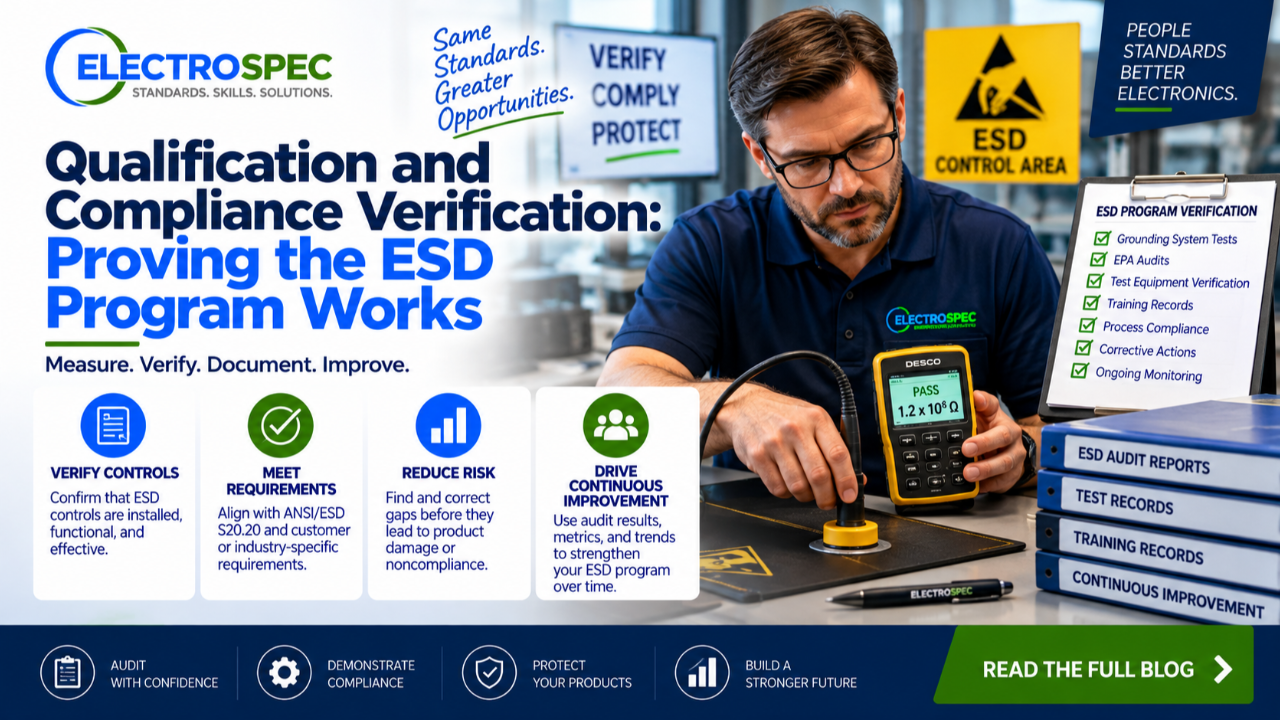
An ESD program is only as strong as its verification.
Written procedures are important.
Training is important.
Signs and workstations are important.
But none of those prove the program is working unless the controls are checked and the results are recorded.
That is the role of qualification and compliance verification.
Qualification Shows a Control Can Work
Qualification is used to show that a selected control, material, process, or system is capable of meeting the intended requirement.
For example, a company may qualify a floor and footwear system, a worksurface, packaging material, ionizer, or workstation setup.
Qualification helps answer the question:
Can this control perform as intended?
It is a technical confirmation before the control is relied upon.
Compliance Verification Shows It Still Works
Compliance verification is ongoing.
It confirms that controls continue to meet requirements during use.
A wrist strap may pass when new and fail later.
A floor may perform well when clean and fail after improper maintenance.
A mat may wear out.
An ionizer may drift.
Packaging may be damaged.
Verification helps detect these problems before they damage product.
Records Are Objective Evidence
In ESD program management, records matter.
A completed test record, audit checklist, calibration record, training record, or corrective action report provides objective evidence.
Objective evidence helps prove that the program is not just written, but active.
It also supports customer audits, internal audits, and root-cause investigations.
If there is no record, it can be difficult to prove the control was checked.
Common Verification Activities
ESD programs may verify many different controls.
These may include wrist straps, footwear, floors, worksurfaces, carts, tools, equipment grounds, ionizers, packaging, garments, humidity, and protected area boundaries.
The frequency of verification should match the risk, standard, customer requirement, and company control plan.
High-risk or high-reliability environments may require more disciplined verification than low-risk areas.
Failed Checks Need Action
A failed check is not just a paperwork issue.
It may indicate a product protection risk.
The ESD program should define what happens when a control fails.
- Should product be contained?
- Should the station be removed from service?
- Should maintenance be performed?
- Should records be reviewed?
- Should corrective action be opened?
A strong program does not ignore failed results.
It responds.
Audits Evaluate the Whole System
Audits look beyond individual test results.
An auditor may evaluate whether procedures are followed, records are complete, training is current, equipment is maintained, packaging is correct, grounding is effective, and employees understand their responsibilities.
Audits help identify gaps between what the program says and what people actually do.
ElectroSpec’s Training Connection
ElectroSpec’s iNARTE ESD training helps students understand verification as a key part of program control.
Students learn why testing, records, audits, and corrective actions are essential to maintaining product protection.
This is valuable for technicians performing checks and engineers or managers responsible for program effectiveness.
Final Thought
An ESD program cannot rely on assumptions.
Qualification shows that a control can work.
Compliance verification shows that it still works.
Records prove that the program is active.
Audits show whether the system is functioning as intended.
A strong ESD professional understands that verification is not extra work.
Verification is how the program earns trust.
Coming Next
Ionization: Controlling Electrostatic Fields When Grounding Is Not Enough
In the next article, we will explain why ionization is needed when insulators or isolated conductors create ESD risk that grounding alone cannot control.