
Why Design Rule Checks Do Not Prove a Good Design
Aug 27, 2026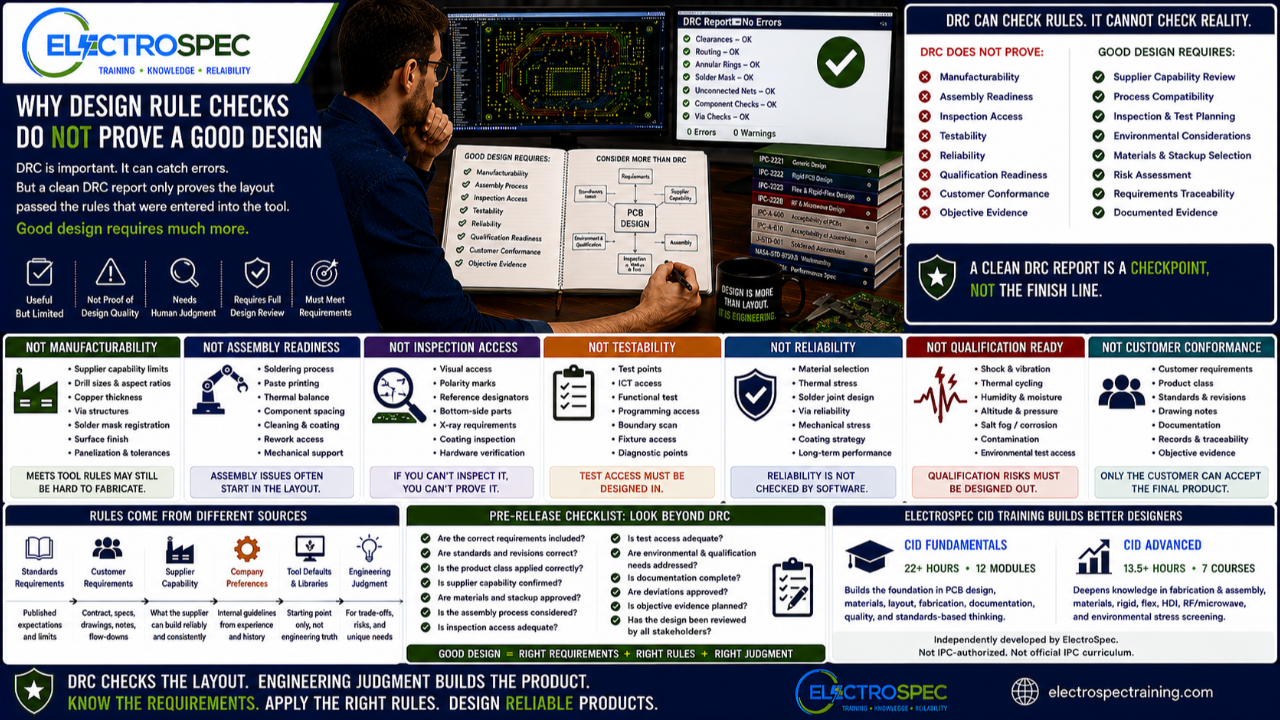
Passing a design rule check is important.
It can catch spacing violations, clearance problems, routing conflicts, unconnected nets, via issues, component placement violations, and other layout errors.
A good ECAD design rule check can help prevent mistakes.
But passing DRC does not prove the PCB is a good design.
It only proves the layout passed the rules that were entered into the tool.
That is a critical difference.
If the wrong rules were entered, the design may pass and still be wrong.
If important requirements were never translated into constraints, the design may pass and still be incomplete.
If the layout meets tool rules but ignores manufacturability, inspection, test, qualification, or customer requirements, the design may pass DRC and still fail in production.
Design rule checks are useful.
They are not proof of design quality.
A Tool Only Checks What It Knows
An ECAD tool does not automatically know the full requirement set.
It does not know the customer contract unless someone translates that contract into requirements.
It does not know the product class unless someone applies it.
It does not know the supplier’s real process capability unless someone configures the rules.
It does not know the intended environment unless someone builds that knowledge into the design review.
It does not know whether the product must survive shock, vibration, humidity, thermal cycling, or long service life unless those requirements are understood and applied.
A design rule check is only as good as the rule set behind it.
The tool can enforce rules.
It cannot decide whether the right rules were chosen.
Passing DRC Does Not Prove Manufacturability
A layout may pass DRC and still be difficult to fabricate.
For example, the design may pass the internal spacing rule, but the selected supplier may struggle with the copper thickness, drill size, aspect ratio, solder mask registration, via structure, or controlled impedance tolerance.
Manufacturability depends on more than tool clearance.
It depends on:
- supplier capability
- material selection
- stackup
- copper thickness
- drill sizes
- via structures
- annular ring
- solder mask registration
- surface finish
- fabrication tolerances
- panelization
- documentation clarity
A DRC may catch some geometry violations.
It may not catch fabrication risk.
That is why supplier capability and design for manufacturability must be reviewed before release.
Passing DRC Does Not Prove Assembly Readiness
A layout may also pass DRC and still create assembly problems.
The tool may show no spacing violation, but manufacturing may still struggle with solder paste printing, component placement, thermal balance, wave soldering, selective soldering, cleaning, coating, or rework access.
Assembly readiness depends on decisions such as:
- land pattern design
- component spacing
- thermal relief
- copper balance
- package selection
- soldering process
- cleaning access
- conformal coating access
- connector support
- fixture access
- rework strategy
A design rule check does not automatically know whether the board will be reflowed, wave soldered, selectively soldered, hand soldered, cleaned, coated, staked, or tested.
The assembly process must shape the layout.
Passing DRC Does Not Prove Inspection Access
A design can pass all ECAD rules and still be hard to inspect.
Inspection access must be designed intentionally.
Designers should ask:
- Can solder joints be inspected?
- Are polarity marks visible?
- Are reference designators useful?
- Can bottom termination components be verified?
- Is X-ray inspection required?
- Can coating coverage be inspected?
- Can cleanliness be verified?
- Can hardware installation be confirmed?
- Can test points be reached?
- Can acceptance evidence be produced?
A design rule check may not warn the designer that a component blocks visual inspection, a mark is hidden after assembly, a test point is inaccessible, or a coating keep-out is missing.
Inspection is part of product acceptance.
It should not be discovered after the board is built.
Passing DRC Does Not Prove Testability
A PCB can be electrically correct and still be difficult to test.
Testability must be considered before release.
The designer should consider:
- in-circuit test access
- functional test access
- programming access
- boundary scan strategy
- connector access
- diagnostic points
- environmental test monitoring
- fixture access
- failure isolation
- acceptance records
A DRC may identify unconnected nets.
It may not determine whether the product can be tested efficiently, diagnosed after failure, verified during qualification, or accepted by the customer.
Testability is a design decision.
Passing DRC Does Not Prove Reliability
Reliability is not proven by a clean design rule report.
Reliability depends on materials, fabrication, assembly, mechanical support, environmental exposure, solder joint design, inspection, test, and process control.
A board may pass DRC while still having reliability concerns such as:
- poor material selection
- weak via strategy
- excessive thermal stress
- inadequate mechanical support
- high solder joint fatigue risk
- insufficient connector retention
- poor coating strategy
- difficult cleaning
- inadequate spacing for the environment
- unsupported heavy components
- insufficient test access
- unclear documentation
Reliability is engineered through the full design and manufacturing system.
It is not guaranteed by a software check.
Passing DRC Does Not Prove Qualification Readiness
If the product must survive shock, vibration, thermal cycling, humidity, altitude, contamination, or other harsh conditions, those requirements must be designed in.
A DRC may not evaluate:
- component mass and vibration risk
- board mounting and flexure
- connector strain
- solder joint fatigue
- via reliability under thermal cycling
- coating coverage
- material compatibility
- cleanliness risk
- environmental test monitoring
- qualification evidence
Qualification failure is often expensive because it occurs late.
A clean DRC report does not mean the product is ready for qualification.
A qualification-aware design review is still required.
Passing DRC Does Not Prove Customer Conformance
The customer requirement is the real obligation.
A design may pass DRC and still fail to meet the customer requirement if the rule set did not include the correct product class, standard revision, material requirement, inspection requirement, test requirement, documentation requirement, or qualification condition.
Designers should ask:
- What customer requirements apply?
- What standards and revisions are invoked?
- What product class applies?
- What drawings and specifications control?
- What materials are required or restricted?
- What fabrication requirements apply?
- What assembly requirements apply?
- What inspection and test evidence is required?
- What qualification requirements apply?
- What objective evidence will prove conformance?
DRC can support compliance.
It does not define compliance by itself.
The Danger of False Confidence
A clean DRC report can create false confidence.
The team may assume:
The layout passed.
The design is ready.
Manufacturing should have no issues.
Inspection should be fine.
Testing should be fine.
The customer should accept it.
That assumption can be risky.
DRC is a checkpoint, not the finish line.
A board can pass DRC and still create supplier questions, fabrication holds, soldering defects, inspection problems, rework, qualification failures, and customer concerns.
The stronger design organization treats DRC as one part of a larger release process.
Design Rule Checks Need Standards Traceability
A meaningful design rule check starts with traceable rules.
Each major rule should have a basis.
For example:
- clearance rules should trace to standards, voltage, product class, customer requirements, or engineering analysis
- trace width rules should trace to current, temperature rise, fabrication capability, and reliability expectations
- via rules should trace to supplier capability, board thickness, plating reliability, and product class
- solder mask rules should trace to fabrication capability, assembly process, and inspection needs
- impedance rules should trace to electrical performance, material properties, stackup, and verification method
- spacing rules should trace to standards, environment, cleanliness, coating, and customer requirements
A rule without traceability is just a number.
A rule with traceability becomes part of the design basis.
The Right Question Is Not “Did It Pass?”
A better question is:
Did the design pass the right checks against the right requirements?
That includes DRC, but it also includes design review, supplier review, manufacturing review, inspection review, test review, and requirements review.
A strong release process should ask:
- Are the rules correct?
- Are the rules traceable?
- Are customer requirements included?
- Are standards and revisions correct?
- Is product class applied correctly?
- Is supplier capability confirmed?
- Is the assembly process considered?
- Is inspection access adequate?
- Is test access adequate?
- Is qualification risk reviewed?
- Is documentation complete?
- Is objective evidence planned?
A good design is not proven by one report.
It is supported by a complete design process.
Design Reviews Still Matter
A design review brings human judgment into the process.
That matters because many PCB design risks are contextual.
A tool may not know why a component is placed near an edge.
A tool may not know a connector will be stressed during installation.
A tool may not know a coating process will cover a test point.
A tool may not know a thermal mass will affect solder joint formation.
A tool may not know a supplier has limited capability for a selected via structure.
A tool may not know a customer expects objective evidence for a specific requirement.
Design reviews help connect the layout to reality.
Supplier Reviews Still Matter
Fabricators and assemblers can identify risks the ECAD tool may not catch.
Supplier review can help identify:
- stackup concerns
- material availability issues
- copper thickness concerns
- via and drilling risks
- HDI process limitations
- flex construction risks
- solder mask registration concerns
- surface finish concerns
- assembly access issues
- inspection limitations
- test fixture concerns
- coating and cleaning issues
Supplier input does not replace standards or customer requirements.
But it helps ensure the design can be built consistently.
CID Builds the Foundation Behind the Rules
ElectroSpec’s CID Fundamentals course helps designers understand the foundation behind PCB design rules.
The course includes 22+ hours of on-demand training across 12 structured modules covering materials, layout principles, mechanical and electrical considerations, thermal management, component technologies, interconnections, fabrication requirements, documentation, quality assurance, manufacturability, and standards-based design thinking.
That foundation helps designers understand what rules mean, where they come from, and how they affect real products.
A designer should not only run DRC.
A designer should understand what the rules are protecting.
CID Advanced Builds the Bigger Design Context
ElectroSpec CID Advanced expands that knowledge into advanced areas, including:
- PCB Fabrication & Assembly
- PCB Materials
- Rigid PCB Design
- Flexible PCB Design
- HDI PCB Design
- RF/Microwave PCB Design
- Environmental Stress Screening
These topics are important because advanced designs often pass basic checks while still hiding advanced risks.
Flex designs need bend and material review.
HDI designs need microvia and supplier capability review.
RF designs need stackup, impedance, material, and fabrication control review.
Harsh-environment designs need environmental stress and qualification review.
Advanced designers need more than clean DRC reports.
They need judgment.
A Better Pre-Release Checklist
Before releasing a PCB design, ask:
- Did the design pass DRC?
- Were the DRC rules verified before use?
- Are the rules traceable to requirements?
- Are customer requirements included?
- Are standards and revisions correct?
- Is supplier capability confirmed?
- Is the stackup approved?
- Are materials appropriate?
- Is assembly process compatibility reviewed?
- Is inspection access adequate?
- Is test access adequate?
- Are environmental and qualification risks reviewed?
- Is documentation complete?
- Are deviations approved?
- Is objective evidence planned?
That checklist turns DRC from a simple software step into part of a disciplined engineering release process.
Independently Developed by ElectroSpec
ElectroSpec’s CID and CID Advanced courses are independently developed by ElectroSpec.
They are not IPC-authorized training and they are not official IPC curriculum.
ElectroSpec developed these courses to provide practical, standards-connected, manufacturing-aware design training for students preparing for CID and CID+ certification.
The focus is not only on passing layout checks.
The focus is on understanding how design decisions affect manufacturability, reliability, inspection, test, qualification, and customer conformance.
Final Thought
Design rule checks are valuable.
Use them.
Respect them.
Configure them carefully.
But do not confuse a clean DRC report with proof of a good design.
A design rule check can confirm that a layout passed the rules in the tool.
It cannot prove that the rules were correct.
It cannot prove manufacturability.
It cannot prove inspection access.
It cannot prove testability.
It cannot prove reliability.
It cannot prove qualification readiness.
It cannot prove customer conformance.
A good PCB design is more than a layout that passes DRC.
It is a product design that meets requirements, can be built, can be inspected, can be tested, can be documented, and can be trusted.
Related ElectroSpec Training
ElectroSpec’s CID Fundamentals course provides 22+ hours of on-demand PCB design training across 12 structured modules.
ElectroSpec’s CID Advanced training expands into PCB Fabrication & Assembly, PCB Materials, Rigid PCB Design, Flexible PCB Design, HDI PCB Design, RF/Microwave PCB Design, and Environmental Stress Screening.
Together, these courses help designers build the standards-connected foundation needed for CID and CID+ certification preparation.
Coming Next
The Design Review Is Where Standards Become Accountability
In the next article, we will discuss why design review should be more than a meeting. It should be the point where requirements, standards, supplier capability, manufacturing, inspection, test, qualification, and engineering judgment are reviewed before the product is released.
IPC CID Certification — ElectroSpec
IPC CID+ Certification — ElectroSpec
IPC CID/CID+ Bundle — Complete PCB Design Certification — ElectroSpec