
Aerospace and Defense Are Not Requirements: Standards Define the Real Design Obligation
Aug 19, 2026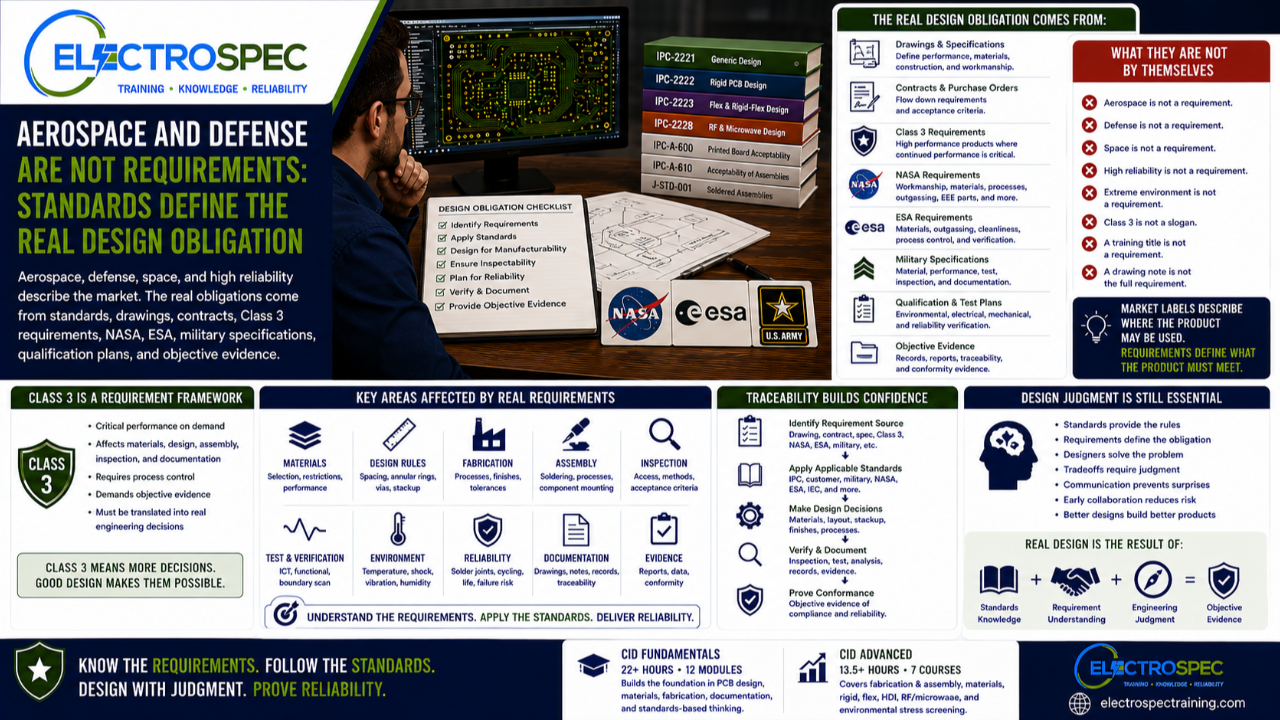
Aerospace.
Defense.
Space.
Mission critical.
High reliability.
Extreme environment.
These words sound important because they are important. They often describe products where failure can have serious consequences. They may involve harsh environments, long service life, high performance expectations, strict documentation, and demanding customer requirements.
But designers need to be careful.
Aerospace and defense are markets. They are not requirements by themselves.
A product may be used in an aerospace system, a defense platform, a spacecraft, a medical device, an industrial controller, or a high-reliability application.
But the market label does not automatically define the design obligation.
The real design obligation comes from the requirement set.
That requirement set may include drawings, contracts, customer specifications, IPC classes, NASA requirements, ESA requirements, military specifications, qualification plans, material restrictions, environmental requirements, test requirements, and objective evidence.
That distinction matters.
Market Language Is Not Enough
Training catalogs, product descriptions, and marketing material often use words like aerospace, defense, space, mission critical, and high reliability.
Those words may help identify the audience.
They may help describe the intended application.
They may help communicate that the product is important.
But they do not answer the designer’s real questions.
A designer still needs to know:
- What standard applies?
- What product class applies?
- What customer drawing applies?
- What contract requirements are flowed down?
- What materials are required or prohibited?
- What fabrication requirements apply?
- What assembly requirements apply?
- What inspection and acceptance criteria apply?
- What qualification testing is required?
- What documentation and objective evidence must be maintained?
- What environment must the product survive?
Without those answers, the phrase aerospace or defense is only a label.
It does not define the design.
The Drawing, Contract, and Flow-Down Define the Obligation
The real requirement usually comes from the technical package.
That may include:
- engineering drawings
- purchase orders
- contracts
- customer specifications
- system requirements
- qualification plans
- acceptance criteria
- standards callouts
- material requirements
- environmental requirements
- inspection requirements
- test requirements
- documentation requirements
This is where designers must pay close attention.
A drawing note may invoke Class 3 requirements.
A contract may include customer-specific flow-downs.
A program may require specific material controls.
A qualification plan may define shock, vibration, humidity, thermal cycling, altitude, or other environmental tests.
A customer specification may add requirements beyond the general IPC framework.
The designer must understand the complete requirement set, not just the market category.
Class 3 Is a Requirement Framework, Not a Slogan
Class 3 is often associated with high-performance electronic products where continued performance or performance on demand is critical.
But Class 3 should never be treated as a slogan.
Class 3 affects real design and manufacturing decisions.
It may influence:
- material selection
- conductor spacing
- annular ring expectations
- plated through-hole reliability
- solder joint reliability
- component selection
- board finish
- cleanliness
- coating
- inspection access
- testability
- documentation
- supplier capability
- process control
- objective evidence
Calling a product Class 3 does not automatically make it reliable.
The design must support the requirement.
The fabrication process must support the requirement.
The assembly process must support the requirement.
Inspection and test must support the requirement.
Objective evidence must support conformance.
That is why designers need to understand what Class 3 means in practice.
NASA, ESA, Military, and Customer Requirements May Go Beyond IPC
IPC standards are an important part of electronics design and manufacturing.
They provide widely used frameworks for PCB design, fabrication, assembly, inspection, and acceptability.
But aerospace, defense, and space programs may require more than IPC alone.
Depending on the product and customer, designers may also need to consider:
- NASA workmanship or program requirements
- European Space Agency requirements
- military specifications
- customer-specific requirements
- space addenda
- material restrictions
- outgassing concerns
- tin whisker mitigation
- radiation considerations
- environmental qualification
- configuration control
- traceability requirements
- lot control
- test records
- inspection records
- process control evidence
The point is not that every aerospace or defense product uses the same requirements.
The point is that the designer must identify which requirements actually apply.
That requires standards literacy and requirement traceability.
High Reliability Must Be Translated Into Engineering Requirements
High reliability is a useful phrase, but it must be translated into design requirements.
What does high reliability mean for this product?
Does it mean long service life?
Does it mean operation after storage?
Does it mean performance during vibration?
Does it mean survival through thermal cycling?
Does it mean operation in humidity?
Does it mean resistance to contamination or corrosion?
Does it mean no maintenance access?
Does it mean mission life without repair?
Does it mean specific inspection records or qualification evidence?
A designer cannot design to a slogan.
A designer designs to requirements.
High reliability must become materials, spacing, stackup, solder joint design, mechanical support, coating strategy, cleanliness control, inspection access, test coverage, qualification planning, and objective evidence.
Extreme Environment Must Be Defined
Extreme environment is another phrase that needs definition.
Extreme compared to what?
A designer should translate the environment into measurable conditions, such as:
- temperature range
- thermal cycling
- shock
- vibration
- humidity
- altitude
- salt fog
- contamination
- corrosion
- mechanical loading
- pressure change
- fluid exposure
- radiation
- storage duration
- operating life
- duty cycle
- maintenance expectations
Once the environment is defined, the designer can make better decisions.
Materials can be selected more intelligently.
Stackups can be reviewed more carefully.
Interconnects can be supported properly.
Coating and cleanliness can be addressed.
Inspection and test can be planned.
Qualification can be considered before the product is built.
Without environmental definition, extreme environment is only a phrase.
Training Titles Do Not Replace Requirement Knowledge
A course may use terms like aerospace, defense, space, extreme environment, or high reliability.
That does not automatically mean the course covers the actual requirements that apply to a specific product.
The better question is not simply:
Does the course say aerospace or defense?
The better question is:
Does the training help the designer understand standards, requirements, materials, fabrication, assembly, inspection, qualification, and traceability?
A course title can identify an audience.
But real design competence comes from understanding the requirement system.
That is where CID and CID Advanced training are valuable.
Standards Traceability Is the Designer’s Defense
For high-reliability products, traceability is not optional.
A designer should be able to explain where a design decision came from.
Was it based on:
- IPC design requirements?
- Class 3 expectations?
- customer flow-downs?
- NASA requirements?
- ESA requirements?
- military specifications?
- material requirements?
- fabrication capability?
- assembly process requirements?
- inspection and acceptance criteria?
- qualification testing?
- engineering analysis?
- engineering judgment?
That traceability helps designers communicate with customers, suppliers, manufacturing teams, inspectors, quality engineers, auditors, and failure analysis teams.
A design decision without traceability can become an opinion.
A design decision with traceability becomes part of the engineering record.
Aerospace and Defense Products Need Objective Evidence
High-reliability products must be supported by evidence.
That evidence may include:
- approved drawings
- material certifications
- fabrication records
- assembly records
- inspection reports
- test records
- qualification results
- process controls
- traceability records
- nonconformance records
- corrective actions
- configuration control records
A drawing note alone does not prove conformance.
A training certificate alone does not prove product reliability.
A market label alone does not prove anything.
The product must be designed, built, inspected, tested, and documented against the actual requirements.
That is why designers must understand how requirements become objective evidence.
CID Builds the Standards Foundation
ElectroSpec’s CID Fundamentals course helps designers build the foundational standards-based design knowledge needed to understand real PCB design requirements.
The course includes 22+ hours of on-demand training across 12 structured modules covering materials, layout principles, mechanical and electrical considerations, thermal management, component technologies, interconnections, fabrication requirements, documentation, quality assurance, manufacturability, and standards-based design thinking.
That foundation matters because designers need to understand how requirements affect real products.
They need to know how a design decision influences fabrication, assembly, inspection, acceptance, reliability, and documentation.
CID Advanced Builds the High-Reliability Design Framework
ElectroSpec CID Advanced builds on that foundation with specialized advanced courses in:
- PCB Fabrication & Assembly
- PCB Materials
- Rigid PCB Design
- Flexible PCB Design
- HDI PCB Design
- RF/Microwave PCB Design
- Environmental Stress Screening
These areas are critical for advanced and high-reliability applications.
Aerospace and defense products often demand stronger understanding of materials, fabrication capability, harsh environments, inspection, reliability, and qualification.
CID Advanced helps designers connect those topics into a broader design framework.
The goal is not to memorize buzzwords.
The goal is to understand the technical requirements behind reliable products.
Environmental Stress Screening Connects Design to Reality
Environmental Stress Screening matters because real products are not used in perfect laboratory conditions.
They may experience shock, vibration, humidity, thermal cycling, handling, storage, transportation, and field use.
Designers should think about environmental stress early because it affects:
- solder joint fatigue
- board flexure
- component support
- connector strain
- material selection
- coating strategy
- cleanliness control
- thermal paths
- interconnect reliability
- test access
- inspection strategy
- qualification planning
Environmental performance must be designed into the product.
It cannot be added at the end with a marketing label.
Standards Do Not Replace Judgment
Even when the applicable standards are identified, the designer still needs judgment.
The designer must decide how to meet the requirements.
That may involve tradeoffs between:
- cost and reliability
- density and manufacturability
- performance and material availability
- miniaturization and inspection access
- electrical performance and mechanical support
- reworkability and packaging density
- supplier capability and design ambition
- schedule and qualification risk
Standards provide the rules.
Designers create the solution.
The standard gives the puzzle pieces.
The designer creates the picture.
A Better Question for Designers
Instead of asking, “Is this aerospace design?” ask:
- What requirement applies?
- What class applies?
- What environment applies?
- What standards are invoked?
- What customer flow-downs apply?
- What materials are required?
- What fabrication controls are needed?
- What assembly controls are needed?
- What inspection and test methods are required?
- What objective evidence will prove conformance?
- What reliability risks must be controlled?
These questions move the designer from market language to engineering reality.
Independently Developed by ElectroSpec
ElectroSpec’s CID and CID Advanced courses are independently developed by ElectroSpec.
They are not IPC-authorized training and they are not official IPC curriculum.
ElectroSpec developed these courses to provide practical, standards-connected, manufacturing-aware design training for students preparing for CID and CID+ certification.
The focus is not on buzzwords.
The focus is on helping designers understand requirements, apply standards, support traceability, and create reliable products.
Final Thought
Aerospace and defense are important markets.
Space and high reliability are serious design environments.
Extreme environment products demand careful engineering.
But none of those terms are requirements by themselves.
Requirements come from drawings, standards, contracts, customer specifications, Class 3 expectations, NASA, ESA, military specifications, qualification plans, environmental conditions, and objective evidence.
A market label describes where the product may be used.
The requirement set defines what the product must meet.
Good designers know the difference.
Related ElectroSpec Training
ElectroSpec’s CID Fundamentals course provides 22+ hours of on-demand PCB design training across 12 structured modules.
ElectroSpec’s CID Advanced training expands into PCB Fabrication & Assembly, PCB Materials, Rigid PCB Design, Flexible PCB Design, HDI PCB Design, RF/Microwave PCB Design, and Environmental Stress Screening.
Together, these courses help designers build the standards-connected foundation needed for CID and CID+ certification preparation.
Coming Next
NASA, Military, ESA, IEC, and IPC: Where Each Standard System Fits
In the next article, we will discuss how different standards systems fit into electronics design and manufacturing, and why designers must understand the full requirement flow-down instead of relying on one standards source alone.
IPC CID Certification — ElectroSpec
IPC CID+ Certification — ElectroSpec
IPC CID/CID+ Bundle — Complete PCB Design Certification — ElectroSpec