
Military, Aerospace, and Extreme Environments: Buzzwords or Real Requirements?
Aug 10, 2026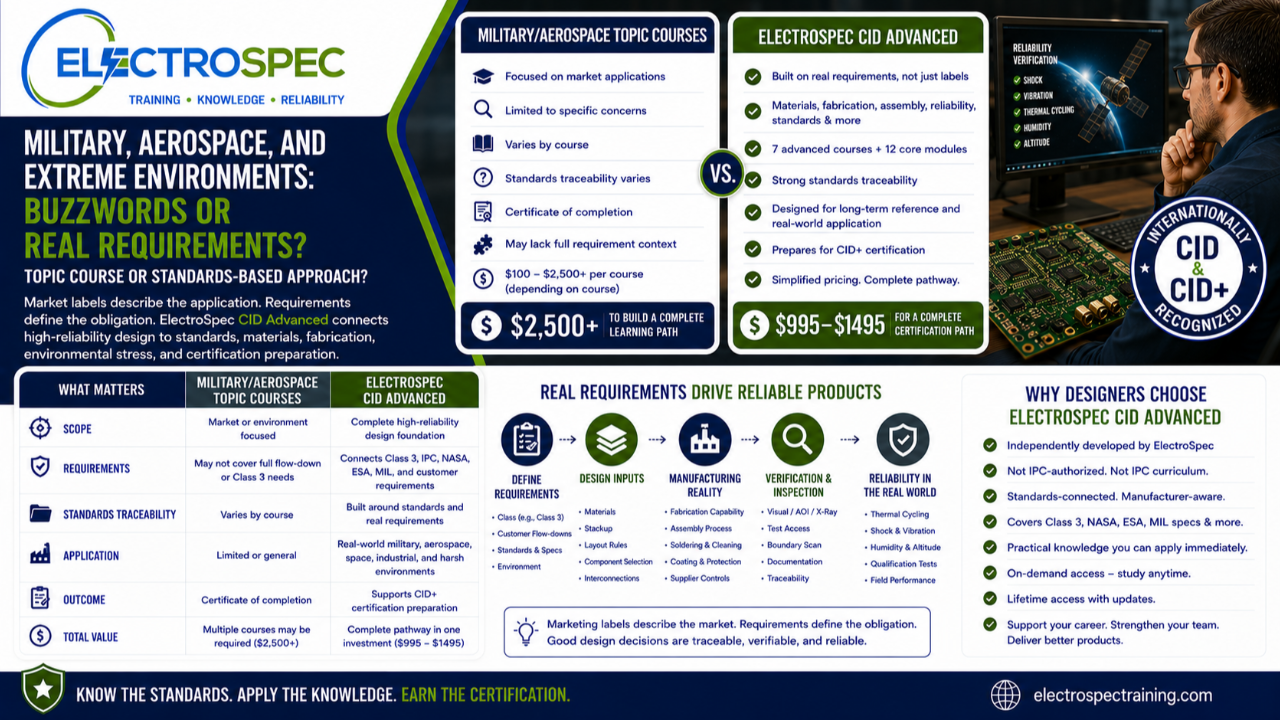
Military, aerospace, space, mission critical, and extreme environment are powerful words.
They sound serious.
They sound advanced.
They suggest reliability, discipline, and technical rigor.
But designers and employers should be careful.
Military and aerospace are markets. They are not requirements by themselves.
A course title, marketing phrase, or training category may describe the audience, but it does not automatically define the technical design obligation.
The real design obligation comes from requirements.
Those requirements may come from the drawing, contract, customer specification, IPC class, NASA requirement, ESA requirement, military specification, qualification plan, environmental test requirement, or product use environment.
That distinction matters.
A Market Label Is Not a Design Requirement
A product may be used in aerospace.
A product may be used in defense.
A product may be used in space.
A product may be used in a harsh environment.
But those labels do not automatically answer the design questions.
The designer still needs to know:
- What class applies?
- What customer requirements apply?
- What drawing notes apply?
- What standards are invoked?
- What materials are required or prohibited?
- What soldering or assembly requirements apply?
- What inspection criteria apply?
- What documentation is required?
- What qualification tests are required?
- What environmental stresses must the product survive?
- What objective evidence must prove conformance?
That is why standards traceability matters.
Aerospace and defense language may help describe the product’s intended market, but it does not replace the requirement flow-down.
The Topic Course Approach
Based on the catalog examples reviewed, some PCB design courses are marketed around military, aerospace, or extreme environment applications.
That can be useful.
A focused course may help designers think about harsh environments, reliability, performance, compliance, or ruggedized design.
For someone needing narrow exposure, that type of course may provide value.
But the limitation is important.
A market-focused course may not provide the complete standards-based framework needed to connect design decisions back to Class 3 expectations, NASA requirements, ESA requirements, military specifications, IPC design standards, materials, manufacturing controls, inspection, testing, qualification, and objective evidence.
For high-reliability products, buzzwords are not enough.
Designers need requirement traceability.
ElectroSpec CID Advanced Focuses on the Requirement Framework
ElectroSpec’s CID Advanced training is built around advanced PCB design topics that support real high-reliability design thinking.
The advanced track includes:
- PCB Fabrication & Assembly
- PCB Materials
- Rigid PCB Design
- Flexible PCB Design
- HDI PCB Design
- RF/Microwave PCB Design
- Environmental Stress Screening
That matters because high-reliability design is not one topic.
It is a system of decisions.
Material selection affects reliability.
Fabrication affects reliability.
Assembly affects reliability.
Flex design affects reliability.
HDI affects reliability.
RF and microwave design affect reliability.
Environmental stress screening and qualification affect reliability.
A designer working in aerospace, defense, medical, industrial, or harsh-environment electronics needs to understand how those areas connect.
Class 3 Is More Than a Label
Class 3 is often associated with high-performance electronic products where continued performance or performance on demand is critical.
But Class 3 should not be treated as a slogan.
Class 3 affects design, fabrication, assembly, inspection, documentation, process control, and reliability expectations.
Designers should consider:
- material selection
- conductor spacing
- annular ring
- plated through-hole reliability
- solder joint reliability
- thermal management
- mechanical support
- connector retention
- cleanliness
- coating
- inspection access
- testability
- supplier capability
- objective evidence
- qualification requirements
Putting “Class 3” on a drawing does not automatically make a product reliable.
The design must support Class 3 expectations.
The manufacturing process must support Class 3 expectations.
Inspection and test must support Class 3 expectations.
Objective evidence must support Class 3 conformance.
NASA, ESA, Military, and Customer Requirements May Go Beyond IPC
IPC standards are important.
They provide a widely used framework for printed board design, fabrication, assembly, and acceptability.
But aerospace, defense, and space programs may involve additional requirements.
Depending on the product and customer, designers may need to consider:
- NASA workmanship or program requirements
- European Space Agency requirements
- military specifications
- defense contract flow-downs
- customer-specific drawings
- space addenda
- prohibited materials
- outgassing concerns
- tin whisker mitigation
- radiation concerns
- cleanliness requirements
- qualification testing
- traceability requirements
- configuration control
- lot control
- material certification
- inspection records
- process control evidence
The point is not that every aerospace or defense product uses the same requirements.
The point is that the designer must know which requirements apply.
That requires standards literacy.
Extreme Environments Must Be Defined
“Extreme environment” is another phrase that sounds meaningful, but it must be translated into actual conditions.
Extreme compared to what?
A designer should define the environment in engineering terms, such as:
- temperature range
- thermal cycling
- shock
- vibration
- humidity
- altitude
- salt fog
- contamination
- corrosion
- mechanical loading
- pressure changes
- fluid exposure
- radiation
- storage conditions
- operating life
- duty cycle
- maintenance expectations
Once the environment is defined, the designer can make better decisions about materials, layout, component selection, interconnections, solder joints, coating, sealing, support, and qualification.
Without that definition, “extreme environment” is only a phrase.
Environmental Stress Screening and Qualification Matter
ElectroSpec’s CID Advanced training includes Environmental Stress Screening because designers need to understand how products are exposed to real-world stresses.
Environmental stress screening and qualification are not afterthoughts.
They should influence design decisions early.
Designers should think about:
- solder joint fatigue
- CTE mismatch
- board flexure
- connector strain
- component derating
- mechanical support
- coating compatibility
- moisture protection
- thermal paths
- vibration isolation
- cleanliness
- corrosion resistance
- test access
- inspection strategy
A product may pass electrical test and still fail under shock, vibration, humidity, thermal cycling, or field use.
That is why harsh-environment design must connect to materials, fabrication, assembly, inspection, and qualification planning.
Standards Traceability Is the Difference
For military, aerospace, space, and harsh-environment products, standards traceability is critical.
A designer should be able to ask:
- What requirement applies?
- Where does the requirement come from?
- Is it from IPC?
- Is it from NASA?
- Is it from ESA?
- Is it from a military specification?
- Is it from the customer drawing?
- Is it from a qualification plan?
- Is it from a contract flow-down?
- Is it a design rule, process rule, inspection rule, or documentation requirement?
- What objective evidence proves compliance?
This is where broad design training matters.
A course that uses aerospace or defense language may be useful.
But the designer needs to trace design decisions back to the actual requirement source.
Courses Come and Go, But Requirements Remain
Training catalogs change.
Course titles are renamed.
Market categories are adjusted.
New buzzwords appear.
Older course names disappear.
That is normal.
But the product still has to meet requirements.
Aerospace, defense, space, medical, and harsh-environment products may be reviewed long after the course is complete.
Designs may be challenged by customers, auditors, inspectors, suppliers, failure analysis teams, or qualification test results.
When that happens, the designer needs more than memory of a course title.
They need a durable standards-based framework.
They need to understand how to connect design choices to requirements.
Certificate of Completion vs. CID+ Preparation
A military, aerospace, or extreme environment topic course may provide a certificate of completion.
That can show that the student completed that course.
But a certificate of completion is not the same as a training pathway built to support a recognized PCB design certification.
ElectroSpec CID Advanced is designed to support preparation for CID+ certification.
That changes the purpose of the training.
The goal is not simply to learn terminology related to military or aerospace design.
The goal is to help advanced designers understand standards, materials, fabrication, assembly, high-reliability design, environmental stress, and certification preparation.
Price and Value
Price should be compared to scope and outcome.
A single military or aerospace topic course may be useful for narrow exposure.
But a designer who needs materials, fabrication, rigid board design, flex, HDI, RF, environmental stress screening, Class 3 thinking, and certification preparation may need a broader training path.
That can become expensive if purchased as multiple separate topic courses.
ElectroSpec’s simplified comparison is different.
ElectroSpec CID Advanced is commonly positioned in the $995 to $1,495 range, depending on the offering.
A broader pathway built from multiple individual topic courses can reach $2,500+ when a student needs complete coverage across advanced design areas.
The better question is:
Is the student buying a market-labeled topic course, or building an advanced standards-based pathway toward CID+ certification?
Comparison Summary
| Question | Military/Aerospace Topic Course | ElectroSpec CID Advanced |
|---|---|---|
| Main purpose | Teach selected market-focused concepts | Build advanced standards-based design knowledge |
| Scope | Course dependent | Materials, fabrication, rigid, flex, HDI, RF/microwave, ESS, reliability |
| Requirement traceability | Varies by course | Built around standards, requirements, and real product application |
| High-reliability focus | Course dependent | Connects Class 3, harsh environments, materials, and qualification thinking |
| Reference value | May be limited to one topic | Designed for long-term reference and project application |
| Outcome | Often certificate of completion | Supports CID+ certification preparation |
| Best fit | Narrow exposure to market-specific concerns | Designers seeking advanced certification-focused standards preparation |
The Better Question for Designers
Instead of asking, “Is this aerospace training?” ask:
- What requirements does the product need to meet?
- What standards are invoked?
- What class applies?
- What environment must the product survive?
- What materials are acceptable?
- What fabrication controls are needed?
- What assembly and soldering requirements apply?
- What inspection and test methods are required?
- What qualification evidence is needed?
- What documentation must be maintained?
- What customer flow-downs apply?
These questions move the discussion from marketing language to engineering reality.
Independently Developed by ElectroSpec
ElectroSpec’s CID Advanced courses are independently developed by ElectroSpec.
They are not IPC-authorized training and they are not official IPC curriculum.
ElectroSpec built these courses to provide practical, standards-connected, manufacturing-aware training for designers pursuing CID+ certification preparation.
The focus is not on buzzwords.
The focus is on helping designers understand requirements and apply them to real products.
Final Thought
Military, aerospace, space, and extreme environment are important markets.
But they are not requirements by themselves.
The real requirement is found in the drawing, standard, specification, contract, qualification plan, environmental condition, and customer flow-down.
A topic course may introduce military or aerospace design concerns.
ElectroSpec CID Advanced helps designers connect high-reliability design to standards traceability, materials, fabrication, assembly, environmental stress, and CID+ certification preparation.
A label may describe the market.
Requirements define the obligation.
Good designers know the difference.
Related ElectroSpec Training
ElectroSpec’s CID Advanced training includes Environmental Stress Screening as part of a broader advanced PCB design pathway.
The advanced track includes PCB Fabrication & Assembly, PCB Materials, Rigid PCB Design, Flexible PCB Design, HDI PCB Design, RF/Microwave PCB Design, and Environmental Stress Screening.
Together, these courses help designers prepare for advanced design work, high-reliability applications, and CID+ certification.
Coming Next
ECAD/MCAD and Constraint Courses: Tools Need Standards Behind Them
In the next article, we will compare model-based PCB and constraint-focused topic courses with ElectroSpec’s CID and CID Advanced approach and explain why tools and constraints are only useful when designers understand the standards and requirements behind them.
IPC CID Certification — ElectroSpec
IPC CID+ Certification — ElectroSpec
IPC CID/CID+ Bundle — Complete PCB Design Certification — ElectroSpec