
Certificate of Completion vs. CID and CID+ Certification: Why the Outcome Matters
Aug 12, 2026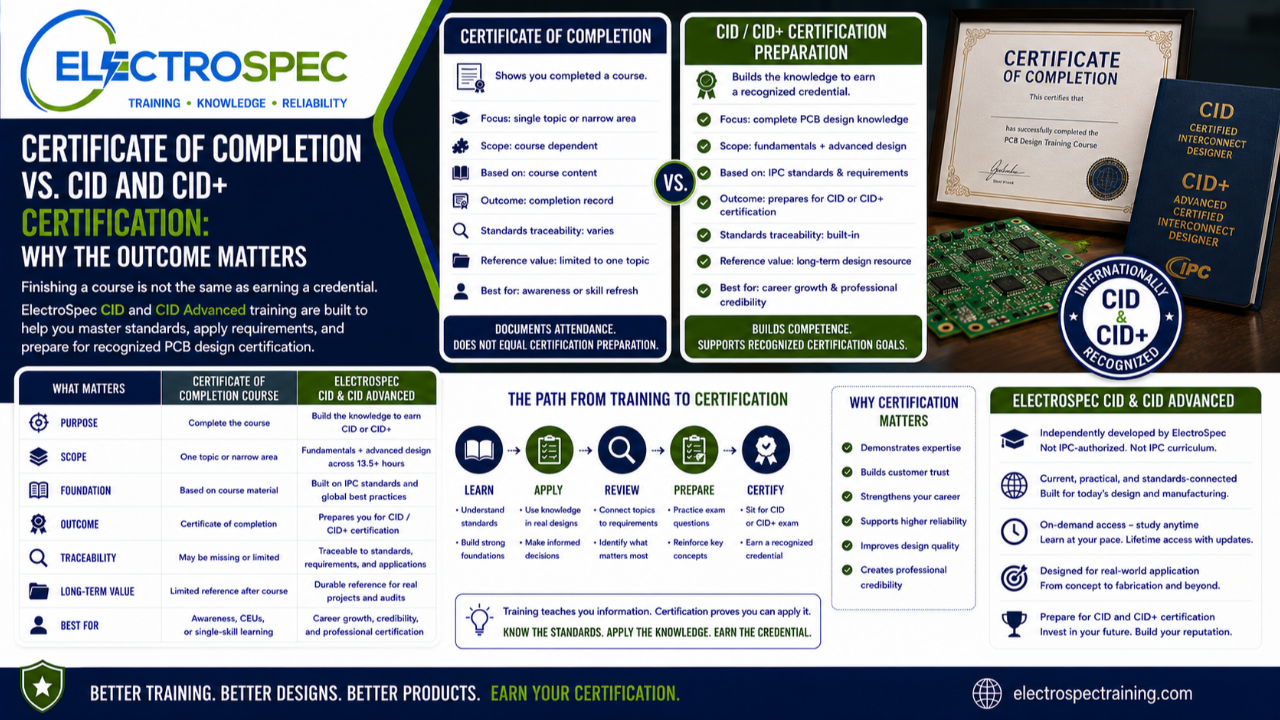
PCB design training can produce different outcomes.
Some courses provide topic exposure.
Some courses provide a certificate of completion.
Some courses support preparation for a recognized professional certification.
Those outcomes are not the same.
A certificate of completion may show that a student completed a course.
But CID and CID+ certification represent a broader professional PCB design credential goal.
That distinction matters for designers, engineers, employers, technical managers, and customers.
When selecting training, the question should not only be:
What course did the student complete?
The better question is:
What outcome does the training support?
A Certificate of Completion Has Value
A certificate of completion is not meaningless.
It can document that a student attended or completed a course.
That may be useful for internal training records, professional development files, HR documentation, or general awareness training.
A completion certificate may be appropriate when the training goal is narrow, such as:
- introduction to a topic
- awareness of a tool
- exposure to a workflow
- overview of a design concept
- internal professional development
- continuing education recordkeeping
That type of training can be helpful.
But a certificate of completion should not be confused with certification preparation or a professional design credential.
Completion Is Not the Same as Certification
Course completion usually means the student completed the assigned course content.
Certification preparation is different.
Certification-focused training should help the student build knowledge, understand standards, apply requirements, review concepts, and prepare for a formal exam or credentialing process.
That difference matters.
A course completion certificate may answer:
Did the student finish the course?
Certification preparation asks a deeper question:
Is the student building the knowledge needed to pursue a recognized PCB design certification?
That is why ElectroSpec’s CID and CID Advanced training are built differently from ordinary topic courses.
ElectroSpec CID Supports a Certification Pathway
ElectroSpec’s CID Fundamentals course is a 22+ hour on-demand PCB Fundamentals Course designed and developed by ElectroSpec.
The course includes 12 structured modules covering materials, layout principles, mechanical and electrical considerations, thermal management, component technologies, interconnections, fabrication requirements, documentation, quality assurance, manufacturability, and standards-based design thinking.
The purpose is not simply to expose students to PCB design.
The purpose is to help students build a broad foundation and approach the CID exam with greater confidence.
That is a different training outcome.
A short topic course may teach one subject.
ElectroSpec CID is built to support a recognized certification pathway.
ElectroSpec CID Advanced Supports Advanced Certification Preparation
ElectroSpec’s CID Advanced training includes 13.5+ hours across seven specialized advanced PCB design courses:
- PCB Fabrication & Assembly
- PCB Materials
- Rigid PCB Design
- Flexible PCB Design
- HDI PCB Design
- RF/Microwave PCB Design
- Environmental Stress Screening
These topics support advanced design understanding across materials, fabrication, assembly, rigid boards, flex, HDI, RF, microwave, reliability, and harsh-environment considerations.
The goal is not only to learn advanced topics.
The goal is to support preparation for CID+ level design knowledge.
That is the key difference.
ElectroSpec CID Advanced is not a disconnected collection of topic lessons.
It is a structured advanced pathway built around standards, requirements, practical design application, and certification preparation.
Topic Courses May Teach Slices
Many PCB design courses are sold by topic.
A student may purchase a course on manufacturability, flex, RF, signal integrity, ECAD/MCAD, constraint engineering, military and aerospace applications, or advanced design concepts.
Those courses may be useful.
But they often teach slices of PCB design.
The designer still has to connect those slices into a full professional framework.
That is where many training paths become fragmented.
The student may finish multiple courses and still be left asking:
- How do these topics connect?
- Which standards apply?
- Where do the requirements come from?
- What should I reference later?
- How does this support certification?
- What does this mean for real product design?
ElectroSpec’s approach is to connect the topics back to a standards-based certification preparation pathway.
Standards Traceability Matters
A completion certificate may show that a student completed a class.
But standards traceability helps the designer understand the basis for design decisions.
A designer should know:
- where a design requirement comes from
- why a rule matters
- whether a value is a standard requirement, supplier capability, customer flow-down, or engineering judgment
- how the design decision affects fabrication
- how the design decision affects assembly
- how the design decision affects inspection
- how the design decision affects acceptance
- how the design decision affects reliability
- how the design decision supports objective evidence
That is why traceability is one of ElectroSpec’s central training themes.
A designer should not only learn what to do.
A designer should understand why the requirement exists and how to reference it later.
Courses Come and Go, But Credentials and Standards Matter
Training catalogs change.
Course titles change.
Courses may be added, removed, renamed, repackaged, or revised over time.
That is normal.
But designers need a durable framework.
A designer may need to reference requirements months or years after training.
A customer, auditor, supplier, quality engineer, inspector, or failure analysis team may ask why a design decision was made.
When that happens, the designer needs more than a memory of a course title.
The designer needs standards knowledge, requirement traceability, documentation logic, and a clear design basis.
That is why a certification-focused training pathway has value beyond course completion.
Current Content Matters
PCB design training should be current and technically relevant.
Before selecting any training provider, students should ask whether the course reflects current design expectations, current standards usage, current manufacturing realities, and current certification goals.
Some legacy materials in the marketplace may still reflect older training structures, older assumptions, or older standard revision eras.
That does not automatically make every older course useless.
But designers should verify what they are buying.
A course built around older 2015 or 2016-era references may not fully support today’s design environment, customer expectations, or certification preparation needs.
ElectroSpec’s CID and CID Advanced courses are designed to remain current, standards-connected, and expandable over time.
Price and Outcome Should Be Compared Together
Price matters.
But price should always be compared to scope and outcome.
A low-cost course may be a good choice for narrow awareness.
A higher-cost course may make sense if it provides deep specialized content.
But the buyer should ask:
What does this training actually lead to?
A course that provides only a completion certificate may be useful, but it is not the same value proposition as a training path designed to support CID or CID+ certification preparation.
ElectroSpec’s simplified comparison is different.
ElectroSpec CID and CID Advanced are commonly positioned in the $995 to $1,495 range, depending on the offering.
A broader learning path built from multiple individual topic courses can reach $2,500+ when students need complete coverage across design areas.
The better question is:
Is the student buying course completion, or building a pathway toward certification?
Comparison Summary
| Question | Certificate of Completion Course | ElectroSpec CID and CID Advanced |
|---|---|---|
| Main purpose | Document course completion | Support CID and CID+ certification preparation |
| Scope | Course dependent | Fundamentals, advanced design, materials, fabrication, assembly, reliability |
| Standards traceability | Varies by course | Built around standards and requirements |
| Reference value | May be limited to one course topic | Designed for long-term reference and application |
| Outcome | Completion record | Certification-focused preparation pathway |
| Best fit | Topic exposure or awareness | Designers seeking recognized PCB design certification preparation |
Employers Should Compare Outcomes, Not Just Course Titles
For employers, the training decision should include more than the course name.
Employers should ask:
- What does this training prepare the employee to do?
- Is the training tied to standards?
- Can the employee reference the material later?
- Does the course support a recognized certification goal?
- Does the course help the employee make better design decisions?
- Does the course improve communication with fabrication, assembly, inspection, and quality teams?
- Does the training support customer confidence?
- Does the training build long-term capability?
A completion certificate may support internal records.
A certification-focused pathway may support professional development, customer credibility, and stronger technical capability.
Designers Should Think Beyond Attendance
Designers should also think carefully about what they want from training.
A designer may simply want to learn one topic.
That is valid.
But if the designer wants a stronger career path, broader technical confidence, and a recognized PCB design credential, then the training path should support that goal.
A designer should ask:
- Am I learning one topic or building a foundation?
- Will this help me understand standards?
- Will I be able to reference this later?
- Will this help me prepare for CID or CID+?
- Will this help me make better design decisions?
- Will this help me communicate with manufacturers and customers?
- Will this improve my professional credibility?
The answer should guide the training decision.
Independently Developed by ElectroSpec
ElectroSpec’s CID and CID Advanced courses are independently developed by ElectroSpec.
They are not IPC-authorized training and they are not official IPC curriculum.
ElectroSpec built these courses to provide practical, standards-connected, manufacturing-aware training for designers pursuing CID and CID+ certification preparation.
The focus is not simply course completion.
The focus is helping designers understand standards, apply requirements, prepare for certification, and make better design decisions.
Final Thought
A certificate of completion can show that a student completed a course.
That has value.
But completion is not the same as certification preparation.
ElectroSpec’s CID and CID Advanced training are built around a different goal.
They help designers build a standards-based framework, connect information back to requirements, retain a durable reference path, and prepare for recognized PCB design certification goals.
A course can document attendance.
A certification pathway can help build a designer.
Related ElectroSpec Training
ElectroSpec’s CID Fundamentals course provides 22+ hours of on-demand PCB design training across 12 structured modules.
ElectroSpec’s CID Advanced training includes PCB Fabrication & Assembly, PCB Materials, Rigid PCB Design, Flexible PCB Design, HDI PCB Design, RF/Microwave PCB Design, and Environmental Stress Screening.
Together, these courses provide a standards-connected path for designers preparing for CID and CID+ certification.
Coming Next
Why ElectroSpec Built CID and CID Advanced as Standards-Based Design Pathways
In the capstone article, we will bring the full comparison series together and explain why ElectroSpec built its CID and CID Advanced training around standards traceability, durable reference value, real-world design application, and certification preparation.
IPC CID Certification — ElectroSpec
IPC CID+ Certification — ElectroSpec
IPC CID/CID+ Bundle — Complete PCB Design Certification — ElectroSpec