
CID and CID+ Training: Designing for Class 1, 2, and 3 Requirements
Jul 12, 2026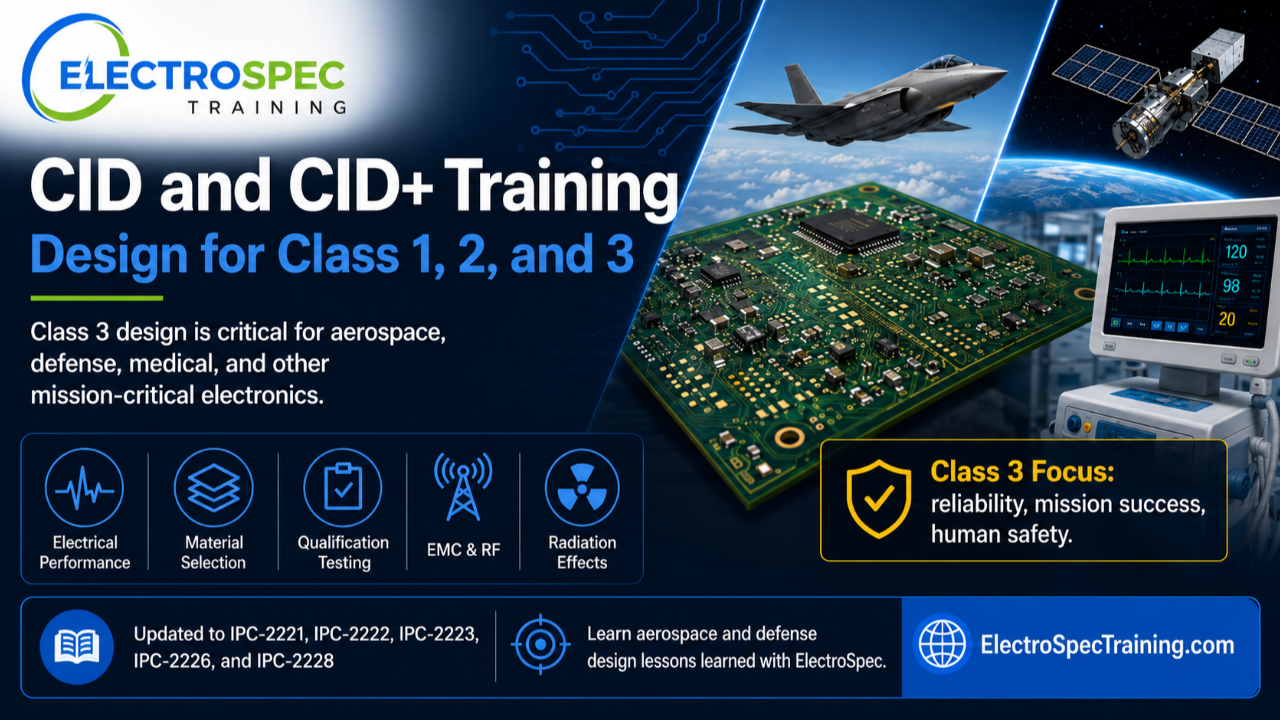
PCB design is not one-size-fits-all.
A printed board used in a consumer product does not carry the same risk as a board used in aerospace, defense, medical, or other high-reliability applications. The design expectations, materials, spacing, plating, documentation, and qualification concerns become more critical as product risk increases.
That is why CID and CID+ training are so valuable.
These courses help designers understand Class 1, Class 2, and Class 3 design requirements, and more importantly, why those requirements exist.
Class 3 becomes especially important for aerospace, defense, medical, space, and mission-critical electronics because the consequence of failure can be much greater. Failure may involve risk to human life, loss of mission, loss of aircraft, loss of spacecraft, loss of medical function, or failure of a critical system.
In these applications, the board is not just expected to work.
It is expected to keep working under demanding conditions.
Understanding Class 1, Class 2, and Class 3
IPC class requirements help define product expectations based on intended use and reliability needs.
Class 1 is typically associated with general electronic products where function is required, but long-term reliability and harsh environment survivability may not be critical.
Class 2 is typically associated with dedicated service electronic products where continued performance and extended life are expected.
Class 3 is associated with high-performance or high-reliability products where failure is not acceptable or could create significant consequence.
This is why Class 3 is often the focus for aerospace, defense, medical, and mission-critical applications.
The higher class does not simply mean “better workmanship.” It means tighter expectations, more conservative defect allowances, stronger reliability assumptions, and greater attention to design decisions that affect performance over time.
CID and CID+ help designers understand these differences so requirements are built into the design before the product reaches fabrication, assembly, inspection, or qualification testing.
Class 3 Is About Risk
Class 3 requirements are not arbitrary.
They are driven by risk.
In aerospace and defense, failure can mean mission failure, loss of system capability, or risk to personnel. In medical electronics, failure can directly affect patient safety. In space, avionics, weapons systems, high-reliability controls, and critical infrastructure, product must often survive environments that are much more severe than normal commercial use.
That is why Class 3 design tends to be more conservative.
The goal is not just to pass basic electrical test.
The goal is to design a board that can survive manufacturing, assembly, environmental exposure, qualification testing, field use, and long-term operation.
Class 3 design thinking asks deeper questions:
Will the board maintain continuity?
Will isolation distances remain adequate?
Will signal integrity be controlled?
Will plating survive thermal cycling?
Will laminate material tolerate high temperature exposure?
Will the design survive shock, vibration, humidity, and environmental stress?
Will the layout support EMC, RF, and system-level compatibility?
Will materials and design choices support the intended mission environment?
CID and CID+ help designers understand how design requirements connect to these questions.
Electrical Performance Still Matters
At the most basic level, electronic assemblies must meet electrical performance requirements.
Continuity must be maintained.
Isolation must be preserved.
Shorts, opens, leakage paths, and marginal spacing must be avoided.
Signal integrity must be supported where circuit performance depends on impedance, controlled geometry, return paths, spacing, shielding, and stackup.
In higher reliability applications, these electrical requirements become more critical because failure may not appear immediately. A board can pass initial electrical test and still be vulnerable to long-term degradation if design margins are too small.
That is where Class 3 thinking matters.
Higher copper weights, additional plating, stronger hole-wall reliability, more conservative spacing, and better electrical isolation can all help support reliability. These choices may increase cost or complexity, but they also provide margin.
CID and CID+ help designers understand that electrical performance is not just about passing test today. It is about maintaining performance through manufacturing, environmental stress, and service life.
Design Margins and Conservative Defect Allowances
High-reliability design often requires more conservative thinking.
In lower-risk products, some process variation or minor defect conditions may be acceptable if functionality is not affected and reliability risk is low.
In Class 3 applications, allowable conditions are usually more restrictive because the consequence of failure is greater.
That means designers must think about manufacturability, inspectability, plating quality, spacing, annular ring, hole reliability, conductor width, solderability, cleanliness sensitivity, and documentation with more discipline.
Good Class 3 design reduces reliance on luck.
It creates margin.
It avoids pushing fabrication and assembly processes to unnecessary extremes.
It gives suppliers clearer requirements.
It reduces the chance that marginal conditions become field failures.
CID and CID+ training help designers recognize these connections before the design is released.
Materials Matter: Laminate, Temperature, and Reliability
Material selection is one of the most important design decisions for high-reliability electronics.
The laminate is not just a carrier for copper.
It is part of the reliability system.
For aerospace, defense, medical, and other demanding environments, laminate selection may need to consider high temperature resistance, thermal cycling, coefficient of thermal expansion, glass transition temperature, decomposition temperature, moisture absorption, dielectric properties, loss characteristics, mechanical robustness, and compatibility with assembly and rework processes.
A more robust laminate may better withstand thermal excursions, soldering temperatures, shock, vibration, humidity, and qualification testing.
The wrong material can create risk even if the layout looks correct.
For example, a board may pass initial inspection but later experience reliability problems due to thermal expansion mismatch, plated through-hole fatigue, delamination, conductive anodic filament risk, moisture sensitivity, dielectric instability, or degradation under environmental stress.
CID and CID+ help designers understand that material selection is not an afterthought.
It is a design requirement.
Qualification Testing Drives Design Choices
High-reliability products are often subjected to demanding qualification and environmental testing.
This may include thermal cycling, thermal shock, mechanical shock, vibration, humidity, temperature extremes, altitude, salt fog, contamination concerns, and other mission-specific conditions.
The board design must support survival through these tests.
That means design choices should not be made only for fabrication convenience or lowest cost.
They must support the actual end-use environment.
This is where designers need to think beyond basic layout rules.
A design that is acceptable for benign commercial use may not be acceptable for a high-vibration defense system or a thermally cycled aerospace application.
CID and CID+ help designers understand how design standards support these more demanding requirements.
EMC and RF Concerns in Complex Electronic Systems
Modern electronic systems rarely operate alone.
They are often part of larger systems with multiple boards, cables, antennas, power supplies, processors, sensors, radios, motors, and communication interfaces.
That creates EMC and RF concerns.
Designers must consider return paths, grounding, shielding, stackup, impedance control, conductor spacing, layer transitions, via structures, reference planes, and noise coupling.
In aerospace, defense, and medical systems, electromagnetic compatibility can be mission-critical.
A board may function properly by itself but fail when integrated into a larger system because of emissions, susceptibility, coupling, grounding, or shielding problems.
CID and CID+ provide design foundation that helps students understand these concerns and how layout decisions affect system behavior.
Radiation Effects and Harsh Environments
For space, high-altitude, defense, and some specialized systems, radiation effects may also be a concern.
Radiation can affect components, materials, insulation systems, and long-term performance. While radiation-hardness is often addressed through part selection, system design, shielding, analysis, testing, and customer-specific requirements, PCB design still plays a role in supporting the overall reliability strategy.
Designers working in these environments must understand that board design is part of the total mission system.
CID and CID+ do not turn every student into a radiation effects specialist, but they help build the design discipline needed to understand how requirements, materials, spacing, documentation, and reliability expectations work together.
There Is Not One Simple “Aerospace PCB Standard”
One important point is that there is not truly one universal “aerospace PCB design standard” that automatically covers every aerospace and defense application.
Instead, designers must design for the end-use environment, product class, customer requirements, mission requirements, fabrication requirements, assembly requirements, inspection requirements, and qualification testing.
Aerospace and defense products may use IPC Class 3 requirements, but Class 3 alone is not the entire story.
The actual design must support the environment in which the product will operate.
That may include thermal cycling, vibration, humidity, shock, altitude, EMC, RF, radiation, cleanliness, coating, repairability, material restrictions, supplier capability, and customer-specific flow-downs.
The standards provide structure.
The design requirements define the mission.
The qualification test proves whether product can survive intended conditions.
CID and CID+ help designers understand how to connect those pieces.
Why CID and CID+ Matter for High-Reliability Design
CID and CID+ training are valuable because they teach designers how to think through requirements.
The goal is not simply to memorize rule numbers.
The goal is to understand why those rules exist and how design decisions affect product performance, manufacturability, inspection, reliability, and mission success.
For Class 3 and high-reliability applications, that thinking becomes critical.
Designers need to understand how copper weight, plating, spacing, laminate selection, stackup, via design, electrical isolation, controlled impedance, documentation, fabrication notes, material requirements, and environmental assumptions all affect final product.
CID provides broad foundation.
CID+ builds deeper understanding for more complex design situations.
Together, they help designers move beyond layout and into design responsibility.
Bottom Line
CID and CID+ courses cover Class 1, Class 2, and Class 3 requirements because printed board design must match product risk.
Class 3 is especially important for aerospace, defense, medical, and mission-critical electronics because failure can involve human safety, mission failure, or loss of critical capability.
High-reliability design is not just about electrical continuity.
It is about maintaining electrical performance, isolation, signal integrity, material stability, plating reliability, EMC behavior, and environmental survivability through manufacturing, qualification testing, and field use.
There is not one simple aerospace PCB rulebook that replaces good design judgment.
The real requirement is to design for the end-use environment and prove product through appropriate qualification testing.
CID and CID+ help designers understand that connection.
They teach designers how requirements, materials, fabrication, assembly, inspection, reliability, and mission environment all come together.
That is why CID and CID+ matter.
They help designers create boards that are not only functional, but appropriate for the environment, risk, and mission they must serve.
Related Reading
Take CID and CID+ Training with ElectroSpec
If you are ready to strengthen your PCB design knowledge, ElectroSpec’s CID and CID+ training programs are built to help designers understand not just what the standards say, but why the requirements matter.
Our courses are updated around key IPC design standards, including IPC-2221, IPC-2222, IPC-2223, IPC-2226, and IPC-2228, along with practical lessons learned from aerospace, defense, high-reliability, and mission-critical design applications.
ElectroSpec focuses on the real-world connection between design requirements, materials, fabrication, assembly, inspection, reliability, and end-use environments.
This is especially important for designers supporting Class 3, aerospace, defense, medical, RF, high-density interconnect, rigid, flex, rigid-flex, and other complex electronic products.
CID and CID+ training should not just prepare you to pass an exam.
It should help you become a better designer.
ElectroSpec’s training is designed to help students understand design decisions, documentation requirements, manufacturability, reliability, and how to design for the actual environment the product must survive.
If you want CID and CID+ training that connects IPC design standards to real aerospace and defense lessons learned, come take the course with ElectroSpec.
Enroll today at ElectroSpecTraining.com and build the PCB design knowledge needed for modern high-reliability electronics.
IPC CID Certification — ElectroSpec