
Does a Drawing Note Require Every Operator and Inspector to Be IPC Certified?
Jul 20, 2026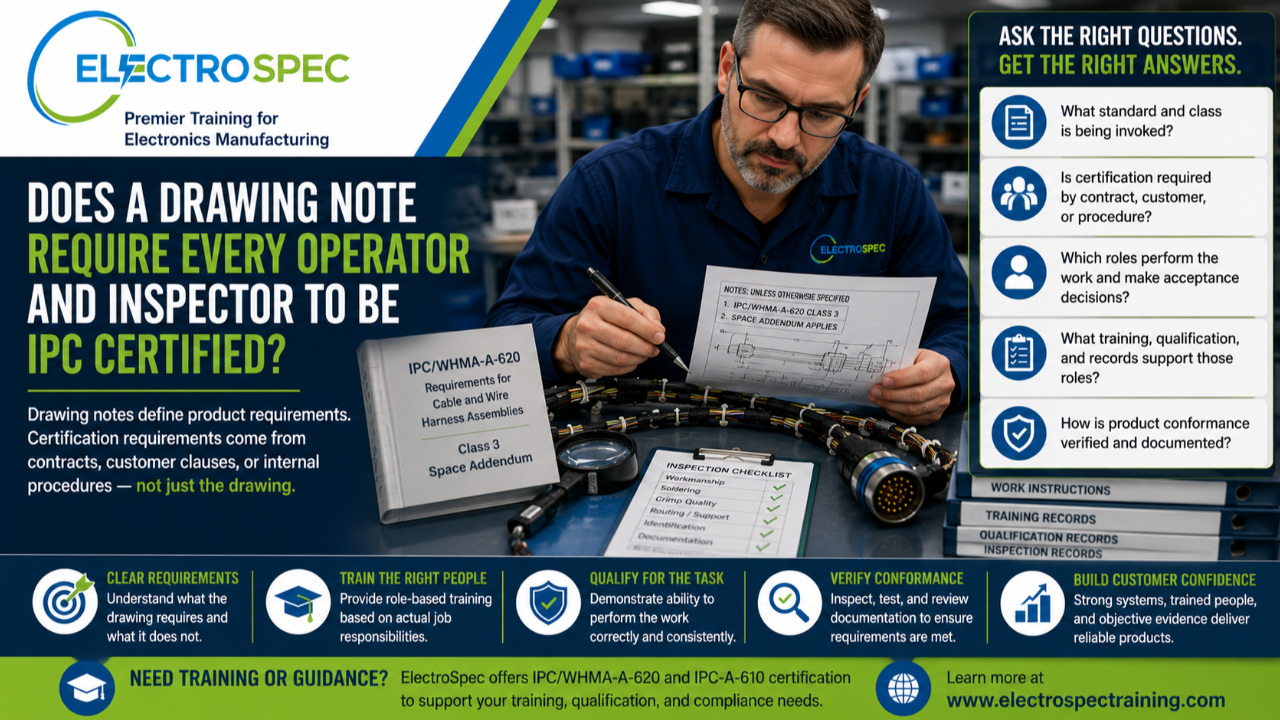
In electronics manufacturing, drawing notes often reference IPC standards.
A drawing may state that a product must meet:
- IPC-A-610 Class 3
- IPC/WHMA-A-620 Class 3
- IPC-A-600 Class 3
- J-STD-001 Class 3
- J-STD-001 Space Addendum
- IPC/WHMA-A-620 Space Addendum
When auditors, customers, or internal quality teams see those notes, the next question is often:
“Are the people working on this product IPC certified?”
That may be a valid question.
But it is not always the correct first question.
A drawing note does not automatically mean every operator, inspector, engineer, or supervisor must hold an IPC certification.
The real answer depends on the drawing, contract, customer flow-down, internal procedures, and the role each person performs.
A Drawing Note Defines Product Requirements
A drawing note typically defines what the product must meet.
It may invoke acceptance requirements, workmanship requirements, process requirements, material requirements, cleanliness requirements, documentation requirements, or inspection criteria.
That means the product must conform to the requirement.
For example:
- A printed circuit board may need to meet IPC-A-600 Class 3.
- An electronic assembly may need to meet IPC-A-610 Class 3.
- A cable harness may need to meet IPC/WHMA-A-620 Class 3.
- A soldered assembly may need to meet J-STD-001 requirements.
- A space product may need to meet applicable Space Addendum requirements.
The product requirement is real.
But that does not automatically answer who must hold a certificate.
Personnel Certification Is a Separate Requirement
Personnel certification is usually established by one or more of the following:
- Contract language
- Purchase order requirements
- Customer quality clauses
- Supplier quality requirements
- Drawing notes
- Internal procedures
- Training matrix
- Inspection authority requirements
- Customer-approved manufacturing plans
- Regulatory or program-specific requirements
If one of these documents explicitly requires certified personnel, then the company must comply.
If a company procedure says inspectors must be IPC certified, then the company must follow its own procedure.
If a customer quality clause requires certified operators or inspectors, then that requirement must be flowed into the training system.
But if the drawing only invokes product acceptability or workmanship criteria, it should not automatically be expanded into a universal certification requirement without reviewing the full requirement flow-down.
Operators and Inspectors Have Different Roles
Operators and inspectors both contribute to product quality, but they perform different functions.
Operators build the product using approved work instructions, qualified tools, controlled materials, and established processes.
Inspectors verify that the product meets the applicable acceptance requirements.
Because their roles are different, their training needs may also be different.
An operator may need:
- Company work instruction training
- Product-specific training
- Tooling training
- ESD training
- Process training
- Hands-on qualification
- Supervised practice
- Periodic reassessment
An inspector may need:
- Acceptance criteria training
- IPC standard knowledge
- Product-specific inspection training
- Magnification and visual inspection skills
- Documentation review training
- Customer flow-down awareness
- Defect recognition experience
- Inspection authority approval
Some organizations may require formal IPC certification for one or both roles.
Others may use internal qualification systems supported by standards training.
The correct answer depends on the requirement.
When Certification May Be Required
IPC certification may be required when:
- The contract specifically requires certified personnel
- The customer quality clause requires certification
- The drawing note explicitly requires certified personnel
- The company’s internal procedures require certification
- The person is making formal product acceptance decisions
- The person is responsible for inspection authority
- The certification is part of the approved training matrix
- The customer or auditor has accepted certification as part of the compliance plan
In these cases, certification becomes part of the requirement.
The organization should maintain records showing who is certified, what they are certified to, when the certification expires, and which tasks or roles the certification supports.
When Certification May Not Be Required
Certification may not be required when the requirement is limited to product acceptability and the company has another approved method to ensure personnel competence.
For example, a company may use:
- Internal training
- Company work instructions
- Task-specific qualification
- Supervisor approval
- Quality approval
- On-the-job training
- Product-specific workmanship demonstrations
- Inspector training
- Objective inspection evidence
If the contract and internal procedures allow this approach, certification may support the training system but may not be mandatory for every person touching the product.
This is why assumptions can be dangerous.
The Problem with Over-Interpreting Drawing Notes
Over-interpreting drawing notes can create unnecessary cost and confusion.
A drawing note that invokes IPC/WHMA-A-620 Class 3 may become incorrectly interpreted as:
“Every operator must be IPC/WHMA-A-620 certified.”
Then it may expand further into:
“Every inspector must be certified.”
Then:
“Every engineer must be certified.”
Then:
“Every person who touches the product must be certified.”
That may be appropriate if the contract or customer specifically requires it.
But if the requirement was only intended to define product acceptability, the company may have created a personnel certification requirement that was never actually flowed down.
That can increase cost without necessarily improving product quality.
The Problem with Under-Interpreting Drawing Notes
The opposite problem is also possible.
A company may assume the drawing note is only a general reference and fail to properly flow the requirement into work instructions, inspection plans, training, or production records.
That creates real risk.
If the drawing invokes IPC Class 3 or Space Addendum requirements, the company must understand how those requirements affect the product and manufacturing system.
The requirement may need to appear in:
- Work instructions
- Inspection checklists
- Manufacturing travelers
- Training records
- Inspection plans
- Acceptance records
- Nonconformance procedures
- Supplier flow-downs
- Quality plans
The answer is not to ignore the requirement.
The answer is to interpret it correctly.
A Better Way to Evaluate the Requirement
When a drawing calls out IPC Class 3 or Space Addendum, ask these questions:
- What standard is being invoked?
- What class or addendum is being invoked?
- Is the requirement product-related, process-related, material-related, inspection-related, documentation-related, or personnel-related?
- Does the contract require certified personnel?
- Does the purchase order include training or certification flow-downs?
- Do internal procedures require certification?
- Which roles perform the work?
- Which roles make acceptance decisions?
- What training or qualification records support those roles?
- What objective evidence proves the product conforms?
This approach is more useful than simply asking whether someone has a certificate.
Certification Is Evidence, But Not the Only Evidence
Training and certification records can be important.
They may show that personnel have been exposed to the applicable standards and requirements.
But they should be evaluated as part of the complete evidence package.
Product conformance may also require:
- Approved drawings
- Work instructions
- Inspection records
- Test records
- Material records
- Process control data
- Tooling records
- Qualification records
- Nonconformance records
- Corrective action records
In high-reliability manufacturing, the goal is not simply to collect certificates.
The goal is to prove that the product was built and verified to meet the requirements.
Final Thought
A drawing note requiring IPC Class 3 or Space Addendum does not automatically mean every operator and inspector must be IPC certified.
It means the requirement must be interpreted correctly and flowed through the manufacturing system.
If the contract, customer, drawing, or internal procedure requires certified personnel, then certification is required.
If the requirement is product-focused, the company must prove the product conforms through objective evidence.
The strongest organizations do both well.
They understand the requirement.
They train and qualify the right people.
They document the process.
They inspect the product.
And they maintain evidence that the product meets the drawing, contract, and customer expectations.
Need Help Interpreting IPC Training Requirements?
If your organization is trying to determine whether IPC-A-610, IPC-A-600, IPC/WHMA-A-620, J-STD-001, Class 3, or Space Addendum drawing notes require certification, ElectroSpec can help you think through the requirement flow-down.
ElectroSpec offers IPC/WHMA-A-620 base CIS certification and IPC-A-610 certification for organizations that need formal IPC credentials, and can also help teams understand how training, qualification, and product conformance fit together.
Coming Next
The Correct Path to IPC/WHMA-A-620 Space Addendum Certification
In the next article, we will explain the normal path from IPC/WHMA-A-620 base certification into the IPC/WHMA-A-620 Space Addendum, including timing, prerequisite modules, testing, hands-on build requirements, and planning considerations.
IPC-A-600 CIS Certification — ElectroSpec
IPC-A-610 Certification & Training Course | ElectroSpec Training
IPC/WHMA-A-620 Certification & Training Course | ElectroSpec Training