
How Auditors Should Evaluate IPC Class 3 and Space Addendum Flow-Downs
Jul 22, 2026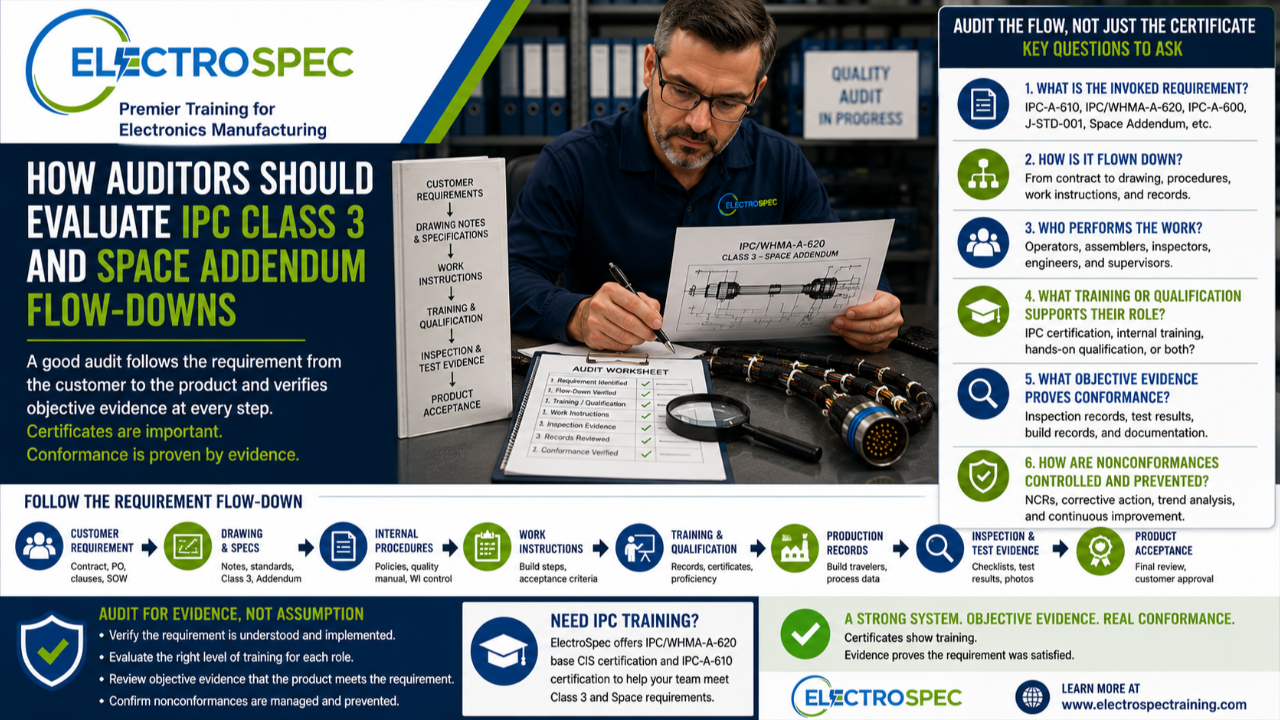
Auditing IPC Class 3 and Space Addendum requirements can be confusing.
A drawing may call out IPC-A-610 Class 3, IPC/WHMA-A-620 Class 3, IPC-A-600 Class 3, J-STD-001 Class 3, J-STD-001 Space Addendum, or IPC/WHMA-A-620 Space Addendum.
Once that happens, auditors often ask the simplest question:
“Show me your IPC certificates.”
Training and certification records may be part of the audit evidence, but they are not the entire answer.
A strong audit does not stop at certificates.
A strong audit follows the requirement through the manufacturing system.
Start with the Actual Requirement
The first step is identifying the actual requirement being invoked.
The requirement may come from:
- Contract language
- Purchase order flow-downs
- Customer quality clauses
- Drawing notes
- Statements of work
- Supplier quality requirements
- Applicable standards
- Internal procedures
Before asking for evidence, the auditor should understand what is being required.
Is the requirement related to product acceptability?
Is it a process requirement?
Is it a material requirement?
Is it a cleanliness requirement?
Is it a documentation requirement?
Is it a personnel training or certification requirement?
Those are not the same thing.
Product Requirements and Personnel Requirements Are Different
A common audit mistake is treating every IPC drawing note as a personnel certification requirement.
That may not be correct.
A drawing note may define what the product must meet.
A customer quality clause may define what training or certification is required.
An internal procedure may define who is authorized to inspect.
Those requirements may overlap, but they should not be assumed to be identical.
For example, a drawing note requiring IPC/WHMA-A-620 Class 3 workmanship means the product must meet the applicable Class 3 requirements.
It does not automatically mean every operator, inspector, engineer, and supervisor must hold IPC/WHMA-A-620 certification unless another requirement says so.
Follow the Requirement Flow-Down
A good auditor follows the requirement from its source into the manufacturing system.
A useful audit path is:
Customer Requirement
↓
Contract or Purchase Order
↓
Drawing Note or Technical Data Package
↓
Internal Procedure
↓
Work Instruction
↓
Training or Qualification Record
↓
Production Record
↓
Inspection or Test Evidence
↓
Product Acceptance
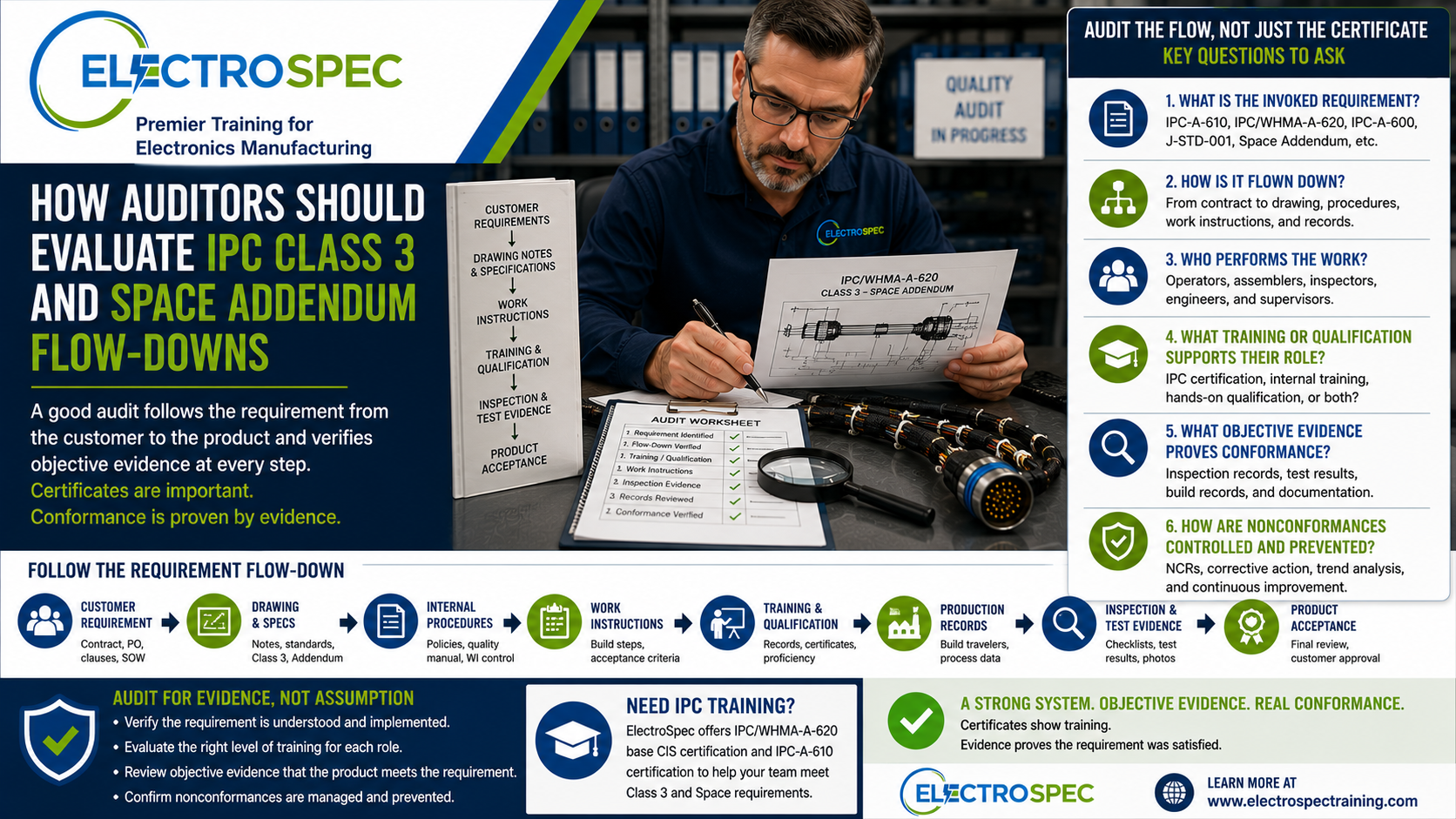
This approach verifies that the requirement was understood, flowed down, implemented, and verified.
It also helps determine whether the organization is controlling the product or simply collecting certificates.
Verify the Requirement Appears in Work Instructions
If an IPC Class 3 or Space Addendum requirement applies to the product, it should be visible somewhere in the manufacturing system.
That may include:
- Work instructions
- Travelers
- Routers
- Inspection plans
- Quality plans
- Drawings
- Checklists
- Manufacturing planning documents
- Test procedures
- Acceptance records
Operators and inspectors should not be expected to guess which requirement applies.
The requirement should be translated into usable manufacturing and inspection instructions.
Evaluate Training and Qualification Based on Role
Auditors should evaluate personnel training based on the work being performed.
An operator may require one type of training.
An inspector may require another.
A quality engineer may need a different level of standards knowledge.
A process engineer may need to understand process controls, materials, tools, and manufacturing risks.
The right question is not always:
“Is everyone IPC certified?”
A better question is:
“Are the right people trained, qualified, and authorized for the work they perform?”
That may involve IPC certification, internal training, product-specific qualification, hands-on demonstration, supervisor approval, or other objective evidence.
Look for Objective Evidence of Product Conformance
Product conformance is proven through objective evidence.
Depending on the product and requirement, that evidence may include:
- First article inspection records
- In-process inspection records
- Final inspection records
- Test results
- Cable and harness inspection records
- Printed board acceptance records
- Electronic assembly inspection records
- Material certifications
- Tool calibration records
- Process control data
- Cleaning records
- ESD compliance records
- Nonconformance records
- Corrective action records
- Customer acceptance records
Training records alone do not prove product conformance.
They only help show that personnel received or completed training.
Avoid Certificate-Only Auditing
A certificate-only audit creates a false sense of confidence.
A person may hold a certificate and still make a mistake.
A product may be built by certified personnel and still fail to meet drawing requirements.
A company may maintain training records but fail to flow requirements into work instructions.
The certificate is one piece of evidence.
It is not the product.
It is not the process.
It is not the inspection record.
It is not the proof of conformance.
Ask Better Audit Questions
Instead of asking only:
“Do your people have IPC certificates?”
auditors should ask:
- What IPC requirement is invoked?
- Where is it invoked?
- Is it product, process, material, documentation, or personnel related?
- Where is the requirement flowed into internal procedures?
- Where is it included in work instructions?
- Who performs the work?
- Who inspects the work?
- Who makes acceptance decisions?
- What training or qualification supports those roles?
- What product records show conformance?
- What happens when product does not conform?
- How are recurring defects prevented?
These questions evaluate the system.
Space Addendum Audits Require Extra Care
Space Addendum requirements should be audited carefully because they often involve higher reliability expectations, tighter workmanship requirements, additional process controls, and more detailed documentation.
For IPC/WHMA-A-620 Space Addendum, the auditor should determine:
- Whether the Space Addendum is actually invoked
- Which product features are affected
- Whether the requirement is flowed into build instructions
- Whether personnel are trained or qualified for the applicable work
- Whether inspection criteria reflect the Space Addendum
- Whether build records and inspection records support conformance
- Whether any required certification is contractually or procedurally required
The point is not simply to find a certificate.
The point is to verify that the product was built and inspected to the applicable requirement.
Internal Procedures Matter
If a company’s internal procedures require IPC certification, then auditors should verify certification records.
If internal procedures require internal qualification, then auditors should verify qualification records.
If procedures require both, then both should be verified.
A company must follow its own documented system.
That is why organizations should be careful when writing training and certification requirements into procedures. Once written, those requirements become auditable.
The Best Audits Improve the System
A good audit does more than find nonconformances.
It helps the organization understand whether requirements are being properly interpreted, flowed down, implemented, and verified.
When performed well, an audit can reveal:
- Missing requirement flow-downs
- Incomplete work instructions
- Training gaps
- Qualification gaps
- Weak inspection evidence
- Poor documentation
- Process control issues
- Misinterpretation of drawing notes
- Overuse or underuse of certification requirements
That information helps the company improve.
Final Thought
Auditing IPC Class 3 and Space Addendum requirements should not be reduced to asking for certificates.
Certificates can be useful evidence of training or certification.
But product conformance requires much more.
A strong audit follows the requirement from the customer to the drawing, from the drawing to the work instruction, from the work instruction to production, and from production to inspection evidence.
That is how auditors verify whether the manufacturing system actually satisfies the invoked requirement.
Need Help Preparing for IPC Flow-Down Audits?
If your organization is preparing for an audit involving IPC-A-610, IPC-A-600, IPC/WHMA-A-620, J-STD-001, Class 3, or Space Addendum requirements, ElectroSpec can help clarify the requirement flow-down.
ElectroSpec offers IPC/WHMA-A-620 base CIS certification and IPC-A-610 certification, and can support discussions around training records, qualification evidence, work instructions, and product conformance documentation.
Coming Next
Building a Real Training and Qualification Program for High-Reliability Cable and Harness Work
In the final article of this series, we will explain how companies can build a practical training and qualification system that includes standards knowledge, company-specific work instructions, hands-on proficiency, inspection evidence, and continuous improvement.
IPC/WHMA-A-620 Certification & Training Course | ElectroSpec Training
Soldering for High Reliability