
Why IPC/WHMA-A-620 Space Addendum Requires More Planning Than Base 620
Jul 21, 2026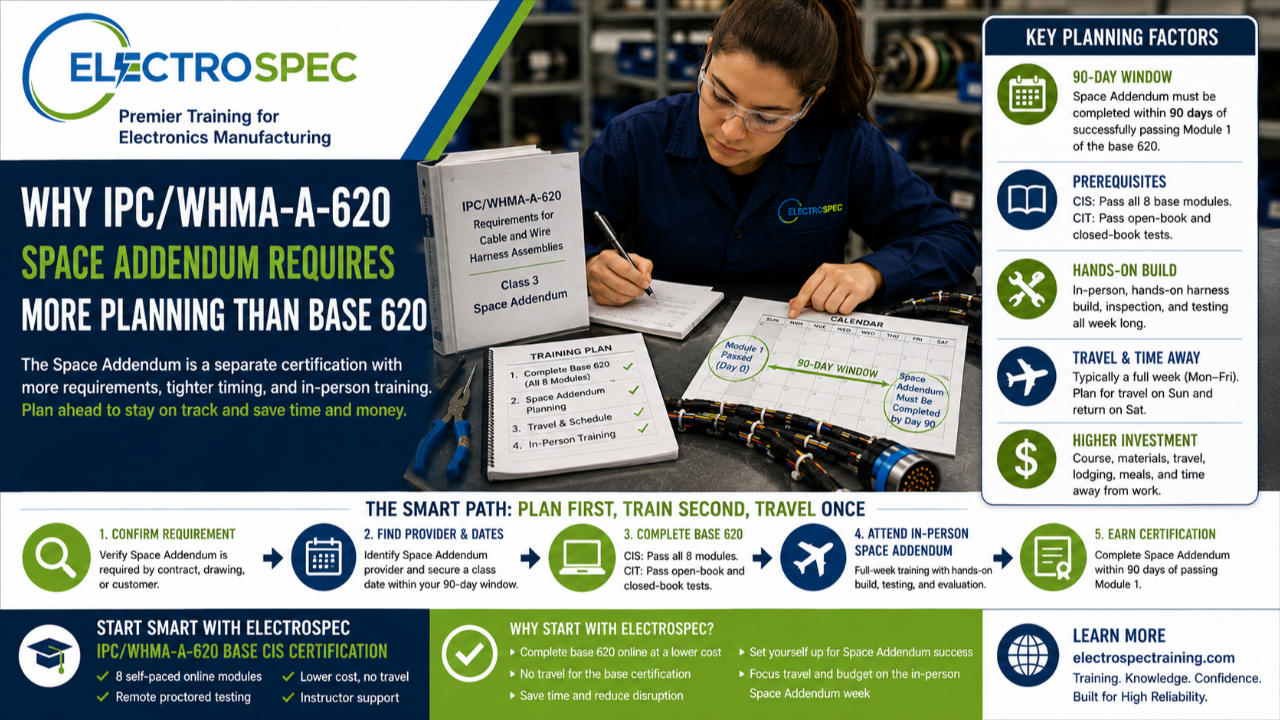
In the previous article, we explained the correct path to IPC/WHMA-A-620 Space Addendum certification.
The most important point was simple:
IPC/WHMA-A-620 base certification and IPC/WHMA-A-620 Space Addendum certification are separate programs.
The base certification comes first.
The Space Addendum comes after.
But there is another important point that students and companies often underestimate:
The Space Addendum requires much more planning than base 620.
That planning includes timing, prerequisites, travel, cost, hands-on workmanship, testing, and training-center availability.
Base 620 Is the Starting Point
IPC/WHMA-A-620 base certification provides the foundation for cable and wire harness requirements.
For CIS students, the base certification requires successful completion of all eight required IPC/WHMA-A-620 CIS modules before proceeding to the Space Addendum.
For CIT students, the path is different. CITs must successfully complete their required IPC/WHMA-A-620 open-book and closed-book testing before proceeding to Space Addendum certification.
This matters because the Space Addendum is not a replacement for base 620.
It builds on it.
The 90-Day Window Matters
One of the biggest planning issues is the 90-day completion window.
The Space Addendum must be completed within the allowed 90-day window tied to successful completion of Module 1 of the IPC/WHMA-A-620 base certification.
That means students and companies should not treat base 620 and Space Addendum as two completely separate scheduling decisions.
They are connected.
For CIS students, once Module 1 is successfully passed, the timing window becomes important. The student still needs to complete all eight base modules and complete the Space Addendum within the required window.
That can create problems if the Space Addendum provider does not have an available class, travel is not approved, or the student’s schedule is not coordinated in advance.
Do Not Start Base 620 Without a Space Addendum Plan
A common mistake is to complete base 620 first and then start looking for a Space Addendum provider.
That may work in some cases.
But it can create unnecessary risk.
A better approach is:
- Confirm that Space Addendum certification is actually required.
- Identify a training center that offers the Space Addendum.
- Confirm available class dates.
- Confirm cost and travel approval.
- Schedule IPC/WHMA-A-620 base certification.
- Complete and pass all required base modules.
- Complete the Space Addendum within the required 90-day window.
This planning sequence reduces the chance of missing the window or having to repeat work.
Space Addendum Usually Requires Travel
Base IPC/WHMA-A-620 certification may be completed remotely through ElectroSpec’s on-demand model.
That can save time, travel, and cost.
The Space Addendum is different.
The Space Addendum typically requires in-person attendance at a training center because of the hands-on build and workmanship evaluation requirements.
Students should expect a full-week commitment, often Monday through Friday.
In practical terms, that may mean:
- Travel on Sunday
- Training during the week
- Hands-on cable and harness build work
- Testing
- Hardware inspection
- Return travel Friday night or Saturday
- Hotel, meals, rental car, and other travel costs
- Time away from production or engineering work
For companies sending multiple students, those costs add up quickly.
Space Addendum Is More Than a Knowledge Test
Base 620 certification focuses on understanding and applying the IPC/WHMA-A-620 standard.
The Space Addendum goes further.
It typically includes hands-on workmanship activity where students build a space-related cable or harness training assembly.
That work may include:
- Stranded wire
- Solid wire
- Coaxial cable
- RF cable
- Shielding
- Connector assembly
- Crimping
- Soldering
- Routing
- Lacing or tying
- Strain relief
- Identification
- Documentation
- Final inspection
This is why the Space Addendum cannot be planned like a short online course.
It requires time, materials, instructor oversight, hardware evaluation, and successful completion of the required work.
The Cost Is Usually Higher
Students are often surprised that Space Addendum training may cost significantly more than the base IPC/WHMA-A-620 certification.
That higher cost is understandable when you consider what may be included:
- Instructor-led training
- Multi-day hands-on build time
- Specialized training materials
- Cable and harness hardware
- Testing
- Inspection of completed workmanship
- Instructor evaluation
- Training center resources
- Travel and lodging
Companies should budget for both the course cost and the travel cost.
When comparing options, the question should not be only:
“What does the course cost?”
The better question is:
“What is the total cost to complete the base certification, Space Addendum, travel, lodging, meals, and time away from work?”
Completing Base 620 Remotely Can Reduce the Burden
One practical strategy is to complete the base IPC/WHMA-A-620 certification remotely before traveling for Space Addendum.
ElectroSpec offers IPC/WHMA-A-620 base CIS certification on-demand and remotely.
That allows students to complete the base requirement without traveling to a training center for the base course.
This can help reduce:
- Travel cost
- Hotel cost
- Meal cost
- Time away from work
- Schedule disruption
- Overall training burden
Then, once the base requirement is complete, the student can focus travel on the Space Addendum portion that typically requires in-person attendance.
Companies Should Confirm the Requirement First
Before spending money on Space Addendum training, companies should confirm that the requirement is truly needed.
Questions to ask include:
- Does the contract require IPC/WHMA-A-620 Space Addendum?
- Does the drawing invoke Space Addendum requirements?
- Does the customer require certified personnel?
- Is the requirement product-related, process-related, or personnel-related?
- Are operators, inspectors, or both required to hold certification?
- Is internal qualification also required?
- Who actually performs the work?
- Who performs inspection and acceptance?
- What objective evidence will be required during audit?
This prevents companies from sending people to training without understanding how the certification fits into the manufacturing and compliance system.
Students Should Ask the Provider Detailed Questions
Before enrolling in Space Addendum, students should ask the provider:
- What are the prerequisites?
- When does the 90-day window begin?
- What base modules must be completed?
- Is the course CIS or CIT?
- Is the course in person?
- How many days is the course?
- What hardware is built?
- What testing is required?
- What passing score is required?
- What happens if the student fails the test or build?
- Are materials included?
- What should the student bring?
- What standard or book is required?
- What is the total cost?
- Are there available dates within the required window?
These questions help avoid surprises.
Space Addendum Planning Protects the Student and Company
Good planning prevents unnecessary stress.
It helps the company:
- Avoid missed timing windows
- Control training cost
- Coordinate travel
- Schedule production coverage
- Select the correct students
- Confirm prerequisites
- Prepare for audits
- Align training with actual requirements
It also helps the student understand what they are getting into before the clock starts.
Final Thought
IPC/WHMA-A-620 Space Addendum certification requires more planning than base IPC/WHMA-A-620 certification because it is more involved, more expensive, more schedule-sensitive, and typically requires in-person hands-on work.
For CIS students, all eight base IPC/WHMA-A-620 modules must be passed before proceeding to the Space Addendum.
For CIT students, the required open-book and closed-book base testing must be completed before proceeding.
The Space Addendum must be completed within the required 90-day window tied to successful completion of Module 1 of the base certification.
The best approach is to confirm the Space Addendum requirement, identify the provider, confirm the schedule, complete base 620 efficiently, and then complete Space Addendum within the required window.
Plan first.
Train second.
Travel once.
Avoid surprises.
Related ElectroSpec Training
ElectroSpec offers IPC/WHMA-A-620 base CIS certification, which is typically the correct starting point before pursuing IPC/WHMA-A-620 Space Addendum through a provider that offers it.
Because ElectroSpec’s base IPC/WHMA-A-620 CIS course is on-demand and remote, students can complete the base certification with lower cost and no travel before attending the in-person Space Addendum week.
Coming Next
How Auditors Should Evaluate IPC Class 3 and Space Addendum Flow-Downs
In the next article, we will explain how auditors should evaluate IPC Class 3, IPC/WHMA-A-620, and Space Addendum requirements by following the requirement from the drawing into work instructions, training records, production evidence, and inspection records.
IPC/WHMA-A-620 Certification & Training Course | ElectroSpec Training
IPC/WHMA-A-620 CIS Certification — ElectroSpec
IPC/WHMA-A-620 CIT Certification — ElectroSpec
IPC/WHMA-A-620 CSE Certification — ElectroSpec