
IPC PCB Design Courses vs. ElectroSpec CID and CID Advanced: Topic Training or Certification Pathway?
Aug 03, 2026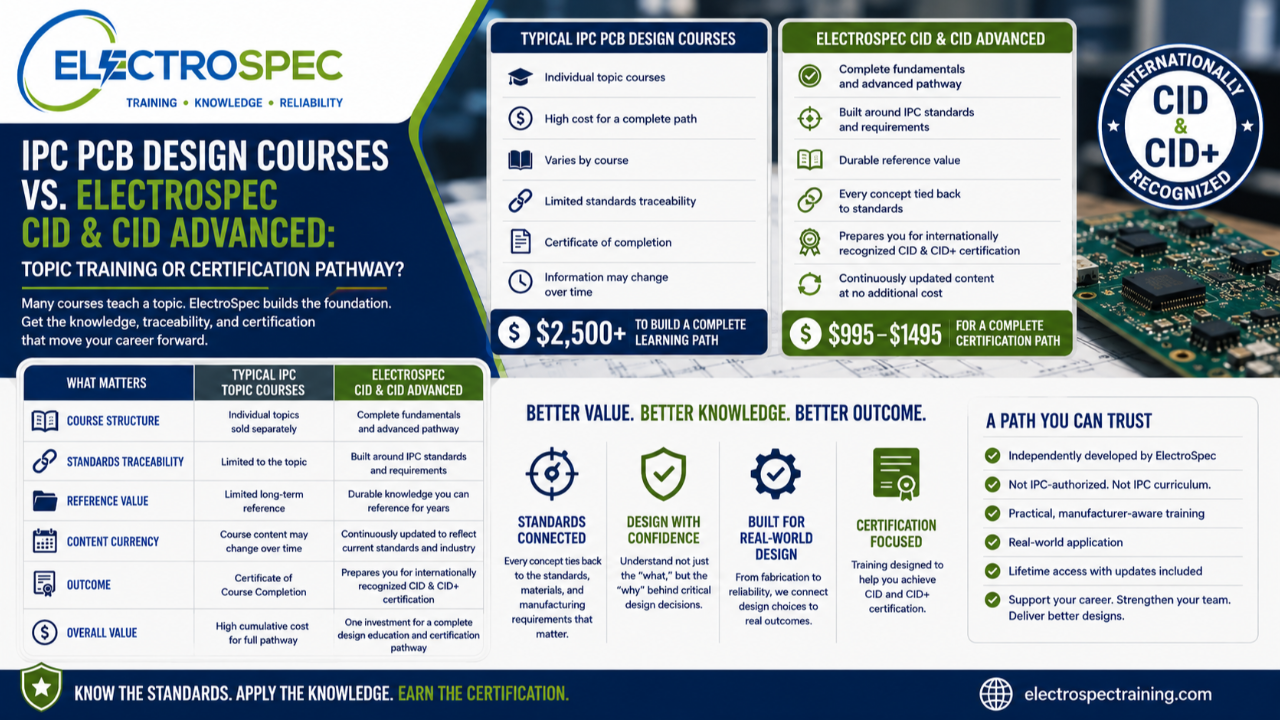
PCB designers have more training options today than ever before.
There are short topic courses, introductory PCB design courses, manufacturability courses, flex and rigid-flex courses, RF courses, signal integrity courses, military and aerospace design courses, and advanced technology courses.
Many of those topics are useful.
But designers, engineers, managers, and employers should ask a more important question before selecting training:
Are you buying a single topic course, or are you investing in a standards-based pathway that supports recognized PCB design certification?
That distinction matters.
A topic course may teach one slice of PCB design. A certification preparation pathway should help the designer build a broader framework, connect information back to standards and requirements, and prepare for a professional credential.
That is the difference ElectroSpec is focused on.
Topic Training Has Value, But It Is Not the Same as a Certification Pathway
IPC and other providers may offer PCB design courses focused on individual subjects such as manufacturability, flex design, RF design, signal integrity, ECAD/MCAD integration, military and aerospace applications, or advanced design concepts.
Those courses can be helpful when a designer needs exposure to one specific topic.
However, a designer who is building professional competence needs more than scattered topic exposure.
A designer needs to understand how requirements connect across:
- materials
- fabrication
- layout
- mechanical design
- electrical design
- thermal management
- component technologies
- interconnections
- documentation
- quality assurance
- manufacturability
- inspection
- acceptance
- reliability
- qualification
A strong PCB designer does not think in isolated topics.
A strong PCB designer understands how design decisions flow into fabrication, assembly, inspection, acceptance, and field performance.
ElectroSpec CID: A Complete PCB Design Foundation
ElectroSpec’s CID course is a 22+ hour on-demand PCB Fundamentals Course designed and developed by ElectroSpec.
It includes 12 structured modules covering the major foundations of PCB design, including materials, layout principles, mechanical and electrical considerations, thermal management, component technologies, interconnections, fabrication requirements, documentation, and quality assurance.
The purpose is not simply to expose the student to PCB design.
The purpose is to help the student build a structured design foundation and approach the CID exam with greater confidence.
That is an important distinction.
A general PCB course may provide information.
ElectroSpec CID is built as a standards-connected preparation path toward an internationally recognized PCB design certification.
ElectroSpec CID Advanced: Advanced Topics in One Integrated Path
ElectroSpec’s CID Advanced training includes 13.5+ hours of advanced on-demand PCB courses, organized into seven specialized areas:
- PCB Fabrication & Assembly, 4.5 hours
- PCB Materials, 1.75 hours
- Rigid PCB Design, 1 hour
- Flexible PCB Design, 1 hour
- HDI PCB Design, 1.5 hours
- RF/Microwave PCB Design, 1.75 hours
- Environmental Stress Screening, 2 hours
These topics are not random add-ons.
They represent advanced domains that designers must understand when preparing for CID+ level design work, including fabrication realities, materials, rigid board design, flex design, HDI, RF/microwave concerns, and environmental reliability.
Additional advanced content will continue to be added over time, and comprehensive track enrollees receive access to new content as it is released.
That gives students a growing reference library, not just a one-time class.
Traceability Matters
One of the most important differences in design training is traceability.
When a designer learns a rule, recommendation, design limit, material concern, or reliability concept, the designer should be able to ask:
Where does this information come from?
Is it tied to a standard?
Is it tied to a material requirement?
Is it tied to fabrication capability?
Is it tied to soldering or assembly process requirements?
Is it tied to acceptance criteria?
Is it tied to Class 3 reliability expectations?
Is it tied to customer, aerospace, defense, NASA, ESA, military, or harsh environment requirements?
Training that cannot connect information back to requirements may still be educational, but it may not give the designer the durable reference framework needed for real engineering work.
ElectroSpec’s CID and CID Advanced approach is built around standards traceability, design requirements, and practical application.
The goal is not just to say what a rule is.
The goal is to help the designer understand why it matters, where it fits, and how it affects the product.
Courses Come and Go, Standards Remain the Reference Framework
Training catalogs change.
Course titles change.
Course descriptions change.
Some courses are added, removed, renamed, or repackaged over time.
That is normal in the training marketplace.
But designers need something more durable than a catalog course title.
They need a reference framework tied to standards, requirements, materials, fabrication, manufacturing, inspection, and reliability.
That is especially important in PCB design because the designer’s work may be reviewed months or years later by manufacturing teams, inspectors, customers, auditors, or failure analysis teams.
A designer should be able to explain not only what design choice was made, but why it was made.
That requires traceability.
Certificate of Completion vs. CID and CID+ Certification
A course completion certificate can show that a person attended or completed a course.
That has value.
But it is not the same as preparing for a recognized professional certification.
CID and CID+ are internationally recognized PCB design credentials.
ElectroSpec’s CID and CID Advanced courses are designed to support that certification path.
That means the training has a different purpose.
It is not just topic exposure.
It is preparation toward a recognized design certification.
For many designers, engineers, employers, and customers, that outcome matters.
Price and Value Should Be Compared Carefully
Price matters, but price should be compared against scope and outcome.
Based on the catalog information reviewed, many individual IPC PCB design courses are priced separately by topic. Some introductory courses may be lower cost, while several advanced topic courses are listed at much higher individual prices.
That does not automatically make one option better than another.
The better question is:
What does the student receive for the price?
A single topic course may be useful for a specific knowledge gap.
But a designer who needs a broader pathway may end up purchasing multiple separate courses across manufacturability, fabrication, flex, RF, signal integrity, military and aerospace applications, and advanced technologies.
ElectroSpec’s approach is different.
ElectroSpec CID and CID Advanced are bundled, on-demand, standards-connected training paths designed to support CID and CID+ preparation.
The value is not only the number of hours.
The value is the structure, standards traceability, reference value, and certification outcome.
The Buyer’s Question
Before selecting PCB design training, ask these questions:
| Question | Why It Matters |
|---|---|
| Is this a topic course or a certification preparation path? | Topic exposure and certification preparation are different goals. |
| Does the training connect back to standards? | Designers need traceability to requirements. |
| Will the student have something to reference later? | Durable learning matters after the course ends. |
| Is the course current and technically relevant? | PCB design standards, materials, and technologies continue to evolve. |
| Does the course support CID or CID+ preparation? | Certification outcome may matter more than course completion. |
| Is the price being compared to one course or a complete pathway? | Value depends on scope and outcome. |
These questions help prevent training decisions based only on course titles, buzzwords, or price.
Independently Developed by ElectroSpec
ElectroSpec’s CID and CID Advanced courses are independently developed by ElectroSpec.
They are not IPC-authorized training and they are not official IPC curriculum.
That is intentional.
ElectroSpec built these courses to help designers prepare with a practical, standards-connected, manufacturing-aware approach.
The courses are designed to support the student’s understanding of PCB design requirements, fabrication, materials, assembly realities, reliability considerations, and certification preparation.
Final Thought
PCB design training should do more than introduce topics.
It should build a designer’s framework.
It should help the student understand where requirements come from, how standards connect, why materials matter, how manufacturing affects design, how inspection and acceptance influence layout decisions, and how reliability is designed into the product.
IPC and other providers may offer useful individual topic courses.
ElectroSpec’s focus is different.
ElectroSpec CID and CID Advanced are built as standards-based, on-demand, certification-focused training pathways.
A course title can teach a topic.
A strong certification pathway can help build a designer.
Related ElectroSpec Training
ElectroSpec offers CID and CID Advanced training for designers, engineers, and technical professionals who want a structured, standards-connected path toward PCB design certification.
CID provides the foundation.
CID Advanced expands into fabrication, materials, rigid board design, flex design, HDI, RF/microwave design, environmental stress screening, and high-reliability design considerations.
Coming Next
Introduction to PCB Design Courses vs. CID Fundamentals
In the next article, we will compare introductory PCB design courses against ElectroSpec’s 22+ hour CID course and explain why introductory exposure is not the same as a complete standards-based design foundation.
IPC CID Certification — ElectroSpec
IPC CID+ Certification — ElectroSpec
IPC CID/CID+ Bundle — Complete PCB Design Certification — ElectroSpec