
Supplier Questions Are Design Feedback
Aug 30, 2026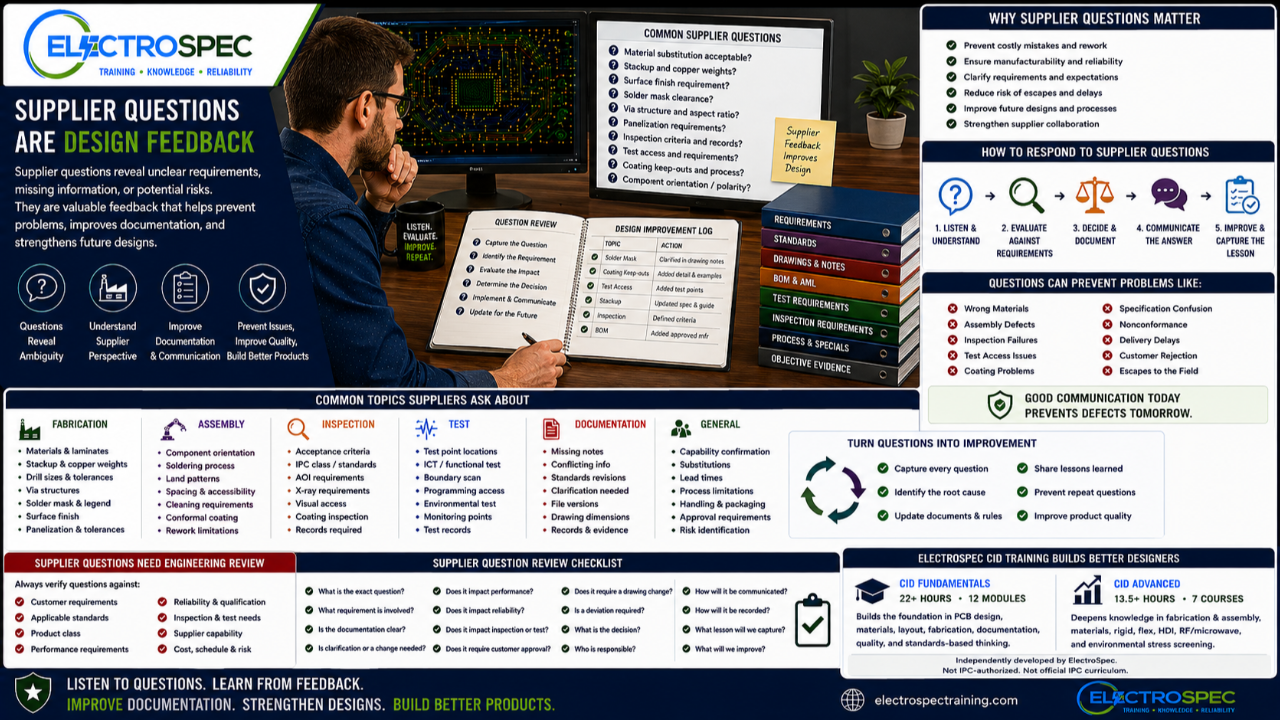
Supplier questions are often treated like interruptions.
A fabricator asks about material selection.
An assembler asks about component orientation.
A process engineer asks about soldering access.
An inspector asks how a feature should be verified.
A test engineer asks where the test access is.
A quality engineer asks what evidence is required.
The first reaction may be frustration.
But supplier questions are not just delays.
They are feedback.
They reveal where the design package may be unclear, incomplete, difficult to manufacture, difficult to inspect, difficult to test, or missing requirement traceability.
A good designer does not ignore supplier questions.
A good designer studies them.
Supplier Questions Reveal Ambiguity
A supplier question often means the technical package did not fully communicate the design intent.
That does not always mean the design is wrong.
It may mean the requirement is not clear enough.
Common questions may involve:
- material selection
- stackup
- copper thickness
- solder mask clearance
- surface finish
- hole tolerances
- controlled impedance
- via structures
- panelization
- assembly polarity
- component orientation
- cleaning
- conformal coating
- inspection criteria
- test access
- required records
Each question is a signal.
The supplier is saying, “We need more information to build this correctly.”
That signal should be taken seriously.
The Supplier Sees the Design Differently
Designers often view the product through function, layout, standards, and requirements.
Fabricators view the design through materials, drilling, plating, etching, lamination, solder mask, surface finish, tolerances, and yield.
Assemblers view the design through paste printing, placement, reflow, wave soldering, selective soldering, manual soldering, cleaning, coating, inspection, test, and handling.
Inspectors view the design through visibility, access, criteria, records, and acceptability.
Each group sees risk from a different position.
That is why supplier questions can be valuable.
They show the designer how the design looks from the manufacturing side.
Not Every Supplier Question Means the Supplier Is Right
Supplier questions deserve respect, but they still require engineering review.
A supplier may ask for a change because it improves yield.
A supplier may ask for a change because it reduces cost.
A supplier may ask for a change because it fits their process better.
A supplier may ask for a change because the documentation is unclear.
A supplier may ask for a change because the design exceeds their capability.
Those reasons are different.
A supplier recommendation may be helpful, but it does not automatically override customer requirements, standards, product class, qualification needs, or engineering intent.
The designer must evaluate the question against the full requirement set.
Supplier Capability Must Be Balanced Against Requirements
Supplier capability is important.
Designers should understand what the supplier can build reliably.
But supplier capability must be used inside the controlling requirement framework.
A fabricator may prefer a larger clearance.
An assembler may prefer more spacing.
A coating supplier may prefer larger keep-out areas.
A test supplier may prefer additional test points.
Those preferences may be technically sound.
But if the product is constrained by size, performance, customer requirements, Class 3 expectations, RF behavior, HDI geometry, flex construction, or qualification requirements, the design team must evaluate the tradeoff carefully.
The correct answer may be:
- accept the supplier recommendation
- revise the design
- clarify the documentation
- choose a different supplier
- request customer approval
- document a deviation
- justify the original design
- update future design rules
The point is not to accept every supplier comment.
The point is to learn from every supplier comment.
Repeated Questions Identify Weak Documentation
One supplier question may be a one-time clarification.
Repeated supplier questions often identify a documentation weakness.
If multiple suppliers ask the same question, the release package likely needs improvement.
For example:
If suppliers repeatedly ask about surface finish, the fabrication notes may be unclear.
If assemblers repeatedly ask about polarity, the assembly drawing may need better markings.
If coating vendors repeatedly ask about keep-outs, the coating requirements may need better definition.
If inspectors repeatedly ask about acceptance criteria, the drawing may need clearer standards callouts.
If test teams repeatedly ask about access, testability may need to be considered earlier in layout.
Repeated questions are not random.
They are process feedback.
Supplier Questions Can Prevent Production Problems
A question before production is better than a defect after production.
A supplier question may prevent:
- incorrect material use
- wrong surface finish
- missed impedance requirement
- soldering defects
- poor cleaning
- coating errors
- incorrect component orientation
- inspection disputes
- test access problems
- missing records
- nonconforming product
- delivery delays
- customer rejection
The best time to discover ambiguity is before the build.
Supplier questions can protect the project if the design team responds properly.
Questions About Materials Should Trigger Review
Material questions are especially important.
A supplier may ask whether an alternate laminate is acceptable.
That question should never be handled casually.
Material changes can affect:
- dielectric performance
- impedance
- thermal behavior
- soldering
- moisture absorption
- dimensional stability
- copper adhesion
- plating reliability
- environmental performance
- qualification status
- customer approval
- cost and availability
For high-reliability products, material substitutions may require formal review and approval.
A material question is not only a purchasing issue.
It is a design and reliability issue.
Questions About Stackup Affect Performance and Buildability
Stackup questions also deserve careful attention.
Stackup affects fabrication, impedance, signal integrity, power integrity, mechanical performance, thermal behavior, and reliability.
A supplier may ask about:
- dielectric thickness
- copper weight
- layer order
- impedance targets
- material availability
- lamination construction
- controlled impedance coupons
- plating requirements
- symmetry
- bow and twist
- manufacturability
A stackup question may reveal that the design intent and supplier process are not aligned.
That should be resolved before release or fabrication.
Questions About Assembly Reveal Process Risk
Assembly supplier questions often reveal process risk.
They may ask about:
- soldering method
- stencil design
- land pattern suitability
- component spacing
- thermal relief
- bottom termination inspection
- cleaning access
- coating access
- rework limitations
- hardware installation
- connector retention
- polarity markings
These questions help the designer understand how layout decisions affect production.
A design may be electrically correct, but still difficult to assemble.
Assembly questions should be used to improve future design decisions.
Questions About Inspection Reveal Acceptance Risk
Inspection questions are important because they affect product acceptance.
An inspector may ask:
- What standard applies?
- What class applies?
- Can this solder joint be inspected?
- Is X-ray required?
- Are markings visible?
- What coating condition is acceptable?
- What defects are rejectable?
- What records are required?
- What alternate inspection method is allowed?
If inspection requirements are unclear, acceptance becomes subjective.
That creates risk.
Designers should make inspection and acceptance expectations clear before production.
Questions About Test Reveal Verification Risk
Test questions can identify gaps in the design.
A test team or supplier may ask:
- Where are the test points?
- How will this net be verified?
- Is programming access available?
- Is boundary scan supported?
- Can functional test reach the required connector?
- Can environmental test monitoring be connected?
- How will failures be isolated?
- What test records are required?
A product that cannot be tested well may be difficult to accept with confidence.
Test access should be designed into the board, not negotiated after release.
Supplier Questions Should Be Captured
Supplier questions should not disappear into email history.
They should be captured and reviewed.
A disciplined organization can track:
- question asked
- requirement involved
- decision made
- person responsible
- customer approval needed
- drawing change required
- deviation required
- future design rule update
- lesson learned
This turns supplier communication into organizational knowledge.
Without capture, the same issues repeat.
With capture, every supplier question can improve the next design.
Supplier Feedback Should Improve Design Rules
Supplier questions should feed back into design rules and release checklists.
If a supplier question reveals a recurring issue, the design organization should ask:
- Should the design rule be updated?
- Should the drawing template be improved?
- Should the release checklist be revised?
- Should a standard note be clarified?
- Should a supplier capability limit be added?
- Should the design review include this topic earlier?
- Should training be improved?
This is how organizations get better.
The goal is not simply to answer questions faster.
The goal is to prevent avoidable questions in future designs.
Supplier Questions Support Standards Traceability
Supplier questions often expose weak traceability.
A supplier may ask, “Why is this required?”
The designer should be able to answer.
The answer may trace to:
- customer drawing
- contract flow-down
- IPC requirement
- product class
- material requirement
- fabrication requirement
- assembly requirement
- inspection criterion
- test requirement
- qualification plan
- engineering judgment
If the answer is unclear, the requirement may need review.
A traceable design is easier to communicate.
It is also easier to build, inspect, test, and defend.
CID Builds the Foundation for Better Supplier Communication
ElectroSpec’s CID Fundamentals course helps designers understand how PCB design decisions affect fabrication, assembly, inspection, documentation, and reliability.
The course includes 22+ hours of on-demand training across 12 structured modules covering materials, layout principles, mechanical and electrical considerations, thermal management, component technologies, interconnections, fabrication requirements, documentation, quality assurance, manufacturability, and standards-based design thinking.
That foundation helps designers respond to supplier questions with technical confidence.
It also helps designers prevent many supplier questions before release.
CID Advanced Builds the Supplier Readiness Mindset
ElectroSpec CID Advanced expands into areas where supplier questions often become more technical.
The advanced track includes:
- PCB Fabrication & Assembly
- PCB Materials
- Rigid PCB Design
- Flexible PCB Design
- HDI PCB Design
- RF/Microwave PCB Design
- Environmental Stress Screening
These topics matter because advanced products generate advanced supplier questions.
Flex designs raise questions about bend radius, coverlay, stiffeners, and transition areas.
HDI designs raise questions about microvias, via fill, sequential lamination, and supplier capability.
RF designs raise questions about materials, stackup, impedance, copper, connectors, and tolerance.
Harsh-environment designs raise questions about coating, cleaning, shock, vibration, thermal cycling, and qualification evidence.
Advanced designers must be ready for those conversations.
A Practical Supplier Question Review Checklist
When a supplier asks a question, the designer should ask:
- What requirement is involved?
- Is the requirement clearly documented?
- Is the supplier asking for clarification or a change?
- Does the request affect customer requirements?
- Does the request affect standards conformance?
- Does the request affect product class?
- Does the request affect reliability?
- Does the request affect inspection or test?
- Does the request require customer approval?
- Does the drawing or package need revision?
- Should this become a future design rule or checklist item?
This turns supplier communication into engineering discipline.
Independently Developed by ElectroSpec
ElectroSpec’s CID and CID Advanced courses are independently developed by ElectroSpec.
They are not IPC-authorized training and they are not official IPC curriculum.
ElectroSpec developed these courses to provide practical, standards-connected, manufacturing-aware design training for students preparing for CID and CID+ certification.
The focus is not only on creating a layout.
The focus is on helping designers understand how the layout becomes a product through suppliers, manufacturing, inspection, test, documentation, and objective evidence.
Final Thought
Supplier questions are not just interruptions.
They are design feedback.
They reveal ambiguity.
They expose manufacturability risk.
They identify missing documentation.
They challenge assumptions.
They help improve release packages.
They strengthen future design rules.
A strong designer listens carefully.
A strong designer evaluates supplier questions against the requirement set.
A strong designer uses supplier feedback to improve the design process.
The best PCB designs are not created in isolation.
They are built through clear requirements, strong standards knowledge, good documentation, supplier collaboration, and engineering judgment.
Related ElectroSpec Training
ElectroSpec’s CID Fundamentals course provides 22+ hours of on-demand PCB design training across 12 structured modules.
ElectroSpec’s CID Advanced training expands into PCB Fabrication & Assembly, PCB Materials, Rigid PCB Design, Flexible PCB Design, HDI PCB Design, RF/Microwave PCB Design, and Environmental Stress Screening.
Together, these courses help designers build the standards-connected foundation needed for CID and CID+ certification preparation.
Coming Next
Design Lessons from Nonconformances and Corrective Actions
In the next article, we will discuss how nonconformances, defects, escapes, rework, supplier findings, and corrective actions can become powerful design feedback when they are traced back to requirements, layout decisions, documentation, and process capability.
IPC CID Certification — ElectroSpec
IPC CID+ Certification — ElectroSpec
IPC CID/CID+ Bundle — Complete PCB Design Certification — ElectroSpec