
What Is IPC-A-600? A Quick Guide to Bare Printed Board Acceptance
Oct 12, 2026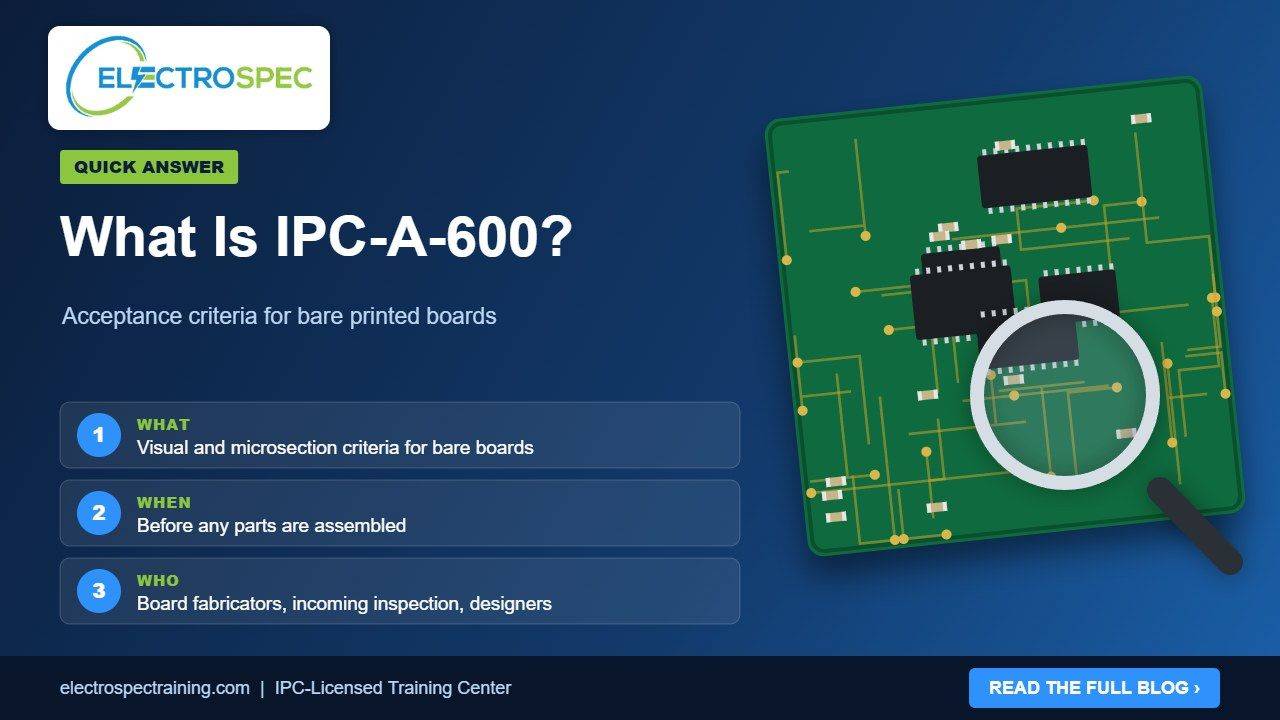
IPC-A-600 is the standard for judging whether a bare printed circuit board is acceptable.
Its full title is Acceptability of Printed Boards. It applies before any components are placed on the board.
The Short Answer
IPC-A-600 shows what a good bare board looks like, inside and out.
It covers what you can see on the surface and what you can only see by cutting the board open and examining a microsection.
What Does IPC-A-600 Cover?
- Edges, surface conditions and base material imperfections
- Solder mask, marking and surface finishes
- Conductor width, spacing and annular ring
- Plated holes and plating quality
- Internal conditions seen in microsections, such as plating voids and layer separation
- Flex, rigid-flex and other board types
IPC-A-600 vs. IPC-A-610
IPC-A-600 judges the bare board. IPC-A-610 judges the finished assembly after parts are soldered on.
A board can pass assembly inspection and still have a hidden fabrication problem. That is why bare-board acceptance matters so much.
Classes and Conditions
IPC-A-600 uses the same Class 1, Class 2 and Class 3 system as other IPC standards.
It describes acceptable and nonconforming conditions for each class. (The current revision, IPC-A-600M, no longer uses a separate "target" condition.)
Who Needs IPC-A-600?
- Printed board fabricators and their inspectors
- Incoming inspection at assembly companies
- Supplier quality engineers who audit board suppliers
- PCB designers who want to understand what can be built and accepted
How Do You Get IPC-A-600 Certified?
The CIS (Certified IPC Specialist) level is the right starting point for inspectors, engineers and designers.
ElectroSpec offers on-demand IPC-A-600 CIS exam preparation with online, proctored testing.